School of Electrical, Electronics and Computer Engineering, University of Ulsan, Ulsan 680-749, Korea.
Sensors (Basel). 2018 Dec 11;18(12):4379. doi: 10.3390/s18124379.
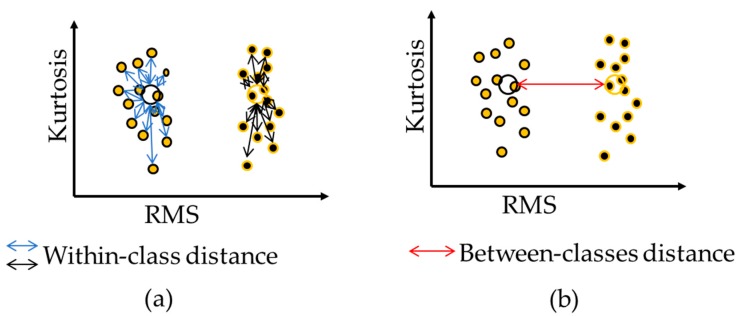
Pressure vessels (PV) are designed to hold liquids, gases, or vapors at high pressures in various industries, but a ruptured pressure vessel can be incredibly dangerous if cracks are not detected in the early stage. This paper proposes a robust crack identification technique for pressure vessels using genetic algorithm (GA)-based feature selection and a deep neural network (DNN) in an acoustic emission (AE) examination. First, hybrid features are extracted from multiple AE sensors that represent diverse symptoms of pressure vessel faults. These features stem from various signal processing domains, such as the time domain, frequency domain, and time-frequency domain. Heterogenous features from various channels ensure a robust feature extraction process but are high-dimensional, so may contain irrelevant and redundant features. This can cause a degraded classification performance. Therefore, we use GA with a new objective function to select the most discriminant features that are highly effective for the DNN classifier when identifying crack types. The potency of the proposed method (GA + DNN) is demonstrated using AE data obtained from a self-designed pressure vessel. The experimental results indicate that the proposed method is highly effective at selecting discriminant features. These features are used as the input of the DNN classifier, achieving a 94.67% classification accuracy.
压力容器(PV)设计用于在各个行业中以高压容纳液体、气体或蒸气,但如果在早期阶段没有检测到裂缝,破裂的压力容器可能会非常危险。本文提出了一种使用基于遗传算法(GA)的特征选择和声学发射(AE)检查中的深度神经网络(DNN)对压力容器进行稳健的裂缝识别技术。首先,从多个 AE 传感器中提取混合特征,这些特征代表压力容器故障的各种症状。这些特征源自不同的信号处理域,如时域、频域和时频域。来自不同通道的异构特征确保了稳健的特征提取过程,但维度较高,可能包含不相关和冗余的特征。这可能会导致分类性能下降。因此,我们使用具有新目标函数的 GA 来选择最具判别力的特征,这些特征对于 DNN 分类器在识别裂缝类型时非常有效。使用自行设计的压力容器获得的 AE 数据验证了所提出方法(GA + DNN)的有效性。实验结果表明,该方法在选择判别特征方面非常有效。这些特征被用作 DNN 分类器的输入,实现了 94.67%的分类准确率。