National Institute of Health (NIHR) Bristol Biomedical Research Centre, Nutrition Theme, University of Bristol, Bristol, United Kingdom.
Department of Population Health Sciences, University of Bristol Medical School, Bristol, United Kingdom.
Head Neck. 2019 Apr;41(4):1053-1062. doi: 10.1002/hed.25543. Epub 2018 Dec 14.
People with head and neck cancer have higher comorbidity levels but it remains unclear if pretreatment comorbidity is an independent prognosticator in head and neck cancer.
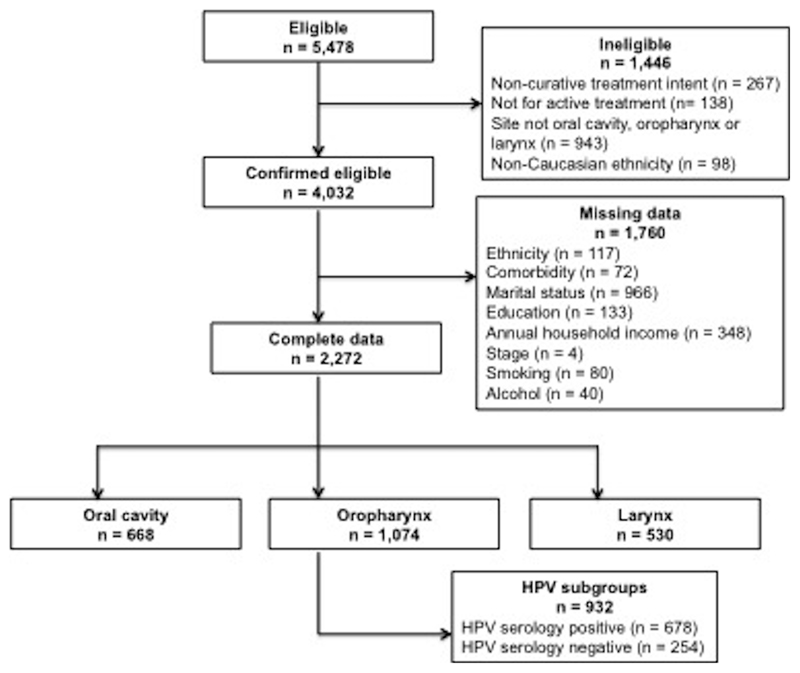
Survival analyses were performed using data from participants in a UK multicentre cohort study with cancers of the oral cavity (n = 668), oropharynx (n = 1074), and larynx (n = 530). Survival analyses were incrementally adjusted for age, sex, marital status, income, education, stage, alcohol, and smoking.
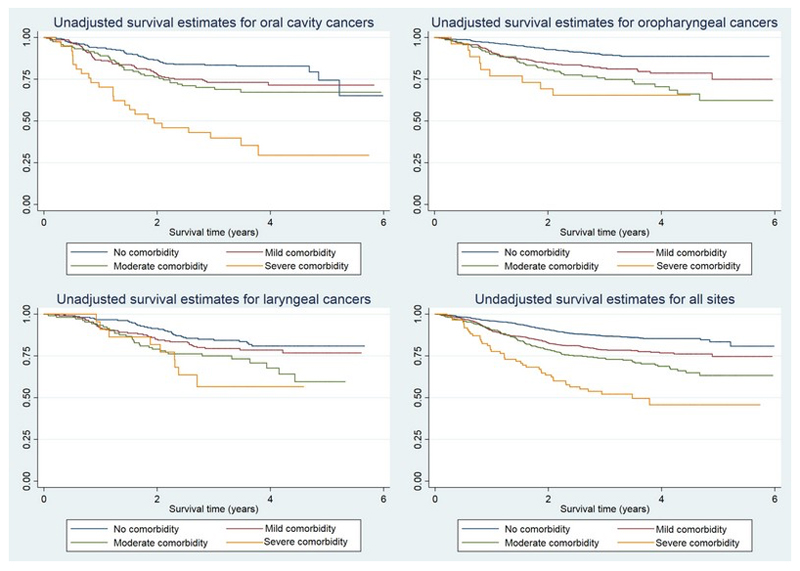
After adjusting for demographic, clinical, and behavioral confounders, higher baseline comorbidity was associated with reduced overall survival (mild comorbidity HR = 1.4, 95% CI = 1.1, 1.7; moderate comorbidity HR = 1.7, 95% CI = 1.3, 2.2; severe comorbidity HR = 2.8, 95% CI = 1.9, 4.; P-trend<.001).
Our findings suggest that comorbidity is an independent prognosticator for overall survival in head and neck cancer. Comorbid illnesses should be considered in the assessment and treatment planning of people with head and neck cancer.
头颈部癌症患者的合并症水平较高,但目前尚不清楚术前合并症是否对头颈部癌症是一个独立的预后因素。
使用来自英国多中心队列研究中患有口腔癌(n=668)、口咽癌(n=1074)和喉癌(n=530)患者的数据进行生存分析。生存分析逐步调整了年龄、性别、婚姻状况、收入、教育程度、分期、酒精和吸烟等混杂因素。
在调整了人口统计学、临床和行为混杂因素后,基线较高的合并症与总体生存率降低相关(轻度合并症 HR=1.4,95%CI=1.1,1.7;中度合并症 HR=1.7,95%CI=1.3,2.2;重度合并症 HR=2.8,95%CI=1.9,4.;P 趋势<.001)。
我们的研究结果表明,合并症是头颈部癌症总体生存率的独立预后因素。在对头颈部癌症患者的评估和治疗计划中应考虑合并症。