Department of Human Genetics, Leiden University Medical Center, Leiden, The Netherlands.
Faculty of Bioengineering and Bioinformatics, Lomonosov Moscow State University, Moscow, Russian Federation.
Eur J Hum Genet. 2019 Mar;27(3):455-465. doi: 10.1038/s41431-018-0291-3. Epub 2018 Dec 14.
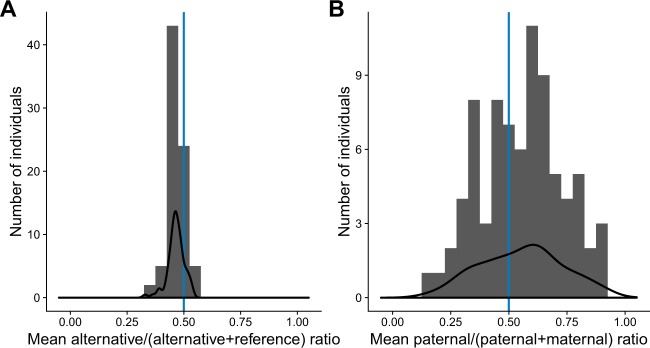
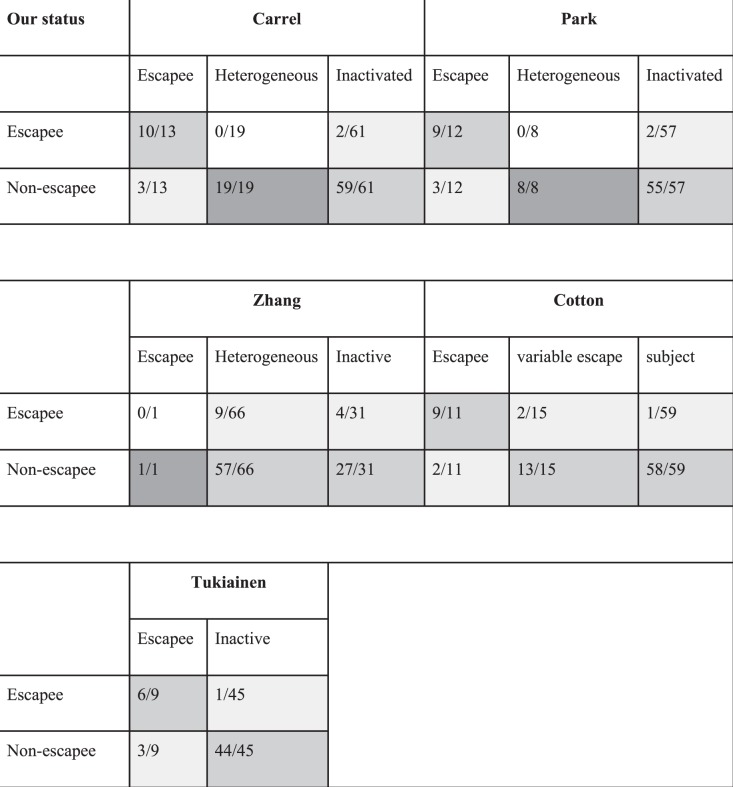
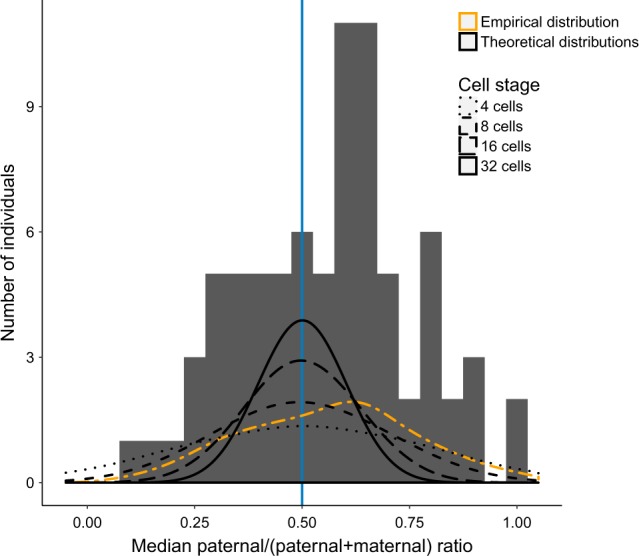
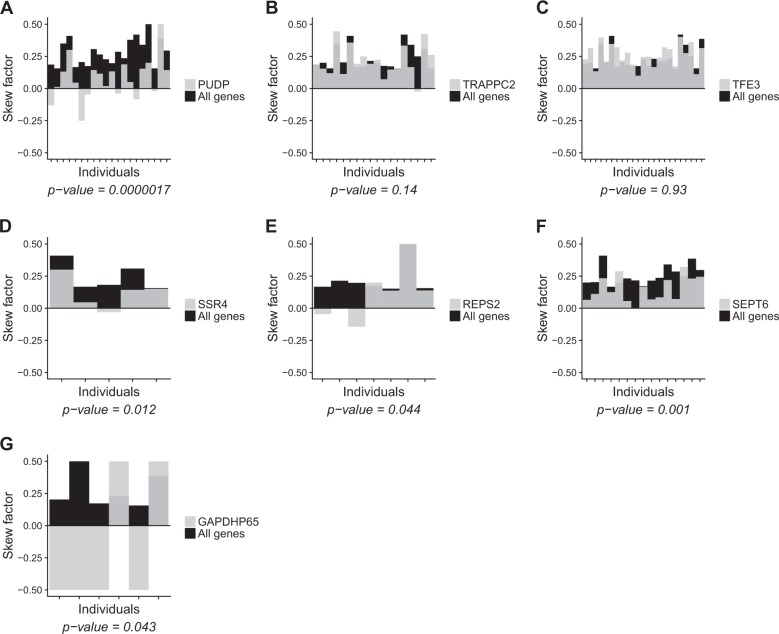
X-inactivation is a well-established dosage compensation mechanism ensuring that X-chromosomal genes are expressed at comparable levels in males and females. Skewed X-inactivation is often explained by negative selection of one of the alleles. We demonstrate that imbalanced expression of the paternal and maternal X-chromosomes is common in the general population and that the random nature of the X-inactivation mechanism can be sufficient to explain the imbalance. To this end, we analyzed blood-derived RNA and whole-genome sequencing data from 79 female children and their parents from the Genome of the Netherlands project. We calculated the median ratio of the paternal over total counts at all X-chromosomal heterozygous single-nucleotide variants with coverage ≥10. We identified two individuals where the same X-chromosome was inactivated in all cells. Imbalanced expression of the two X-chromosomes (ratios ≤0.35 or ≥0.65) was observed in nearly 50% of the population. The empirically observed skewing is explained by a theoretical model where X-inactivation takes place in an embryonic stage in which eight cells give rise to the hematopoietic compartment. Genes escaping X-inactivation are expressed from both alleles and therefore demonstrate less skewing than inactivated genes. Using this characteristic, we identified three novel escapee genes (SSR4, REPS2, and SEPT6), but did not find support for many previously reported escapee genes in blood. Our collective data suggest that skewed X-inactivation is common in the general population. This may contribute to manifestation of symptoms in carriers of recessive X-linked disorders. We recommend that X-inactivation results should not be used lightly in the interpretation of X-linked variants.
X 染色体失活是一种成熟的剂量补偿机制,可确保男性和女性的 X 染色体基因表达水平相当。X 染色体失活的偏斜通常可以用一个等位基因的负选择来解释。我们证明,父本和母本 X 染色体的不平衡表达在普通人群中很常见,而 X 染色体失活机制的随机性足以解释这种不平衡。为此,我们分析了来自荷兰基因组项目的 79 名女性儿童及其父母的血液衍生 RNA 和全基因组测序数据。我们计算了覆盖≥10 的所有 X 染色体杂合单核苷酸变体中父本相对于总计数的中位数比值。我们鉴定了两个在所有细胞中相同 X 染色体失活的个体。在近 50%的人群中观察到两条 X 染色体的表达不平衡(比值≤0.35 或≥0.65)。经验观察到的偏斜可以用一种理论模型来解释,该模型假设 X 染色体失活发生在一个胚胎阶段,在此阶段八个细胞产生造血区室。逃避 X 染色体失活的基因从两个等位基因表达,因此表现出比失活基因更小的偏斜。利用这一特征,我们鉴定了三个新的逃逸基因(SSR4、REPS2 和 SEPT6),但在血液中未发现许多先前报道的逃逸基因的支持。我们的综合数据表明,偏斜的 X 染色体失活在普通人群中很常见。这可能导致隐性 X 连锁疾病携带者出现症状。我们建议不要轻易在 X 连锁变体的解释中使用 X 染色体失活结果。