Peng Xiao-Fan, Meng Xiang-Yu, Wei Cheng, Xing Zhen-Hua, Huang Jia-Bin, Fang Zhen-Fei, Hu Xin-Qun, Liu Qi-Ming, Zhu Zhao-Wei, Zhou Sheng-Hua
Department of Cardiology, The Second Xiangya Hospital, Central South University, Changsha 410000, China,
Department of Urology, Zhongnan Hospital of Wuhan University, Wuhan 430071, China.
Cancer Manag Res. 2018 Nov 26;10:6263-6274. doi: 10.2147/CMAR.S181178. eCollection 2018.
The association between metabolic syndrome (MS) and bladder cancer (BC) was not fully investigated, and most primary studies and pooled analyses were only focused on certain specific components.
To further investigate this issue and obtain more precise findings, we conducted this updated evidence synthesis of published studies, which involved not only MS components but also the MS in its entirety.
We searched the PubMed, EMBASE, and Web of Science databases for observational studies on the association between BC susceptibility and/or mortality, and MS and its components. We extracted data from included studies, evaluated heterogeneity, and performed meta-analytic quantitative syntheses.
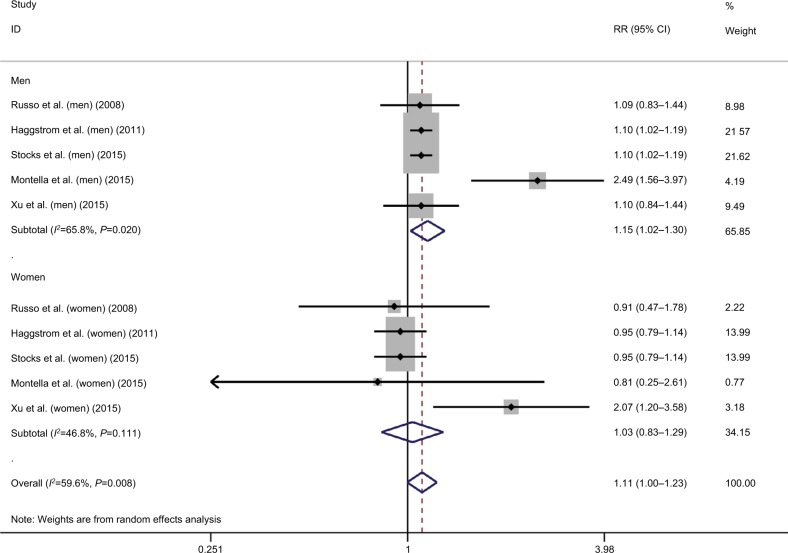
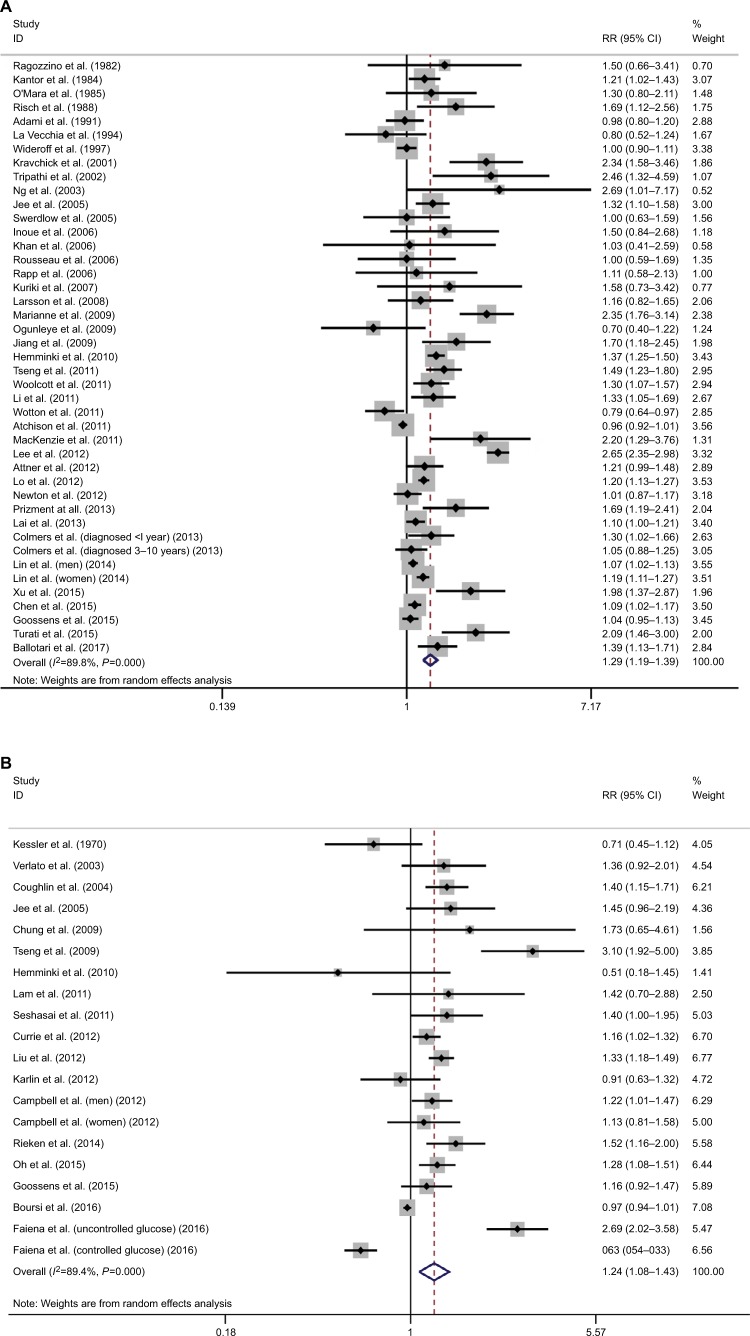
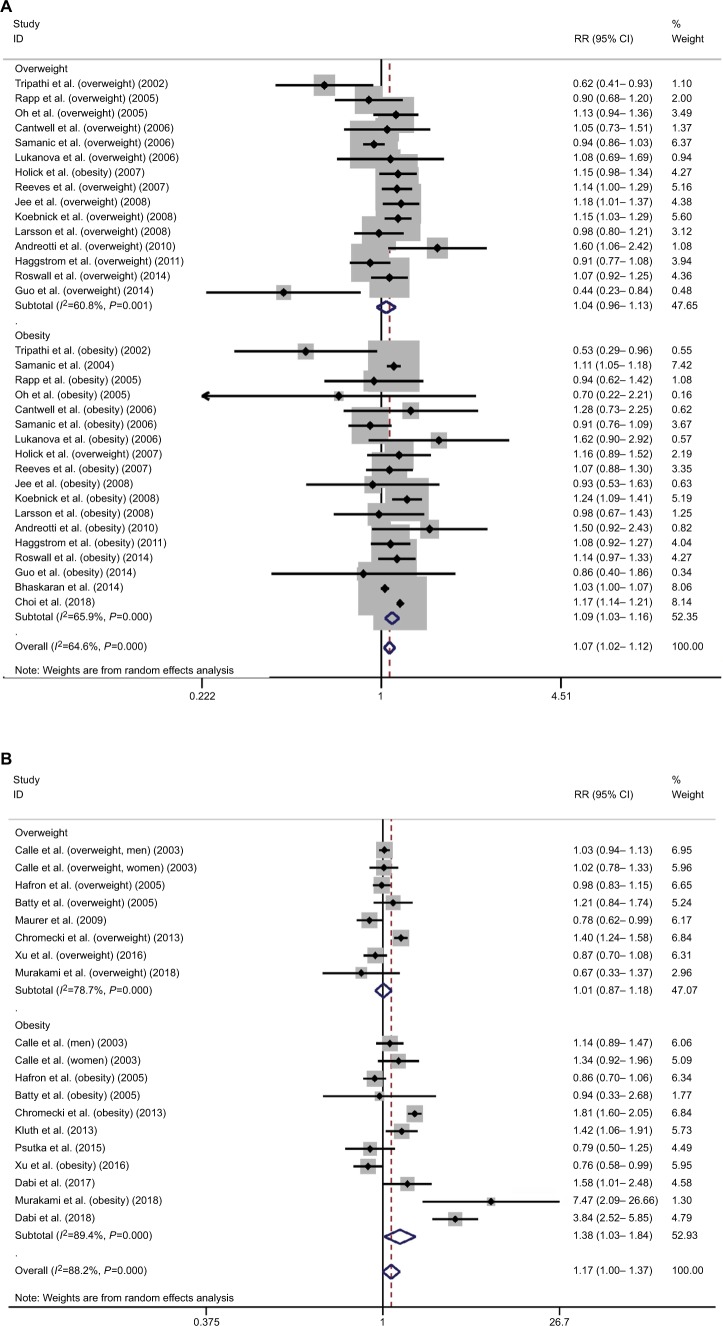
A total of 95 studies with 97,795,299 subjects were included in the present study. According to the results, MS significantly increased the risk of BC (risk ratio [RR]=1.11, 95% CI=1.00-1.23); diabetes significantly increased the risk of BC (RR=1.29, 95% CI=1.19-1.39) and associated with poor survival (RR=1.24, 95% CI=1.08-1.43). Excessive body weight was associated with increased susceptibility (RR=1.07, 95% CI=1.02-1.12), recurrence (RR=1.46, 95% CI=1.18-1.81), and mortality (RR=1.17, 95% CI=1.00-1.37). As indicated by cumulative meta-analysis, sample size was inadequate for the association between BC susceptibility and MS, the association between BC recurrence and excessive body weight, and the association between BC survival and diabetes. The sample size of the meta-analysis was enough to reach a stable pooled effect for other associations.
Diabetes and excessive body weight as components of MS are associated with increased susceptibility and poor prognosis of BC. Uncertainty remains concerning the impact of overall MS, hypertension, and dyslipidemia on BC susceptibility and prognosis, for which further investigations are needed.
代谢综合征(MS)与膀胱癌(BC)之间的关联尚未得到充分研究,大多数初步研究和汇总分析仅关注某些特定成分。
为了进一步研究这个问题并获得更精确的结果,我们对已发表的研究进行了更新的证据综合分析,这些研究不仅涉及MS的各个成分,还涉及整体的MS。
我们在PubMed、EMBASE和科学网数据库中搜索关于BC易感性和/或死亡率与MS及其成分之间关联的观察性研究。我们从纳入的研究中提取数据,评估异质性,并进行荟萃分析定量综合。
本研究共纳入95项研究,涉及97,795,299名受试者。结果显示,MS显著增加了BC的风险(风险比[RR]=1.11,95%置信区间[CI]=1.00-1.23);糖尿病显著增加了BC的风险(RR=1.29,95%CI=1.19-1.39),并与较差的生存率相关(RR=1.24,95%CI=1.08-1.43)。超重与易感性增加(RR=1.07,95%CI=1.02-1.12)、复发(RR=1.46,95%CI=1.18-1.81)和死亡率(RR=1.17,95%CI=1.00-1.37)相关。累积荟萃分析表明,对于BC易感性与MS之间的关联、BC复发与超重之间的关联以及BC生存率与糖尿病之间的关联,样本量不足。荟萃分析的样本量足以对其他关联达成稳定的汇总效应。
作为MS组成部分的糖尿病和超重与BC易感性增加和预后不良相关。关于整体MS、高血压和血脂异常对BC易感性和预后的影响仍存在不确定性,需要进一步研究。