Vatsa Naman, Jana Nihar Ranjan
Cellular and Molecular Neuroscience Laboratory, National Brain Research Centre, Gurugram, India.
School of Bioscience, Indian Institute of Technology, Kharagpur, India.
Front Mol Neurosci. 2018 Dec 4;11:448. doi: 10.3389/fnmol.2018.00448. eCollection 2018.
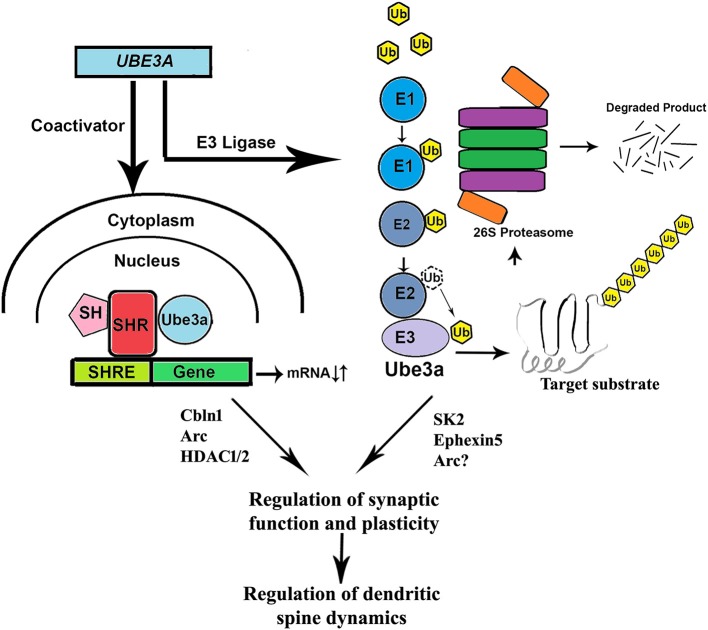
UBE3A is a dual function protein consisting of ubiquitin ligase as well as transcriptional co-activator function. gene is imprinted in the brain with preferential maternal-specific expression particularly in the neuron and loss of activity of the maternally inherited causes Angelman syndrome (AS), characterized by severe mental retardation, lack of speech, seizures and autistic features. Interestingly, duplication, triplication, or gain-of-function mutations in the gene are also linked with autism clinically distinguished by social impairments and stereotyped behaviors. These findings indicate that the expression and activity of UBE3A must be tightly regulated during brain development and UBE3A might be playing a crucial role in controlling synaptic function and plasticity through proteasome-mediated degradation as well as transcriptional regulation of its target proteins. In fact, several recent reports demonstrated the role of UBE3A in the modulation of synaptic function and plasticity. This review focuses on the critical role of UBE3A in regulating the synaptic function and how its altered activity is associated with autism.
UBE3A是一种具有双重功能的蛋白质,兼具泛素连接酶以及转录共激活因子功能。该基因在大脑中呈现印记状态,具有母源特异性表达偏好,尤其是在神经元中,母源遗传的该基因活性丧失会导致天使综合征(AS),其特征为严重智力迟钝、言语缺失、癫痫发作以及自闭症特征。有趣的是,该基因的重复、三倍体化或功能获得性突变在临床上也与以社交障碍和刻板行为为特征的自闭症相关联。这些发现表明,UBE3A的表达和活性在大脑发育过程中必须受到严格调控,并且UBE3A可能通过蛋白酶体介导的降解以及对其靶蛋白的转录调控在控制突触功能和可塑性方面发挥关键作用。事实上,最近的几份报告证明了UBE3A在调节突触功能和可塑性方面的作用。本综述聚焦于UBE3A在调节突触功能中的关键作用以及其活性改变如何与自闭症相关联。