• 文献检索
  • 文档翻译
  • 深度研究
  • 学术资讯
  • Suppr Zotero 插件Zotero 插件
  • 邀请有礼
  • 套餐&价格
  • 历史记录
应用&插件
Suppr Zotero 插件Zotero 插件浏览器插件Mac 客户端Windows 客户端微信小程序
定价
高级版会员购买积分包购买API积分包
服务
文献检索文档翻译深度研究API 文档MCP 服务
关于我们
关于 Suppr公司介绍联系我们用户协议隐私条款
关注我们

Suppr 超能文献

核心技术专利:CN118964589B侵权必究
粤ICP备2023148730 号-1Suppr @ 2026

文献检索

告别复杂PubMed语法,用中文像聊天一样搜索,搜遍4000万医学文献。AI智能推荐,让科研检索更轻松。

立即免费搜索

文件翻译

保留排版,准确专业,支持PDF/Word/PPT等文件格式,支持 12+语言互译。

免费翻译文档

深度研究

AI帮你快速写综述,25分钟生成高质量综述,智能提取关键信息,辅助科研写作。

立即免费体验

非梗阻性无精子症男性经皮附睾或睾丸精子抽吸术取精失败的风险预测模型。

A risk prediction model of sperm retrieval failure with fine needle aspiration in males with non-obstructive azoospermia.

机构信息

West China School of Public Health and Healthy Food Evaluation Research Center, Sichuan University, Chengdu, Sichuan, China.

Human Sperm Bank, West China Second University Hospital of Sichuan University, Chengdu, Sichuan, China.

出版信息

Hum Reprod. 2019 Feb 1;34(2):200-208. doi: 10.1093/humrep/dey366.

DOI:10.1093/humrep/dey366
PMID:30576444
原文链接:https://pmc.ncbi.nlm.nih.gov/articles/PMC6343465/
Abstract

STUDY QUESTION

Can we predict the risk of sperm retrieval failure among men with non-obstructive azoospermia (NOA) before they undergo fine needle aspiration (FNA)?

SUMMARY ANSWER

Our model, which includes FSH level, age and testicular volume as variables, can predict the risk of sperm retrieval failure with FNA.

WHAT IS KNOWN ALREADY

Combined with ICSI, testicular sperm aspiration (TESA) can enable patients with NOA to have their own genetic offspring. Nearly all reproductive medicine centres in China have applied FNA, but approximately half of patients with NOA experience testicular sperm retrieval failure. Nevertheless, the models developed to predict the likelihood of obtaining spermatozoa with testicular sperm extraction (TESE) cannot accurately predict sperm retrieval, and few of these models have been sufficiently validated.

STUDY DESIGN, SIZE, DURATION: This study involved three cohorts including 597 men with NOA. From 1 January 2015 to 31 July 2017, a retrospective cohort of 317 males with NOA who underwent FNA procedures at a university affiliated hospital were included to build a risk prediction model of sperm retrieval failure with FNA. Then, from 25 October 2017 to 31 March 2018, two prospective cohorts of 61 and 219 males with NOA from the same hospital and one other reproductive specialist hospital respectively, were recruited to validate the risk prediction model.

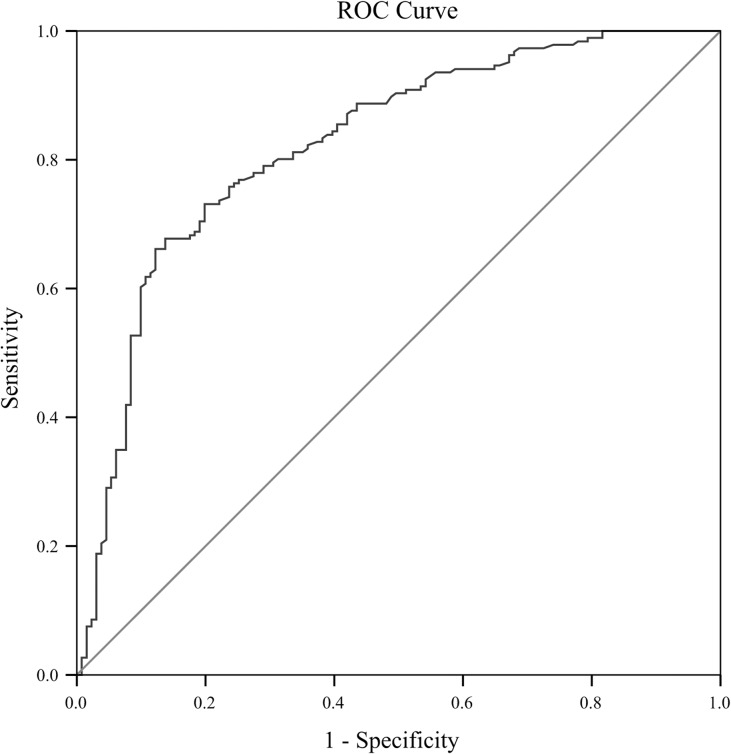
PARTICIPANTS/MATERIALS, SETTING, METHODS: All men with NOA undergoing their first TESE procedure as part of a fertility treatment were included. The primary end-point was the presence of one or more spermatozoa (regardless of their motility) obtained with FNA. A binary multivariable logistic model was built to predict the risk of sperm retrieval failure after TESA using the dataset from the retrospective cohort. A cut-off value for risk was calculated with receiver operating characteristic (ROC) curve analysis. Two validation sets from the prospective cohort were used to validate the risk prediction model by measures including prediction accuracy and the true positive rate.

MAIN RESULTS AND THE ROLE OF CHANCE

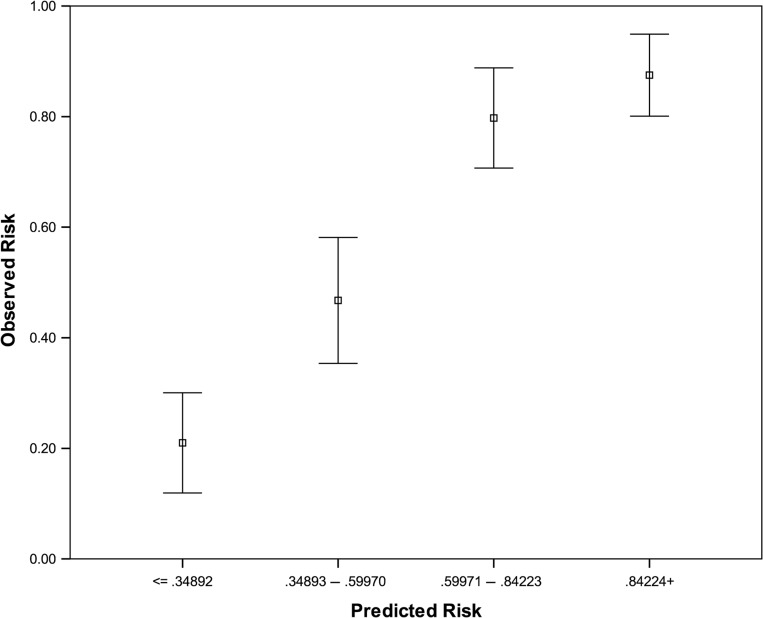
A total of 327 (54.8%) males with NOA experienced sperm retrieval failure with FNA. FSH level, age and testicular volume were included in the prediction model for sperm retrieval failure risk. The model had an AUC of 82.3% (95% CI: 77.6-87.1%) and a cut-off value of 64.61% with a sensitivity of 0.677 and specificity of 0.863 for predicted risk. The predictive accuracies were 85.25 and 83.56% in the external validation sets from two centres. Specifically, 85.71 and 85.15% of NOA patients from two centres that experienced sperm retrieval failure were correctly identified using our model.

LIMITATIONS, REASONS FOR CAUTION: A small proportion of males with NOA in whom sperm were successfully retrieved with FNA were misclassified; therefore, TESA techniques with higher sperm retrieval rates may be attempted in patients with high predicted risks of sperm retrieval failure rather than terminating the efforts to produce a genetic offspring. In addition, the ability to achieve a live birth using sperm retrieved with FNA was not tested in this study.

WIDER IMPLICATIONS OF THE FINDINGS

We would recommend the use of micro-TESE for men with NOA and a high predicted risk of FNA failure.

STUDY FUNDING/COMPETING INTEREST(S): This study was partly supported by National Key R&D Program of China (No. 2017YFC0907305), the National Natural Science Foundation of China (No.81803332), Sichuan Science & Technology Program (No. 2018SZ0144, 2016SZ0066, 2018SZ0284 and 2018FZ0043), Chengdu Science & Technology Bureau (No. 2018-YF05-01265-SN), Postdoctoral Research foundation of Sichuan University (No. 2018SCU12012) and West China Second University Hospital of Sichuan University (No. kx027). There are no competing interests related to this study.

TRIAL REGISTRATION NUMBER

Not applicable.

摘要

研究问题

我们能否在男性接受细针抽吸(FNA)之前预测非梗阻性无精子症(NOA)患者的精子提取失败风险?

总结答案

我们的模型包括 FSH 水平、年龄和睾丸体积作为变量,可以预测 FNA 时精子提取失败的风险。

已知情况

结合 ICSI,睾丸精子抽吸(TESA)可以使 NOA 患者拥有自己的遗传后代。中国几乎所有的生殖医学中心都应用了 FNA,但大约一半的 NOA 患者经历了睾丸精子提取失败。然而,用于预测睾丸精子提取(TESE)获得精子可能性的模型不能准确预测精子提取,而且这些模型中很少有经过充分验证的。

研究设计、大小、持续时间:这项研究包括三个队列,共 597 名 NOA 男性。2015 年 1 月 1 日至 2017 年 7 月 31 日,回顾性队列纳入了 317 名在大学附属医院接受 FNA 手术的 NOA 男性,建立了 FNA 时精子提取失败风险的预测模型。然后,从 2017 年 10 月 25 日至 2018 年 3 月 31 日,来自同一医院和另一家生殖专家医院的两个前瞻性队列分别招募了 61 名和 219 名 NOA 男性,验证风险预测模型。

参与者/材料、设置、方法:所有接受 TESE 作为生育治疗一部分的 NOA 男性均纳入研究。主要终点是通过 FNA 获得一个或多个精子(无论其活力如何)。使用回顾性队列中的数据集,使用二元多变量逻辑模型预测 TESA 后精子提取失败的风险。通过接收者操作特征(ROC)曲线分析计算风险的截断值。使用两个前瞻性队列的验证集通过预测准确性和真阳性率等措施来验证风险预测模型。

主要结果和机会的作用

327 名(54.8%)NOA 男性经历了 FNA 时的精子提取失败。FSH 水平、年龄和睾丸体积被纳入预测模型中。该模型的 AUC 为 82.3%(95%CI:77.6-87.1%),截断值为 64.61%,预测风险的灵敏度为 0.677,特异性为 0.863。在来自两个中心的外部验证集中,预测准确率分别为 85.25%和 83.56%。具体来说,两个中心中经历精子提取失败的 85.71%和 85.15%的 NOA 患者被我们的模型正确识别。

局限性、谨慎的原因:少数 FNA 成功提取精子的 NOA 男性被错误分类;因此,对于预测精子提取失败风险较高的患者,可能会尝试使用精子提取率较高的 TESA 技术,而不是终止产生遗传后代的努力。此外,本研究未测试使用 FNA 提取的精子是否能实现活产。

研究的广泛意义

我们建议对 NOA 且预测 FNA 失败风险较高的男性使用微 TESE。

研究资助/利益冲突:本研究部分由国家重点研发计划(No.2017YFC0907305)、国家自然科学基金(No.81803332)、四川省科技计划(No.2018SZ0144、2016SZ0066、2018SZ0284 和 2018FZ0043)、成都市科技局(No.2018-YF05-01265-SN)、四川大学博士后研究基金(No.2018SCU12012)和四川大学华西第二医院(No.kx027)资助。本研究无利益冲突。

临床试验注册号

不适用。

https://cdn.ncbi.nlm.nih.gov/pmc/blobs/b022/6343465/58d721485081/dey366f02.jpg
https://cdn.ncbi.nlm.nih.gov/pmc/blobs/b022/6343465/cd4bab132169/dey366f01.jpg
https://cdn.ncbi.nlm.nih.gov/pmc/blobs/b022/6343465/58d721485081/dey366f02.jpg
https://cdn.ncbi.nlm.nih.gov/pmc/blobs/b022/6343465/cd4bab132169/dey366f01.jpg
https://cdn.ncbi.nlm.nih.gov/pmc/blobs/b022/6343465/58d721485081/dey366f02.jpg

相似文献

1
A risk prediction model of sperm retrieval failure with fine needle aspiration in males with non-obstructive azoospermia.非梗阻性无精子症男性经皮附睾或睾丸精子抽吸术取精失败的风险预测模型。
Hum Reprod. 2019 Feb 1;34(2):200-208. doi: 10.1093/humrep/dey366.
2
Prediction model for obtaining spermatozoa with testicular sperm extraction in men with non-obstructive azoospermia.非梗阻性无精子症男性通过睾丸精子提取获取精子的预测模型。
Hum Reprod. 2016 Sep;31(9):1934-41. doi: 10.1093/humrep/dew147. Epub 2016 Jul 12.
3
Prediction model for live birth in ICSI using testicular extracted sperm.使用睾丸提取精子的卵胞浆内单精子注射术活产预测模型
Hum Reprod. 2016 Sep;31(9):1942-51. doi: 10.1093/humrep/dew146. Epub 2016 Jul 12.
4
Prediction of sperm extraction in non-obstructive azoospermia patients: a machine-learning perspective.预测非梗阻性无精子症患者的精子提取:机器学习视角。
Hum Reprod. 2020 Jul 1;35(7):1505-1514. doi: 10.1093/humrep/deaa109.
5
How successful is TESE-ICSI in couples with non-obstructive azoospermia?TESE-ICSI 在非梗阻性无精子症夫妇中的成功率如何?
Hum Reprod. 2015 Aug;30(8):1790-6. doi: 10.1093/humrep/dev139. Epub 2015 Jun 16.
6
Ultrasonographic caput epididymis diameter is reduced in non-obstructive azoospermia compared with normozoospermia but is not predictive for successful sperm retrieval after TESE.超声检测附睾头直径在非梗阻性无精子症中较正常精子症小,但不能预测 TESE 后精子获取的成功。
Hum Reprod. 2014 Jul;29(7):1368-74. doi: 10.1093/humrep/deu092. Epub 2014 May 7.
7
Prediction model for clinical pregnancy for ICSI after surgical sperm retrieval in different types of azoospermia.不同类型无精子症患者经外科取精后行 ICSI 的临床妊娠预测模型。
Hum Reprod. 2020 Sep 1;35(9):1972-1982. doi: 10.1093/humrep/deaa163.
8
Testicular histopathology as a predictor of a positive sperm retrieval in men with non-obstructive azoospermia.睾丸组织病理学作为非梗阻性无精子症患者精子获取阳性的预测因子。
BJU Int. 2013 Mar;111(3):492-9. doi: 10.1111/j.1464-410X.2012.11203.x. Epub 2012 May 15.
9
Sperm recovery and ICSI outcomes in men with non-obstructive azoospermia: a systematic review and meta-analysis.非梗阻性无精子症患者精子恢复和卵胞浆内单精子注射治疗结局的系统评价和荟萃分析。
Hum Reprod Update. 2019 Nov 5;25(6):733-757. doi: 10.1093/humupd/dmz028.
10
Potential of testis-derived circular RNAs in seminal plasma to predict the outcome of microdissection testicular sperm extraction in patients with idiopathic non-obstructive azoospermia.睾丸来源的环状 RNA 在精液中的潜力可预测特发性非梗阻性无精子症患者显微睾丸精子提取术的结果。
Hum Reprod. 2021 Sep 18;36(10):2649-2660. doi: 10.1093/humrep/deab196.

引用本文的文献

1
Development of a predictive nomogram for testicular sperm extraction outcomes in patients with non-obstructive azoospermia using testicular volume, follicle-stimulating hormone levels, and testosterone levels as key parameters.以睾丸体积、促卵泡激素水平和睾酮水平作为关键参数,开发用于预测非梗阻性无精子症患者睾丸精子提取结果的列线图。
Transl Androl Urol. 2025 Jan 31;14(1):112-123. doi: 10.21037/tau-24-531. Epub 2025 Jan 22.
2
Does the FNA sperm retrieval failure prediction model work well for current NOA individuals undertaking risk screening before the operation? Model validation, high-risk population identification and potential alternative sperm retrieval exploration.FNA精子获取失败预测模型对于当前术前进行风险筛查的非梗阻性无精子症个体是否有效?模型验证、高危人群识别及潜在替代精子获取探索。
BMC Med Inform Decis Mak. 2024 Dec 30;24(1):415. doi: 10.1186/s12911-024-02816-5.
3

本文引用的文献

1
[Effect of testicular puncture biopsy on the success rate of microdissection testicular sperm extraction for idiopathic non-obstructive azoospermia].[睾丸穿刺活检对特发性非梗阻性无精子症患者显微外科睾丸取精成功率的影响]
Beijing Da Xue Xue Bao Yi Xue Ban. 2018 Aug 18;50(4):613-616.
2
Prediction model for obtaining spermatozoa with testicular sperm extraction in men with non-obstructive azoospermia.非梗阻性无精子症男性通过睾丸精子提取获取精子的预测模型。
Hum Reprod. 2016 Sep;31(9):1934-41. doi: 10.1093/humrep/dew147. Epub 2016 Jul 12.
3
A novel stepwise micro-TESE approach in non obstructive azoospermia.
Role of Follicle-stimulating Hormone, Inhibin B, and Anti-Müllerian Hormone in Predicting Sperm Retrieval from Men with Nonobstructive Azoospermia Undergoing Microdissection Testicular Sperm Extraction: A Systematic Review and Meta-analysis.促卵泡生成素、抑制素B和抗苗勒管激素在预测接受显微外科睾丸精子提取术的非梗阻性无精子症男性精子获取中的作用:一项系统评价和荟萃分析。
Eur Urol Open Sci. 2024 May 27;65:3-12. doi: 10.1016/j.euros.2024.05.001. eCollection 2024 Jul.
4
Development and validation predictive models of sperm retrieval for azoospermic men undergoing testicular sperm aspiration: a multicentre, retrospective, cohort study.经睾丸精子抽吸术治疗的非梗阻性无精子症男性的精子获取预测模型的建立和验证:一项多中心、回顾性、队列研究。
J Assist Reprod Genet. 2022 Aug;39(8):1779-1787. doi: 10.1007/s10815-022-02531-y. Epub 2022 Jul 23.
5
Predictors of testicular sperm retrieval in patients with non-obstructive azoospermia: a review.非梗阻性无精子症患者睾丸精子提取的预测因素:综述
J Int Med Res. 2021 Apr;49(4):3000605211002703. doi: 10.1177/03000605211002703.
6
Hormonal markers as noninvasive predictors of sperm retrieval in non-obstructive azoospermia.激素标志物作为非梗阻性无精子症精子获取的非侵入性预测指标。
J Assist Reprod Genet. 2021 Aug;38(8):2049-2059. doi: 10.1007/s10815-021-02176-3. Epub 2021 Mar 31.
7
Successful Targeted Testicular Sperm Extraction Using Microsurgical Technique (microTESE) Following Fine Needle Aspiration (FNA) Mapping in a Non-Obstructive Azoospermia (NOA) Patient: A Case Report.在一名非梗阻性无精子症(NOA)患者中,经细针抽吸(FNA)定位后,使用显微外科技术成功进行靶向睾丸精子提取(microTESE):病例报告
J Reprod Infertil. 2021 Jan-Mar;22(1):65-69. doi: 10.18502/jri.v22i1.4997.
8
Non-obstructive azoospermia: current and future perspectives.非梗阻性无精子症:现状与未来展望
Fac Rev. 2021 Jan 26;10:7. doi: 10.12703/r/10-7. eCollection 2021.
9
Altered Gut Microbial Metabolites in Amnestic Mild Cognitive Impairment and Alzheimer's Disease: Signals in Host-Microbe Interplay.肠道微生物代谢物在遗忘型轻度认知障碍和阿尔茨海默病中的改变:宿主-微生物相互作用的信号。
Nutrients. 2021 Jan 14;13(1):228. doi: 10.3390/nu13010228.
一种用于非梗阻性无精子症的新型逐步显微睾丸精子提取方法。
BMC Urol. 2016 May 12;16(1):20. doi: 10.1186/s12894-016-0138-6.
4
Comparison of microdissection testicular sperm extraction, conventional testicular sperm extraction, and testicular sperm aspiration for nonobstructive azoospermia: a systematic review and meta-analysis.显微切割睾丸取精术、传统睾丸取精术和睾丸精子抽吸术治疗非梗阻性无精子症的比较:一项系统评价和荟萃分析
Fertil Steril. 2015 Nov;104(5):1099-103.e1-3. doi: 10.1016/j.fertnstert.2015.07.1136. Epub 2015 Aug 8.
5
Etiology of azoospermia in a military population.军人人群中无精子症的病因。
J Urol. 2015 Apr;193(4):1318-21. doi: 10.1016/j.juro.2014.10.048. Epub 2014 Oct 16.
6
Follicle-stimulating hormone as a predictor for sperm retrieval rate in patients with nonobstructive azoospermia: a systematic review and meta-analysis.促卵泡生成素作为非梗阻性无精子症患者取精成功率的预测指标:一项系统评价与荟萃分析
Asian J Androl. 2015 Mar-Apr;17(2):281-4. doi: 10.4103/1008-682X.139259.
7
The association between serum follicle-stimulating hormone levels and the success of microdissection testicular sperm extraction in patients with azoospermia.无精子症患者血清卵泡刺激素水平与显微外科睾丸取精术成功率之间的关联。
Urol J. 2014 Sep 6;11(4):1825-8.
8
Severe testicular atrophy does not affect the success of microdissection testicular sperm extraction.严重的睾丸萎缩并不影响显微镜下睾丸精子提取的成功率。
J Urol. 2014 Jan;191(1):175-8. doi: 10.1016/j.juro.2013.07.065. Epub 2013 Aug 1.
9
A comparison of models for predicting sperm retrieval before microdissection testicular sperm extraction in men with nonobstructive azoospermia.比较模型预测非梗阻性无精子症患者行显微镜下睾丸精子抽吸术之前的精子获取。
J Urol. 2013 Feb;189(2):638-42. doi: 10.1016/j.juro.2012.09.038. Epub 2012 Dec 20.
10
Microdissection testicular sperm extraction: an update.微量睾丸精子提取术:最新进展。
Asian J Androl. 2013 Jan;15(1):35-9. doi: 10.1038/aja.2012.141. Epub 2012 Dec 17.