Kentish-Barnes Nancy, Chevret Sylvie, Azoulay Elie
AP-HP, Saint Louis University Hospital, Medical Intensive Care Unit, Famiréa Group, 1 avenue Claude Vellefaux, Paris, France.
ECSTRA Team, Biostatistics and Clinical Epidemiology, UMR 1153 (CRESS), INSERM, Paris Diderot Sorbonne University, Paris, France.
Trials. 2018 Dec 22;19(1):698. doi: 10.1186/s13063-018-3084-7.
Providing appropriate support and care for end-of-life patients and their relatives is a major concern and a daily responsibility for intensivists. Bereaved relatives of non-surviving patients in intensive care units (ICUs) often suffer from prolonged grief, posttraumatic stress disorder, anxiety, and depression. A physician-driven intervention, consisting of three meetings with the family, might reduce the post-ICU burden of bereaved family members 6 month after death. The patient's nurse is actively involved at each step. We hypothesize that this strategy will improve communication in the end-of-life setting and thus, should reduce the post-ICU burden for family members, specifically the development of prolonged grief 6 months after the death.
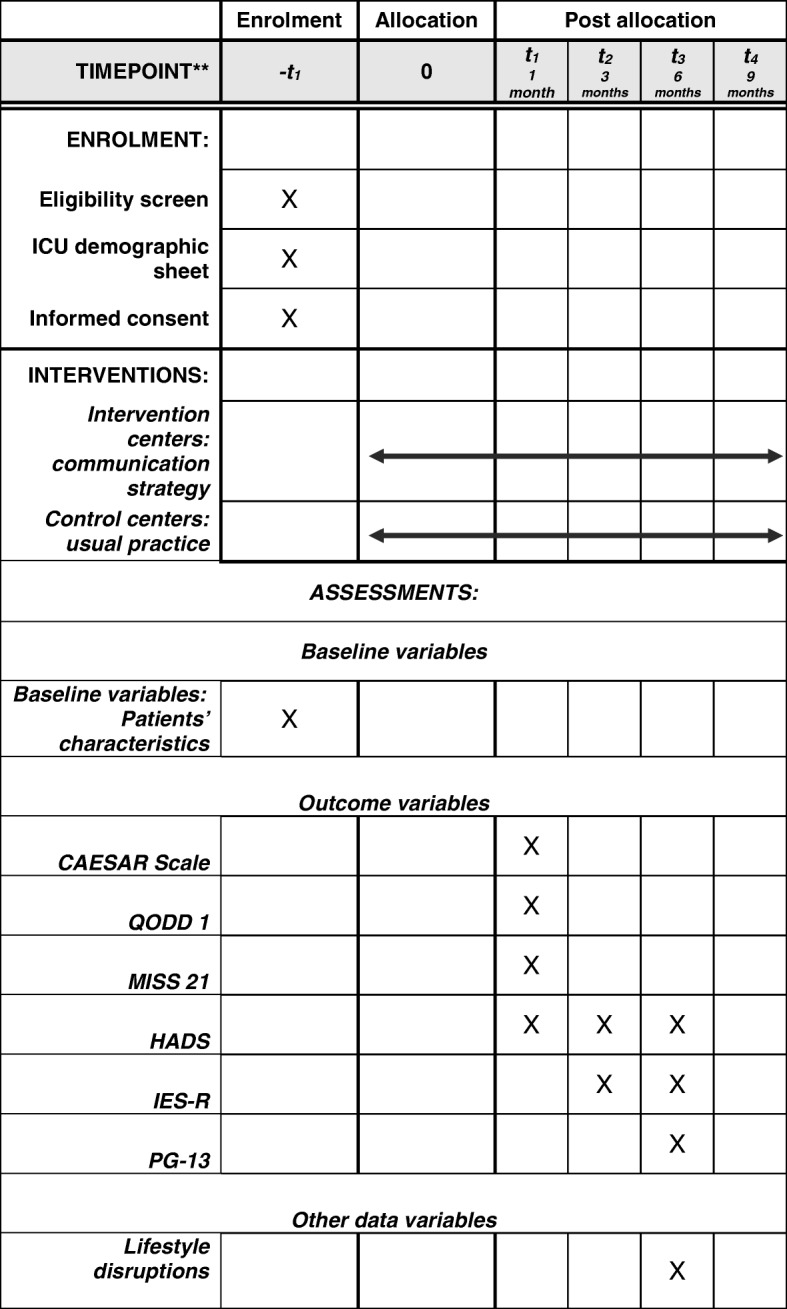
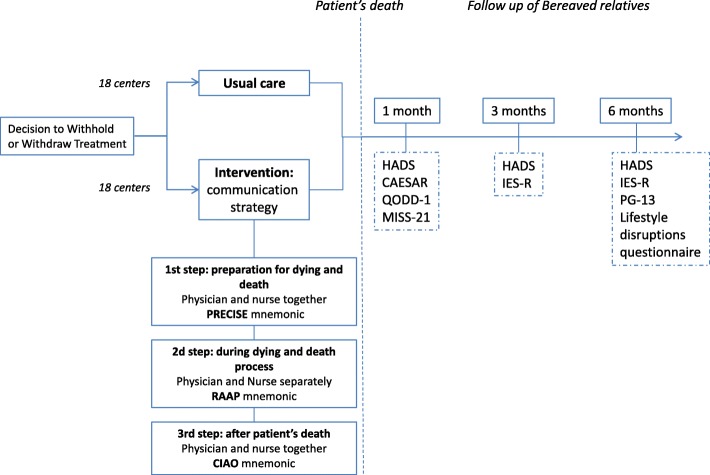
METHODS/DESIGN: The COSMIC-EOL trial is a prospective, multicenter, cluster randomized controlled trial in which centers are allocated to two parallel arms: (1) intervention centers where relatives benefit from three-step physician-driven support during the dying and death process and (2) control centers where, during the dying and death process, relatives receive the standard of care practice. Each of the 36 participating centers will include 25 relatives of patients with a length of stay ≥2 days. Participating relatives will be followed up by phone at 1, 3, and 6 months after the patient's death to complete questionnaires permitting evaluation of their post-ICU burden. The main outcome is prolonged grief measured 6 months after the death using the PG-13. Other outcomes include evaluation of quality of dying, quality of communication, anxiety, depression, and post-traumatic stress. The estimated duration of the study is 36 months.
The results of the trial will provide information about the effectiveness of physician-driven support for relatives of patients dying in an ICU. The study is expected to demonstrate a decrease in the ICU burden for bereaved relatives who benefitted from this intervention.
ClinicalTrials.gov, NCT02955992 . Registered on November 3rd 2016.
为临终患者及其亲属提供适当的支持和护理是重症监护医生的主要关切和日常职责。重症监护病房(ICU)中未存活患者的亲属常常遭受长期悲伤、创伤后应激障碍、焦虑和抑郁之苦。一项由医生主导的干预措施,包括与家属进行三次会面,可能会减轻家属在患者死亡6个月后的ICU后负担。患者的护士会积极参与每一个环节。我们假设这一策略将改善临终环境中的沟通,从而减轻家属的ICU后负担,特别是在患者死亡6个月后长期悲伤的发生率。
方法/设计:COSMIC-EOL试验是一项前瞻性、多中心、整群随机对照试验,各中心被分配到两个平行组:(1)干预组中心,亲属在患者临终和死亡过程中受益于医生主导的三步支持;(2)对照组中心,亲属在患者临终和死亡过程中接受标准护理。36个参与中心中的每个中心将纳入25名住院时间≥2天的患者的亲属。参与的亲属将在患者死亡后的1个月、3个月和6个月接受电话随访,以完成问卷,从而评估他们的ICU后负担。主要结局是使用PG-13量表在患者死亡6个月后测量的长期悲伤。其他结局包括对临终质量、沟通质量、焦虑、抑郁和创伤后应激进行评估。研究预计持续时间为36个月。
试验结果将提供有关医生主导的支持对ICU中临终患者亲属有效性的信息。预计该研究将证明,受益于这种干预的丧亲亲属的ICU负担会有所减轻。
ClinicalTrials.gov,NCT02955992。于2016年11月3日注册。