Graduate Program in Neuroscience, Boston University School of Medicine, Boston, MA 02118, USA; Department of Pharmacology and Experimental Therapeutics, Boston University School of Medicine, Boston, MA 02118, USA.
Department of Pharmacology and Experimental Therapeutics, Boston University School of Medicine, Boston, MA 02118, USA; Department of Neurology, Boston University School of Medicine, Boston, MA 02118, USA.
Trends Mol Med. 2019 Feb;25(2):96-111. doi: 10.1016/j.molmed.2018.11.004. Epub 2018 Dec 18.
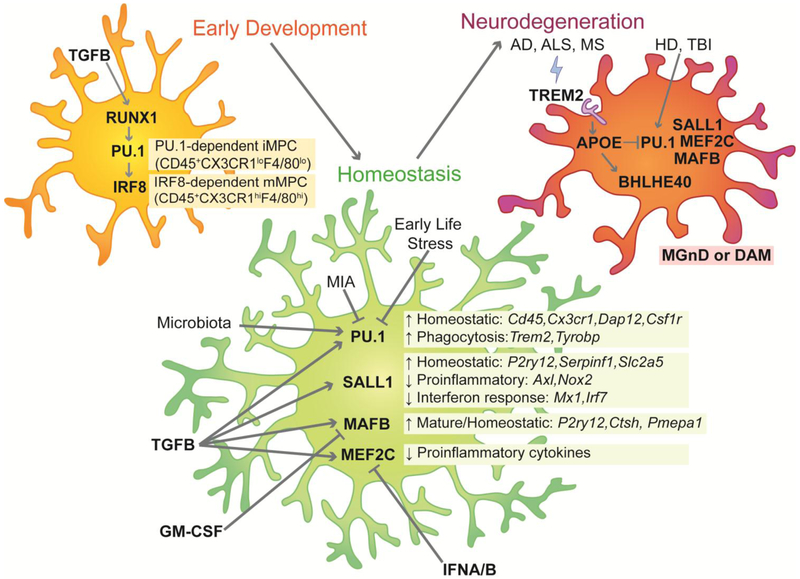
Microglia are the resident immune cells that maintain brain homeostasis and contribute to neurodegenerative disorders. Recent studies of microglia at transcriptomic and epigenetic levels revealed specific molecular pathways that regulate microglia development, maturation, and reactive states. The transcription factor PU.1 plays a key role in regulating several microglial functions. Environmental factors such as microbiota, early life stress, and maternal immune activation can dysregulate PU.1 and innate immune response. This review discusses the epigenetic regulation of key transcriptional factors in human and murine microglia, highlighting their networks for shaping the microglial function. PU.1 and other microglia-specific transcriptional factors can be further studied to determine their therapeutic applications in neurologic disorders.
小胶质细胞是驻留的免疫细胞,它们维持着大脑的内环境稳态,并有助于神经退行性疾病的发生。最近对小胶质细胞在转录组和表观遗传水平的研究揭示了调节小胶质细胞发育、成熟和反应状态的特定分子途径。转录因子 PU.1 在调节几种小胶质细胞功能方面发挥着关键作用。环境因素,如微生物群、生命早期应激和母体免疫激活,可使 PU.1 和先天免疫反应失调。本综述讨论了人类和鼠类小胶质细胞中关键转录因子的表观遗传调控,强调了它们形成小胶质细胞功能的网络。可以进一步研究 PU.1 和其他小胶质细胞特异性转录因子,以确定它们在神经疾病治疗中的应用。