Geriatric Education and Research in Aging Sciences (GERAS), St Peter's Hospital, 88 Maplewood Ave, Hamilton, ON, Canada.
School of Rehabilitation Sciences, IAHS 403, McMaster University, 1400 Main St. W., Hamilton, Ontario, L8S 1C7, Canada.
BMC Geriatr. 2018 Dec 27;18(1):320. doi: 10.1186/s12877-018-1010-1.
Frail older adults living in long term care (LTC) homes have a high fracture risk, which can result in reduced quality of life, pain and death. The Fracture Risk Scale (FRS) was designed for fracture risk assessment in LTC, to optimize targeting of services in those at highest risk. This study aims to examine the construct validity and discriminative properties of the FRS in three Canadian provinces at 1-year follow up.
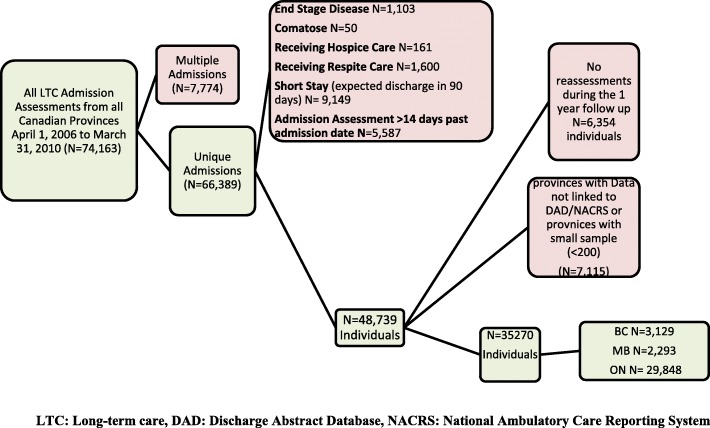
LTC residents were included if they were: 1) Adults admitted to LTC homes in Ontario (ON), British Columbia (BC) and Manitoba (MB) Canada; and 2) Received a Resident Assessment Instrument Minimum Data Set Version 2.0. After admission to LTC, one-year hip fracture risk was evaluated for all the included residents using the FRS (an eight-level risk scale, level 8 represents the highest fracture risk). Multiple logistic regressions were used to determine the differences in incident hip or all clinical fractures across the provinces and FRS risk levels. We examined the differences in incident hip or all clinical fracture for each FRS level across the three provinces (adjusted for age, BMI, gender, fallers and previous fractures). We used the C-statistic to assess the discriminative properties of the FRS for each province.
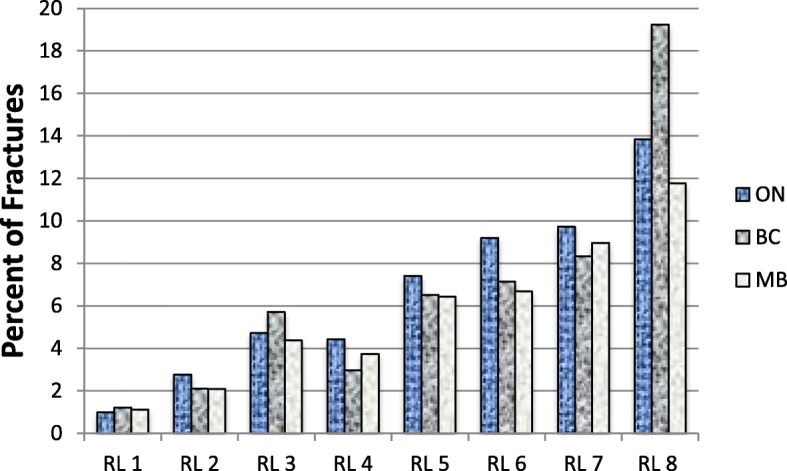
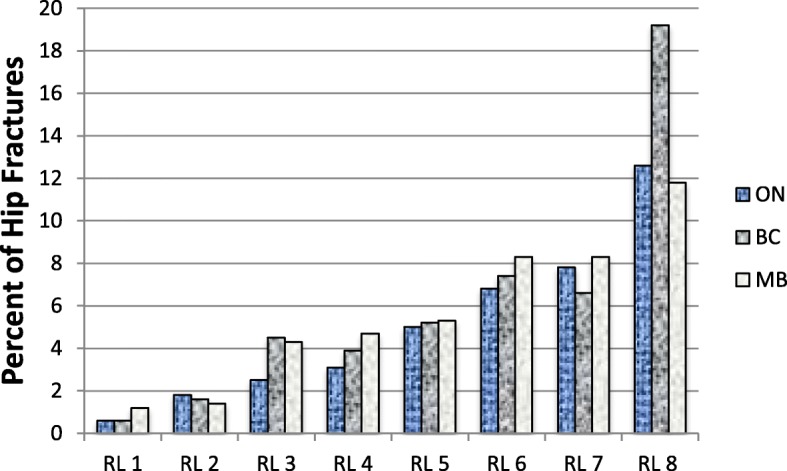
Descriptive statistics on the LTC populations in ON (n = 29,848), BC (n = 3129), and MB (n = 2293) are: mean (SD) age 82 (10), 83 (10), and 84 (9), gender (female %) 66, 64, and 70% respectively. The incident hip fractures and all clinical fractures for FRS risk level were similar among the three provinces and ranged from 0.5 to 19.2% and 1 to 19.2% respectively. The overall discriminative properties of the FRS were similar between ON (C-statistic = 0.673), BC (C-statistic = 0.644) and MB (C-statistic = 0.649) samples.
FRS is a valid tool for identifying LTC residents at different risk levels for hip or all clinical fractures in three provinces. Having a fracture risk assessment tool that is tailored to the LTC context and embedded within the routine clinical assessment may have significant implications for policy, service delivery and care planning, and may improve care for LTC residents across Canada.
长期护理(LTC)机构中身体虚弱的老年人骨折风险较高,这会导致生活质量下降、疼痛和死亡。骨折风险评估量表(FRS)是专为 LTC 机构中的骨折风险评估而设计的,旨在针对风险最高的人群优化服务目标。本研究旨在探讨 FRS 在加拿大三个省份的 1 年随访中在构建有效性和区分性方面的表现。
研究对象为符合以下条件的 LTC 居民:1)入住加拿大安大略省(ON)、不列颠哥伦比亚省(BC)和马尼托巴省(MB)的 LTC 机构的成年人;2)接受居民评估仪器最小数据集 2.0 版。在入住 LTC 机构后,对所有纳入的居民使用 FRS(一个八级风险量表,八级代表最高骨折风险)评估一年的髋部骨折风险。采用多项逻辑回归分析确定各省和 FRS 风险水平之间的髋部或所有临床骨折的发生率差异。我们在调整年龄、BMI、性别、跌倒和既往骨折的情况下,比较了三个省份的每个 FRS 水平之间的髋部或所有临床骨折发生率差异。我们使用 C 统计量评估了每个省份的 FRS 区分性能。
ON(n=29848)、BC(n=3129)和 MB(n=2293)的 LTC 人群的描述性统计数据如下:平均(标准差)年龄分别为 82(10)、83(10)和 84(9),性别(女性%)分别为 66%、64%和 70%。FRS 风险水平的髋部骨折和所有临床骨折发生率在三个省份之间相似,范围分别为 0.5%至 19.2%和 1%至 19.2%。ON(C 统计量=0.673)、BC(C 统计量=0.644)和 MB(C 统计量=0.649)样本的 FRS 的总体区分性能相似。
FRS 是一种有效的工具,可用于识别三个省份中不同髋部或所有临床骨折风险水平的 LTC 居民。拥有针对 LTC 环境量身定制并嵌入常规临床评估中的骨折风险评估工具可能对政策、服务提供和护理计划具有重大意义,并可能改善加拿大各地 LTC 居民的护理。