Department of Chemistry, Graduate School of Science, Tohoku University, 6-3 Aoba, Aramaki, Aoba-ku, Sendai, Miyagi 980-8578, Japan.
Department of Physics, Graduate School of Pure and Applied Sciences, University of Tsukuba, 1-1-1 Tennodai, Tsukuba, Ibaraki 305-8571, Japan.
Molecules. 2018 Dec 26;24(1):76. doi: 10.3390/molecules24010076.
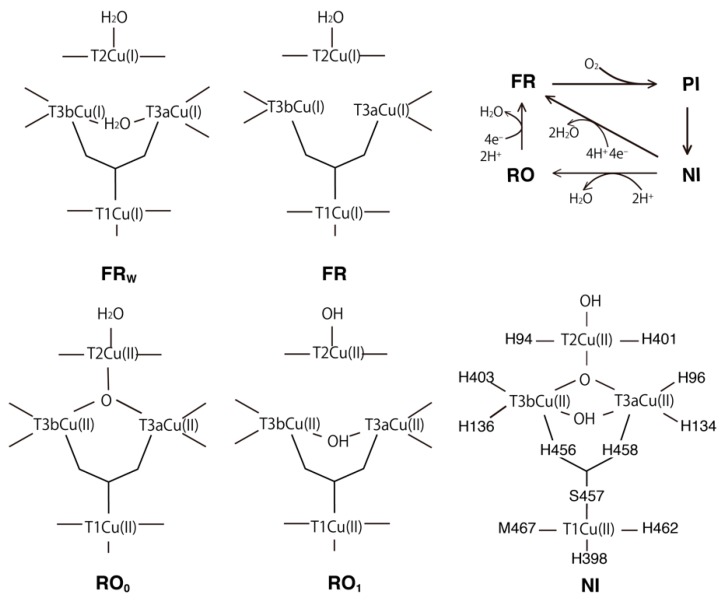
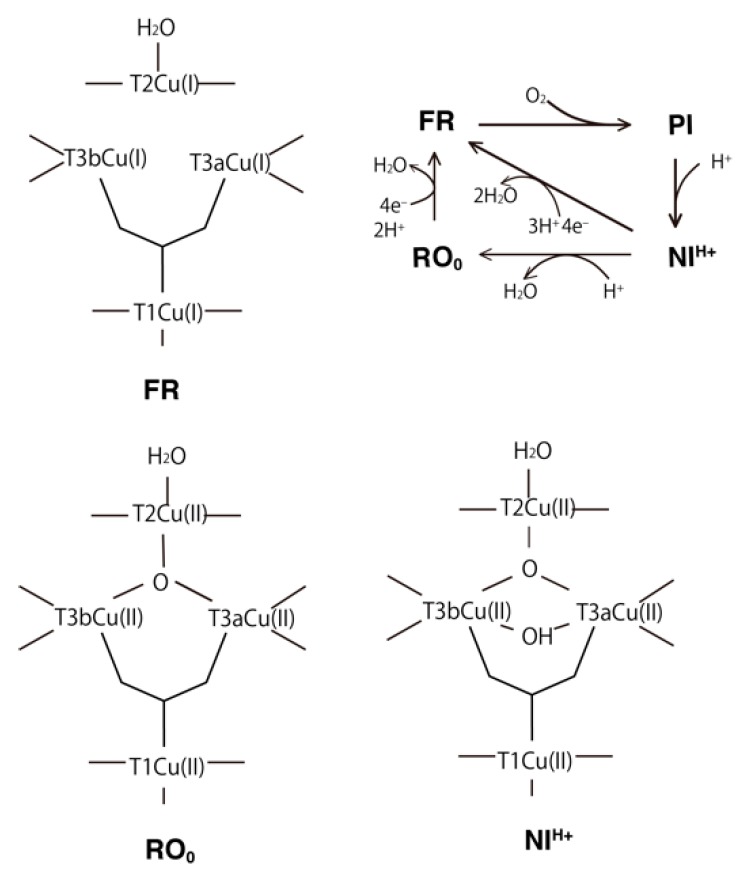
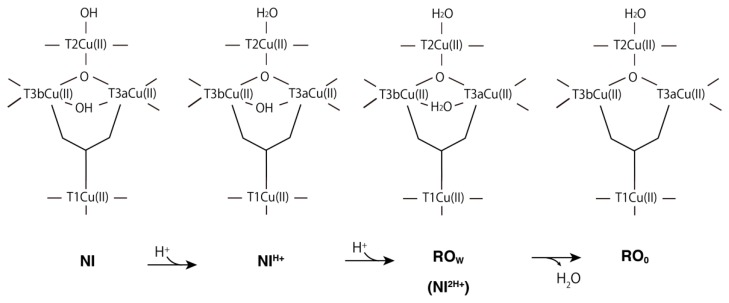
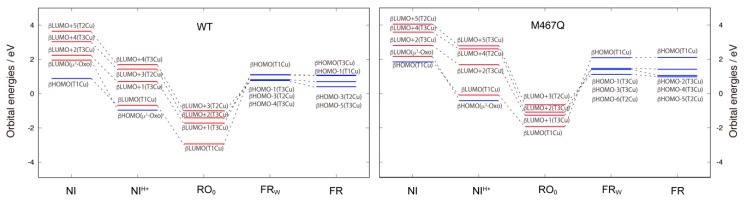
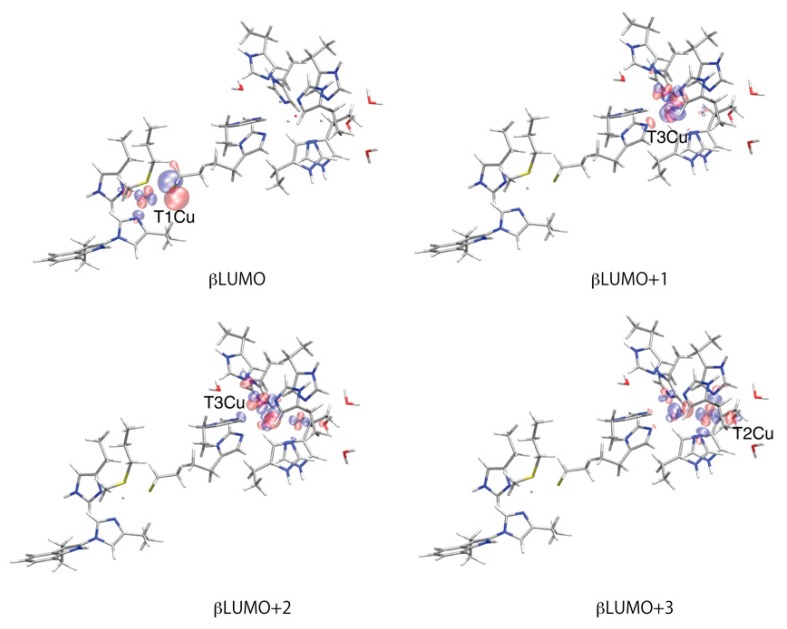
Geometric and electronic structure changes in the copper (Cu) centers in bilirubin oxidase (BOD) upon a four-electron reduction were investigated by quantum mechanics/molecular mechanics (QM/MM) calculations. For the QM region, the unrestricted density functional theory (UDFT) method was adopted for the open-shell system. We found new candidates of the native intermediate (NI, intermediate II) and the resting oxidized (RO) states, i.e., NI and RO₀. Elongations of the Cu-Cu atomic distances for the trinuclear Cu center (TNC) and very small structural changes around the type I Cu (T1Cu) were calculated as the results of a four-electron reduction. The QM/MM optimized structures are in good agreement with recent high-resolution X-ray structures. As the structural change in the TNC upon reduction was revealed to be the change in the size of the triangle spanned by the three Cu atoms of TNC, we introduced a new index () to characterize the specific structural change. Not only the wild-type, but also the M467Q, which mutates the amino acid residue coordinating T1Cu, were precisely analyzed in terms of their molecular orbital levels, and the optimized redox potential of T1Cu was theoretically reconfirmed.
采用量子力学/分子力学(QM/MM)计算方法研究了胆红素氧化酶(BOD)中铜(Cu)中心在四电子还原过程中的几何和电子结构变化。对于QM 区域,采用非限制密度泛函理论(UDFT)方法处理开壳体系。我们发现了天然中间物(NI,中间物 II)和休息氧化态(RO)的新候选物,即 NI 和 RO₀。三核 Cu 中心(TNC)的 Cu-Cu 原子距离的伸长和 T1Cu 周围非常小的结构变化被计算为四电子还原的结果。QM/MM 优化结构与最近的高分辨率 X 射线结构吻合良好。由于还原过程中 TNC 的结构变化被揭示为 TNC 中三个 Cu 原子所构成的三角形大小的变化,因此我们引入了一个新的指标()来描述特定的结构变化。不仅对野生型,而且对突变了配位 T1Cu 的氨基酸残基的 M467Q 进行了精确的分子轨道能级分析,并从理论上重新确认了 T1Cu 的优化氧化还原电位。