Wiromrat Pattara, Panamonta Ouyporn
Khon Kaen University Faculty of Medicine, Department of Pediatrics, Division of Endocrinology, Khon Kaen, Thailand
J Clin Res Pediatr Endocrinol. 2019 Sep 3;11(3):227-233. doi: 10.4274/jcrpe.galenos.2018.2018.0213. Epub 2018 Dec 28.
Longitudinal data regarding random luteinizing hormone (LH) concentrations in patients with idiopathic central precocious puberty (ICPP) during treatment are limited. Therefore, we sought to evaluate random LH and estradiol concentrations during monthly leuprolide injection and their associations with pubertal progression and final adult height (FAH) in girls with ICPP.
Medical records of 27 girls with ICPP who had attained FAH were reviewed. Patients’ height, weight, Tanner stage, growth rate (GR), bone age, random LH measured by both immunoradiometric and immunochemiluminescent methods, follicular-stimulating hormone (FSH) and estradiol levels were monitored until FAH.
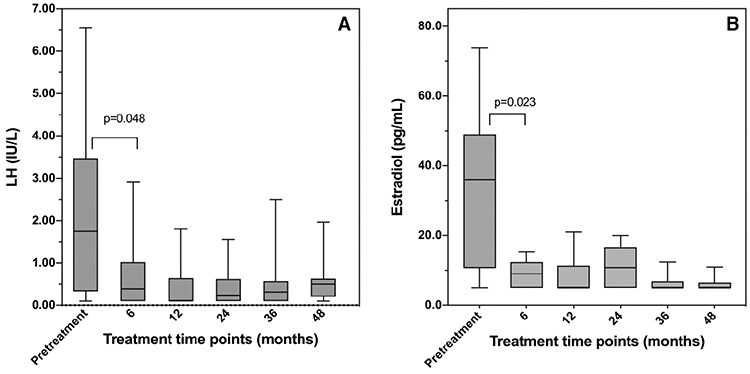
Treatment was started at a mean (±standard deviation) age of 8.1±0.6 years with mean duration of 3.9±0.2 years. At six months of follow-up, random LH (p=0.048), FSH (p<0.001) and estradiol (p=0.023) concentrations were decreased compared with baseline. Thereafter, random LHs were well suppressed. GRs gradually decreased to prepubertal norm by month 12. Seventeen patients (63%) exhibited pubertal LH concentrations at least once during treatment visits. Furthermore, 43 of a total 116 (37%) LH measurements were found elevated. However, those patients with elevated random LH did not show signs of pubertal progression. After treatment, mean FAH was greater than predicted adult height (p<0.0001) and target height (p=0.03). At no time points of treatment did random LH, FSH and estradiol correlate with GRs or FAH.
Elevated random LH is commonly found in ICPP girls during monthly leuprolide treatment. However, these elevations were not associated with clinical progression of puberty or decreased FAH, suggesting that it is not a reliable method for CPP monitoring.
关于特发性中枢性性早熟(ICPP)患者治疗期间随机促黄体生成素(LH)浓度的纵向数据有限。因此,我们试图评估ICPP女孩在每月注射亮丙瑞林期间的随机LH和雌二醇浓度,以及它们与青春期进展和最终成年身高(FAH)的关系。
回顾了27例已达到FAH的ICPP女孩的病历。监测患者的身高、体重、 Tanner分期、生长速率(GR)、骨龄、通过免疫放射测定法和免疫化学发光法测量的随机LH、促卵泡生成素(FSH)和雌二醇水平,直至达到FAH。
治疗开始时的平均(±标准差)年龄为8.1±0.6岁,平均持续时间为3.9±0.2年。随访6个月时,随机LH(p = 0.048)、FSH(p<0.001)和雌二醇(p = 0.023)浓度与基线相比有所下降。此后,随机LH得到良好抑制。到第12个月时,GR逐渐降至青春期前正常水平。17例患者(63%)在治疗期间至少有一次出现青春期LH浓度。此外,在总共116次LH测量中有43次(37%)升高。然而,那些随机LH升高的患者并未表现出青春期进展的迹象。治疗后,平均FAH高于预测成年身高(p<0.0001)和靶身高(p = 0.03)。在治疗的任何时间点,随机LH、FSH和雌二醇均与GR或FAH无相关性。
在ICPP女孩每月接受亮丙瑞林治疗期间,常见随机LH升高。然而,这些升高与青春期的临床进展或FAH降低无关,这表明它不是监测CPP的可靠方法。