Biomedical Engineering Department, Faculty of Engineering, Minia University, Minia, Egypt.
Biomedical Engineering Department, Faculty of Engineering, Misr University for Science and Technology (MUST), 6th of October City, Egypt.
PLoS One. 2018 Dec 31;13(12):e0209603. doi: 10.1371/journal.pone.0209603. eCollection 2018.
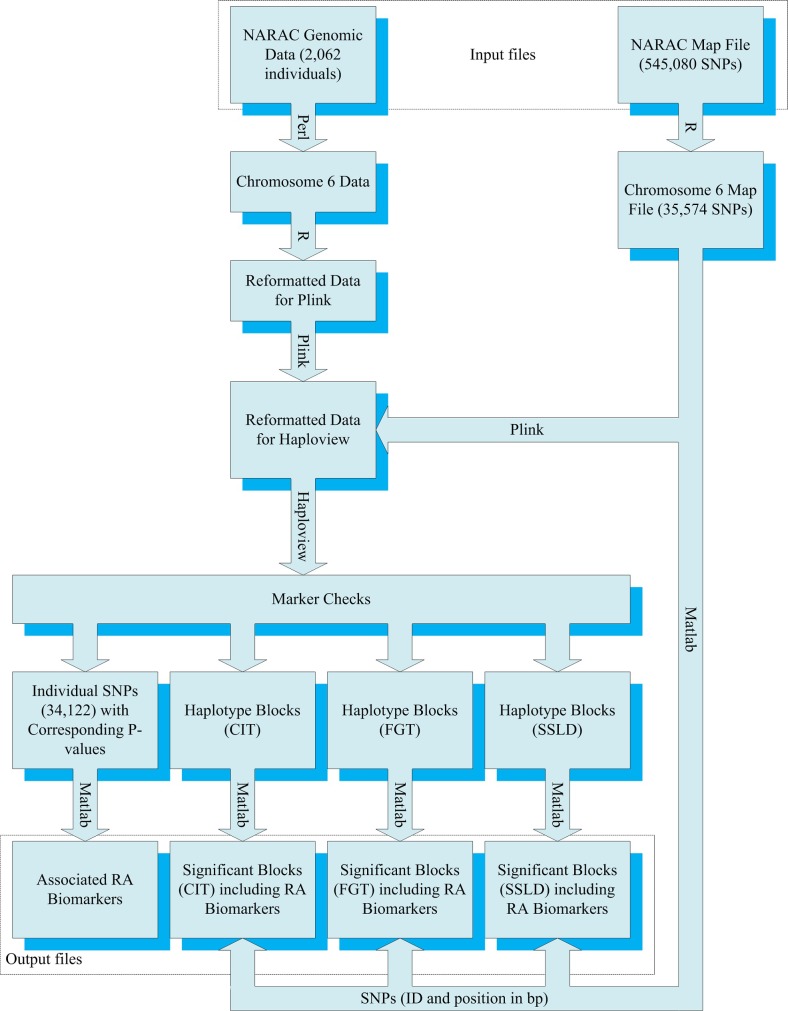
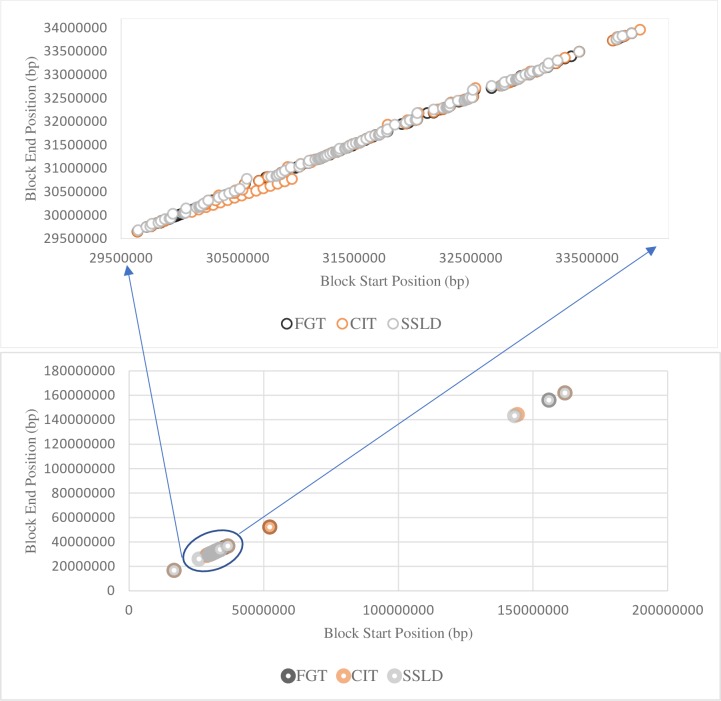
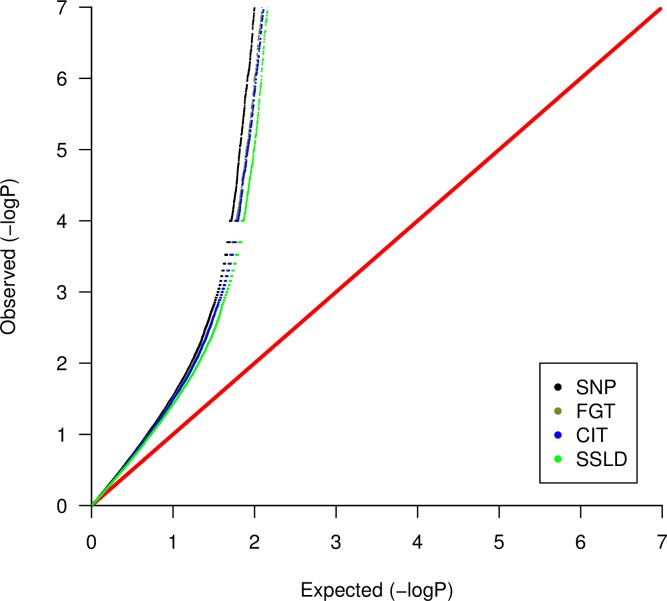
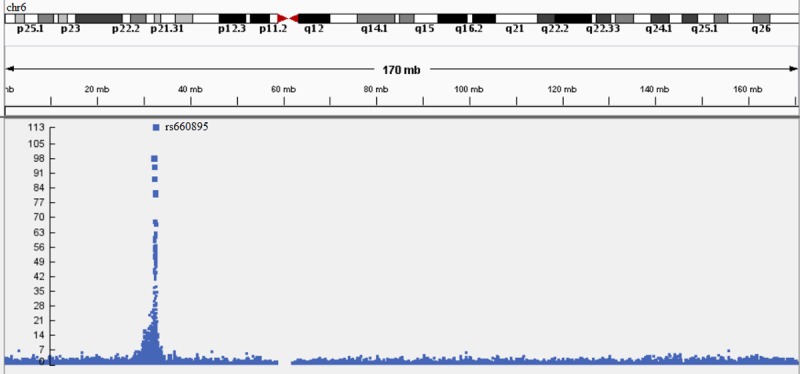
Haplotype-based methods compete with "one-SNP-at-a-time" approaches on being preferred for association studies. Chromosome 6 contains most of the known genetic biomarkers for rheumatoid arthritis (RA) disease. Therefore, chromosome 6 serves as a benchmark for the haplotype methods testing. The aim of this study is to test the North American Rheumatoid Arthritis Consortium (NARAC) dataset to find out if haplotype block methods or single-locus approaches alone can sufficiently provide the significant single nucleotide polymorphisms (SNPs) associated with RA. In addition, could we be satisfied with only one method of the haplotype block methods for partitioning chromosome 6 of the NARAC dataset? In the NARAC dataset, chromosome 6 comprises 35,574 SNPs for 2,062 individuals (868 cases, 1,194 controls). Individual SNP approach and three haplotype block methods were applied to the NARAC dataset to identify the RA biomarkers. We employed three haplotype partitioning methods which are confidence interval test (CIT), four gamete test (FGT), and solid spine of linkage disequilibrium (SSLD). P-values after stringent Bonferroni correction for multiple testing were measured to assess the strength of association between the genetic variants and RA susceptibility. Moreover, the block size (in base pairs (bp) and number of SNPs included), number of blocks, percentage of uncovered SNPs by the block method, percentage of significant blocks from the total number of blocks, number of significant haplotypes and SNPs were used to compare among the three haplotype block methods. Individual SNP, CIT, FGT, and SSLD methods detected 432, 1,086, 1,099, and 1,322 associated SNPs, respectively. Each method identified significant SNPs that were not detected by any other method (Individual SNP: 12, FGT: 37, CIT: 55, and SSLD: 189 SNPs). 916 SNPs were discovered by all the three haplotype block methods. 367 SNPs were discovered by the haplotype block methods and the individual SNP approach. The P-values of these 367 SNPs were lower than those of the SNPs uniquely detected by only one method. The 367 SNPs detected by all the methods represent promising candidates for RA susceptibility. They should be further investigated for the European population. A hybrid technique including the four methods should be applied to detect the significant SNPs associated with RA for chromosome 6 of the NARAC dataset. Moreover, SSLD method may be preferred for its favored benefits in case of selecting only one method.
基于单体型的方法在关联研究中优于"逐个单核苷酸多态性(SNP)"的方法。6 号染色体包含大多数已知的类风湿关节炎(RA)疾病的遗传生物标志物。因此,6 号染色体是单体型方法测试的基准。本研究的目的是检测北美类风湿关节炎联合会(NARAC)数据集,以确定单体型块方法或单一基因座方法是否足以提供与 RA 相关的显著单核苷酸多态性(SNP)。此外,我们是否可以仅使用单体型块方法之一来划分 NARAC 数据集的 6 号染色体?在 NARAC 数据集中,2062 个人(868 例病例,1194 例对照)包含 35574 个 SNP。个体 SNP 方法和三种单体型块方法被应用于 NARAC 数据集以鉴定 RA 生物标志物。我们采用了三种单体型划分方法,即置信区间检验(CIT)、四配子检验(FGT)和连锁不平衡的固脊柱(SSLD)。通过严格的 Bonferroni 校正多重检验的 P 值来评估遗传变异与 RA 易感性之间的关联强度。此外,还比较了三种单体型块方法的块大小(碱基对(bp)和包含的 SNP 数量)、块数、块方法覆盖的 SNP 百分比、总块数中显著块的百分比、显著单体型和 SNP 的数量。个体 SNP、CIT、FGT 和 SSLD 方法分别检测到 432、1086、1099 和 1322 个相关 SNP。每种方法都检测到了其他方法未检测到的显著 SNP(个体 SNP:12、FGT:37、CIT:55 和 SSLD:189 SNP)。916 个 SNP 被三种单体型块方法都检测到。367 个 SNP 被单体型块方法和个体 SNP 方法检测到。这些 367 个 SNP 的 P 值低于仅用一种方法检测到的 SNP 的 P 值。这 367 个 SNP 被所有方法检测到,是 RA 易感性的有希望的候选者。它们应该在欧洲人群中进一步研究。应该应用包括四种方法的混合技术来检测与 NARAC 数据集 6 号染色体 RA 相关的显著 SNP。此外,在选择一种方法的情况下,SSLD 方法可能是首选,因为它具有有利的优势。