Department of General Practice and Primary Health Care, School of Population Health, University of Auckland, Auckland, New Zealand.
School of Population Health, University of Auckland, Auckland, New Zealand.
Aging Clin Exp Res. 2019 Oct;31(10):1407-1417. doi: 10.1007/s40520-018-1106-7. Epub 2019 Jan 2.
Frailty is a multidimensional geriatric syndrome associated with functional loss. The Senior Chef (SC, nutrition) and SAYGO (strength and balance exercise) programmes are well accepted among older adults but the impact of each, or a combination of both, on the frailty syndrome in pre-frail older adults is unknown.
To determine the effectiveness and cost-effectiveness of a complex intervention consisting of the SC and/or SAYGO programmes to prevent progression of frailty in pre-frail older adults.
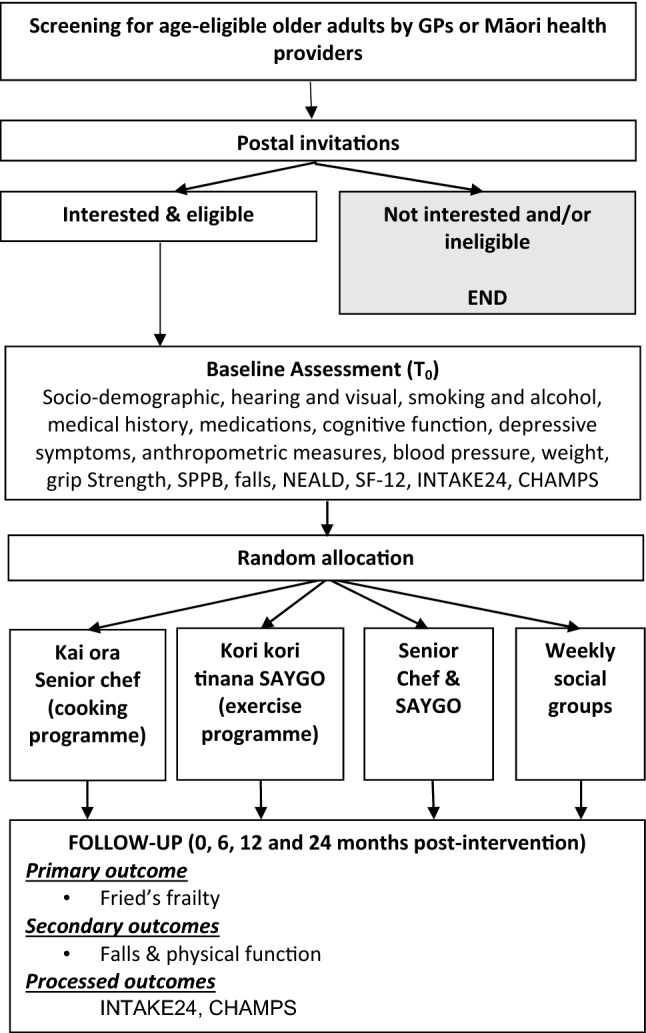
A multi-centre randomised controlled assessor-blinded study. The four intervention groups are SC, an 8-week nutrition education and cooking class; SAYGO, a 10-week strength and balance exercise class; SC plus SAYGO, and a social group (Control). Community-dwelling adults aged 75+ (60 + Māori and Pasifika) in New Zealand are recruited through health providers. Participants are not terminally ill or with advanced dementia, and have a score of 1 or 2 on the FRAIL questionnaire. Baseline assessments are completed using standardised questionnaires prior to randomisation. Four follow-up assessments are completed: immediately after intervention, 6, 12 and 24 months post-intervention. The primary outcome is frailty score, secondary outcomes are falls, physical function, quality of life, food intake, physical activity, and sustainability of the strategy. Study outcomes will be analysed using intention-to-treat approach. Cost analyses will be completed to determine if interventions are cost effective relative to the control group.
This trial is designed to be a real world rigorous assessment of whether the two intervention strategies can prevent progression of frailty in older people. If successful, this will generate valuable information about effectiveness of this nutrition and exercise strategy, and provide insights for their implementation.
Australian and New Zealand Clinical Trials Registry number-ACTRN12614000827639.
衰弱是一种与功能丧失相关的多维老年综合病症。高级厨师(SC,营养)和 SAYGO(力量和平衡运动)计划在老年人中广受欢迎,但尚不清楚每个计划或两者的结合对衰弱前期老年人衰弱综合征的影响。
确定由 SC 和/或 SAYGO 计划组成的复杂干预措施预防衰弱前期老年人衰弱进展的效果和成本效益。
一项多中心随机对照评估者盲法研究。四个干预组分别是:SC,即为期 8 周的营养教育和烹饪课程;SAYGO,即为期 10 周的力量和平衡运动课程;SC 加 SAYGO,以及一个社交小组(对照组)。新西兰的社区居住成年人(年龄 75 岁以上,包括 60 岁以上的毛利人和太平洋岛民)通过健康提供者招募。参与者无绝症或晚期痴呆症,且 FRAIL 问卷得分为 1 或 2。在随机分组前,使用标准化问卷进行基线评估。共进行 4 次随访评估:干预后立即、6、12 和 24 个月后。主要结局是衰弱评分,次要结局是跌倒、身体功能、生活质量、食物摄入、身体活动以及策略的可持续性。将使用意向治疗方法分析研究结果。将进行成本分析以确定干预措施相对于对照组是否具有成本效益。
该试验旨在真实评估两种干预策略是否可以预防老年人衰弱的进展。如果成功,这将为该营养和运动策略的有效性提供有价值的信息,并为其实施提供见解。
澳大利亚和新西兰临床试验注册编号-ACTRN12614000827639。