Byun Kyung Do, Hwang Hyo Jun, Park Ki Jae, Kim Min Chan, Cho Se Heon, Ju Mi Ha, Lee Jin Hwa, Jeong Jin Sook
Department of Surgery, Dong-A University College of Medicine, Busan, Korea.
Breast Medical Center, Dong-A University College of Medicine, Busan, Korea.
J Breast Cancer. 2018 Dec;21(4):406-414. doi: 10.4048/jbc.2018.21.e61. Epub 2018 Dec 26.
T-cell immunoglobulin and mucin domain-containing molecule 3 (TIM-3) is an emerging immune response molecule related to T-cell anergy. There has been tremendous interest in breast cancer targeting immune checkpoint molecules, especially in the triple-negative breast cancer (TNBC). This study was designed to investigate TIM-3 expression on tumor infiltrating lymphocytes (TILs), its relationships with clinicopathological para-meters and expression of programmed death receptor 1 (PD-1)/programmed death receptor ligand 1 (PD-L1), and its prognostic role.
Immunohistochemistry on tissue microarray blocks produced from 109 samples of invasive ductal carcinoma type TNBC was performed with antibodies toward TIM-3, PD-1, PD-L1 and breast cancer-related molecular markers. Associations between their expression and clinicopathological parameters as well as survival analyses were performed.
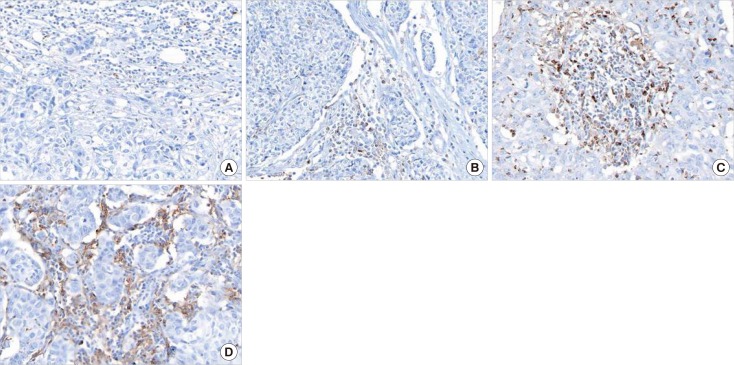
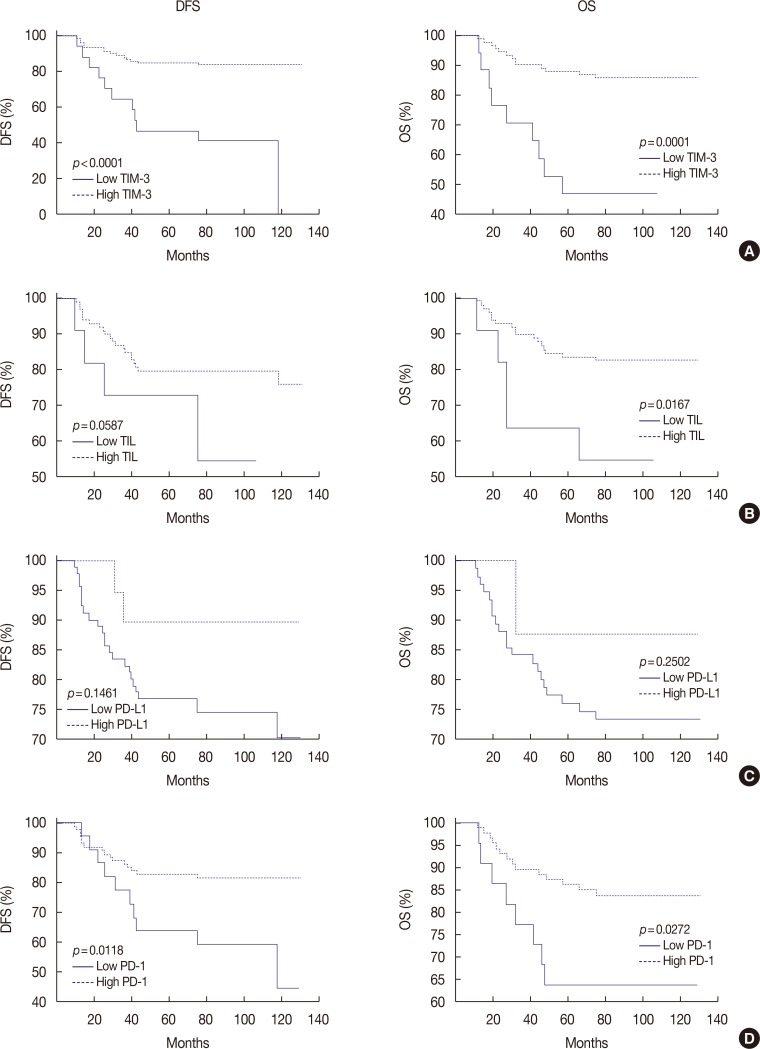
TIM-3 was expressed in TILs from all 109 TNBCs, consisting of 17 cases (<5%), 31 cases (6%-25%), 48 cases (26%-50%), and 13 cases (>51%). High TIM-3 was significantly correlated with younger patients (=0.0101), high TILs (=0.0029), high tumor stage (=0.0018), high PD-1 (=0.0001) and high PD-L1 (=0.0019), and tended to be associated with higher histologic grade, absence of extensive components and microcalcification. High TIM-3 expression was significantly associated with a combinational immunophenotype group of high PD-L1 and high PD-1 (<0.0001). High TIM-3 demonstrated a significantly better disease-free survival (DFS) (<0.0001) and longer overall survival (OS) (=0.0001), together with high TILs and high PD-1. In univariate survival analysis, high TIM-3 showed reduced relapse risk (<0.0001) and longer OS (=0.0003), together with high PD-1 expression. In multivariate analysis, high TIM-3 was statistically significant in predicting prognosis, showing better DFS (hazard ratio [HR], 0.0994; 95% confidence interval [CI], 0.0296-0.3337; =0.0002) and longer OS (HR, 0.1109; 95% CI, 0.0314-0.3912; =0.0006).
In this study, we demonstrate that TIM-3 expression is an independent positive prognostic factor in TNBC, despite its association with poor clinical and pathologic features.
含T细胞免疫球蛋白和粘蛋白结构域分子3(TIM-3)是一种新出现的与T细胞无能相关的免疫反应分子。针对免疫检查点分子的乳腺癌研究一直备受关注,尤其是三阴性乳腺癌(TNBC)。本研究旨在调查TIM-3在肿瘤浸润淋巴细胞(TILs)上的表达、其与临床病理参数及程序性死亡受体1(PD-1)/程序性死亡受体配体1(PD-L1)表达的关系及其预后作用。
对109例浸润性导管癌TNBC样本制作的组织芯片进行免疫组化,使用针对TIM-3、PD-1、PD-L1及乳腺癌相关分子标志物的抗体。分析它们的表达与临床病理参数之间的关联并进行生存分析。
TIM-3在所有109例TNBC的TILs中均有表达,其中表达水平<5%的有17例,6%-25%的有31例,26%-50%的有48例,>51%的有13例。高TIM-3表达与年轻患者显著相关(P = 0.0101)、高TILs(P = 0.0029)、高肿瘤分期(P = 0.0018)、高PD-1(P = 0.0001)及高PD-L1(P = 0.0019)相关,且倾向于与更高的组织学分级、无广泛成分及无微钙化相关。高TIM-3表达与高PD-L1和高PD-1的联合免疫表型组显著相关(P<0.0001)。高TIM-3与高TILs和高PD-1一起,显示出显著更好的无病生存期(DFS)(P<0.0001)和更长的总生存期(OS)(P = 0.0001)。在单因素生存分析中,高TIM-3与高PD-1表达一起,显示出复发风险降低(P<0.0001)和更长的OS(P = 0.0003)。在多因素分析中,高TIM-3在预测预后方面具有统计学意义,显示出更好的DFS(风险比[HR],0.0994;95%置信区间[CI],0.0296 - 0.3337;P = 0.0002)和更长的OS(HR,0.1109;95%CI,0.0314 - 0.3912;P = 0.0006)。
在本研究中,我们证明TIM-3表达是TNBC的一个独立的阳性预后因素,尽管它与不良的临床和病理特征相关。