1 Department of Critical Care Nursing Kyoto University Graduate School of Human Health Science Kyoto Japan.
2 Division of Environmental Medicine and Population Sciences Department of Social and Environmental Medicine Graduate School of Medicine Osaka University Suita Japan.
J Am Heart Assoc. 2019 Jan 8;8(1):e009436. doi: 10.1161/JAHA.118.009436.
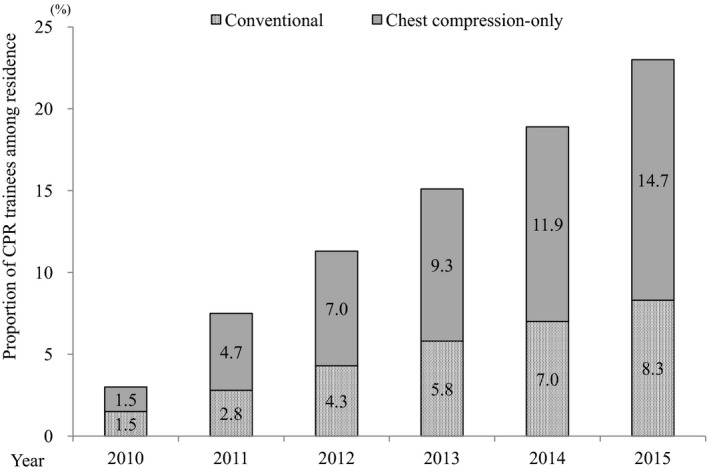
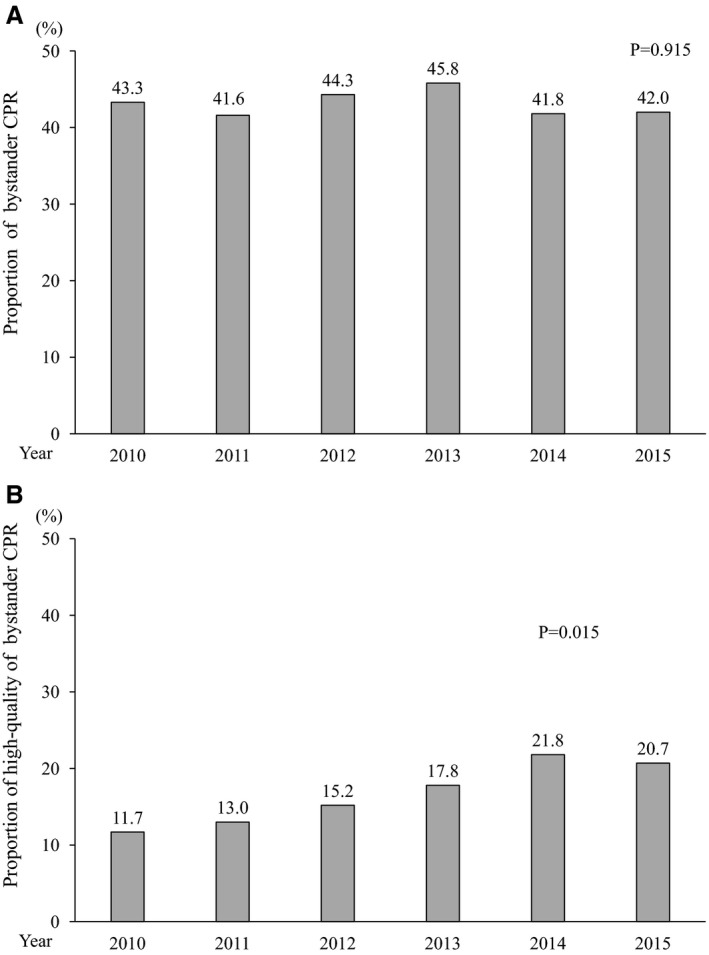
Background Little is known about whether cardiopulmonary resuscitation ( CPR ) training can increase bystander CPR in the community or the appropriate target number of CPR trainings. Herein, we aimed to demonstrate community-wide aggressive dissemination of CPR training and evaluate temporal trends in bystander CPR . Methods and Results We provided CPR training (45-minute chest compression-only CPR plus automated external defibrillator use training or the conventional CPR training), targeting 16% of residents. All emergency medical service-treated out-of-hospital cardiac arrests of medical origin were included. Data on patients experiencing out-of-hospital cardiac arrest and bystander CPR quality were prospectively collected from September 2010 to December 2015. The primary outcome was the proportion of high-quality bystander CPR . During the study period, 57 173 residents (14.7%) completed the chest compression-only CPR training and 32 423 (8.3%) completed conventional CPR training. The proportion of bystander CPR performed did not change (from 43.3% in 2010 to 42.0% in 2015; P for trend=0.915), but the proportion of high-quality bystander CPR delivery increased from 11.7% in 2010 to 20.7% in 2015 ( P for trend=0.015). The 1-year increment was associated with high-quality bystander CPR (adjusted odds ratio, 1.461; 95% CI, 1.055-2.024). Bystanders who previously experienced CPR training were 3.432 times (95% CI, 1.170-10.071) more likely to perform high-quality CPR than those who did not. Conclusions We trained 23.0% of the residents in the medium-sized city of Osaka, Japan, and demonstrated that the proportion of high-quality CPR performed on the scene increased gradually, whereas that of bystander CPR delivered overall remained stable.
关于心肺复苏(CPR)培训是否可以增加社区中的旁观者 CPR 或适当的 CPR 培训目标数量,目前知之甚少。在此,我们旨在展示社区范围内积极推广 CPR 培训,并评估旁观者 CPR 的时间趋势。
我们提供了 CPR 培训(45 分钟的仅胸部按压 CPR 加自动体外除颤器使用培训或常规 CPR 培训),目标是针对 16%的居民。所有由紧急医疗服务治疗的医学起源的院外心脏骤停均包括在内。从 2010 年 9 月至 2015 年 12 月,前瞻性收集了院外心脏骤停患者和旁观者 CPR 质量的数据。主要结局是高质量旁观者 CPR 的比例。在研究期间,有 57173 名居民(14.7%)完成了仅胸部按压 CPR 培训,有 32423 名居民(8.3%)完成了常规 CPR 培训。旁观者进行 CPR 的比例没有变化(从 2010 年的 43.3%到 2015 年的 42.0%;趋势 P 值=0.915),但高质量旁观者 CPR 实施的比例从 2010 年的 11.7%增加到 2015 年的 20.7%(趋势 P 值=0.015)。1 年的增长与高质量的旁观者 CPR 相关(调整后的优势比,1.461;95%CI,1.055-2.024)。以前接受过 CPR 培训的旁观者进行高质量 CPR 的可能性是未接受过培训的旁观者的 3.432 倍(95%CI,1.170-10.071)。
我们在日本大阪的中等城市培训了 23.0%的居民,并证明现场实施高质量 CPR 的比例逐渐增加,而旁观者 CPR 的实施比例总体保持稳定。