Institut für Organische Chemie and Center for Molecular Biosciences Innsbruck (CMBI) , Universität Innsbruck , Innrain 80-82 , 6020 Innsbruck , Austria.
Anal Chem. 2019 Jan 15;91(2):1659-1664. doi: 10.1021/acs.analchem.8b05387. Epub 2019 Jan 7.
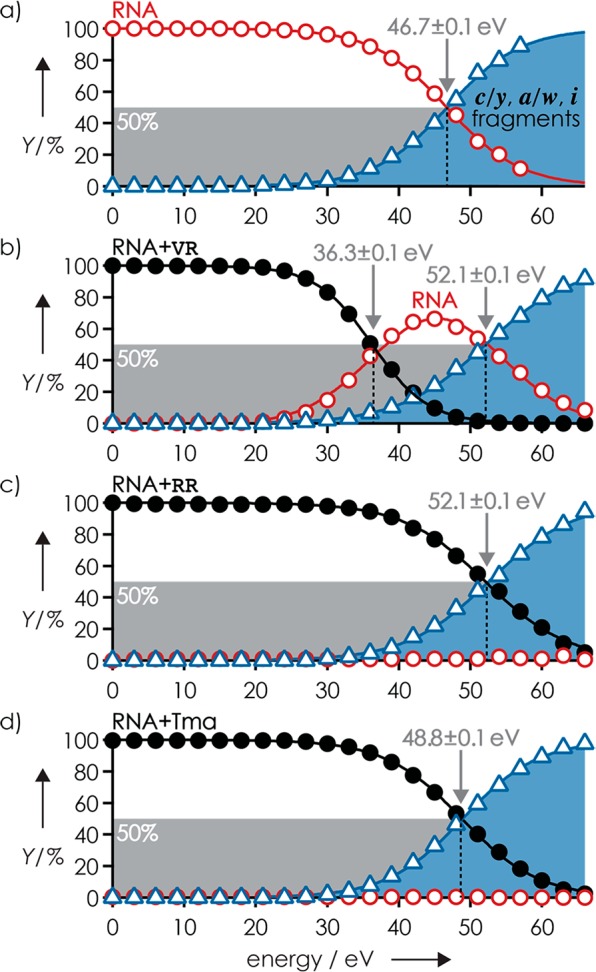
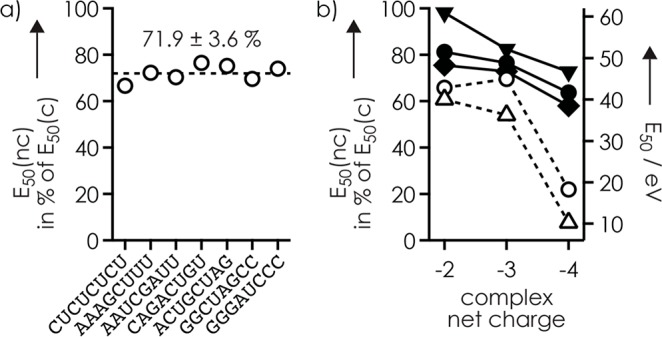
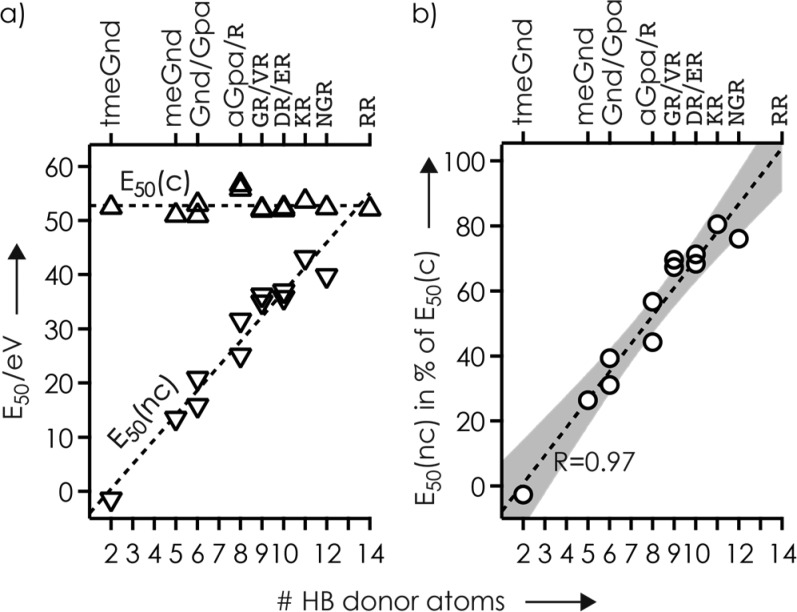
Interactions of ribonucleic acids (RNA) with basic ligands such as proteins or aminoglycosides play a key role in fundamental biological processes. Native top-down mass spectrometry (MS) has recently been extended to binding site mapping of RNA-ligand interactions by collisionally activated dissociation, without the need for laborious sample preparation procedures. The technique relies on the preservation of noncovalent interactions at energies that are sufficiently high to cause RNA backbone cleavage. In this study, we address the question of how many and what types of noncovalent interactions allow for binding site mapping by top-down MS. We show that proton transfer from protonated ligand to deprotonated RNA within salt bridges initiates loss of the ligand, but that proton transfer becomes energetically unfavorable in the presence of additional hydrogen bonds such that the noncovalent interactions remain stronger than the covalent RNA backbone bonds.
核糖核酸(RNA)与碱性配体(如蛋白质或氨基糖苷类抗生素)的相互作用在基本的生物过程中起着关键作用。 最近,通过碰撞激活解离,将原生自上而下的质谱(MS)技术扩展到 RNA-配体相互作用的结合位点映射,而无需繁琐的样品制备程序。 该技术依赖于在足以引起 RNA 骨架断裂的能量下保持非共价相互作用。 在这项研究中,我们探讨了多少种和哪种类型的非共价相互作用允许通过自上而下的 MS 进行结合位点映射。 我们表明,在盐桥中从质子化配体到去质子化 RNA 的质子转移会引发配体的丢失,但是在存在额外氢键的情况下,质子转移变得在能量上不利,使得非共价相互作用仍然比共价 RNA 骨架键更强。