Department of Public Health, College of Health Sciences, Debre Markos University, Debre Markos, Ethiopia.
Department of Preventive Medicine, School of Public Health, College of Health Sciences, Addis Ababa University, Addis Ababa, Ethiopia.
PLoS One. 2019 Jan 7;14(1):e0209903. doi: 10.1371/journal.pone.0209903. eCollection 2019.
HIV-infected adults receiving anti-retroviral therapy have a high prevalence of food insecurity in both high- and low-income settings., Women bear an inequitable burden of food insecurity due to lack of control over resources and over household food allocation decision-making. The few studies conducted on the association between food insecurity and gender among HIV-infected adults have inconclusive findings. Therefore, the objective of this systematic review and meta-analysis was to estimate the pooled effect of gender on food insecurity among HIV-infected adults receiving antiretroviral therapy.
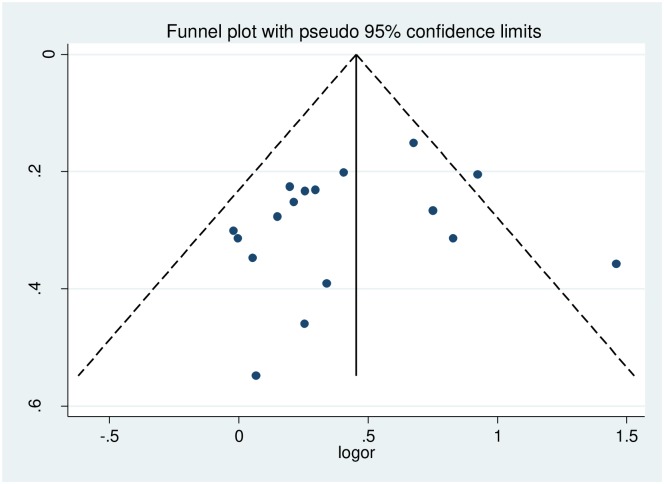
We conducted an electronic, web-based search using PubMed, CINAHL, PopLine, MedNar, Embase, Cochrane library, the JBI Library, the Web of Science and Google Scholar. We included studies which reported the association between food insecurity and gender among HIV-infected adults receiving antiretroviral therapy whose age was greater than 18 years. The analysis was conducted using STATA 14 software. A random effects model was used to estimate the pooled effect a 95% confidence interval(CI). Forest plots were used to visualize the presence of heterogeneity. Funnel plots and Egger's and Begg's tests were used to check for publication bias.
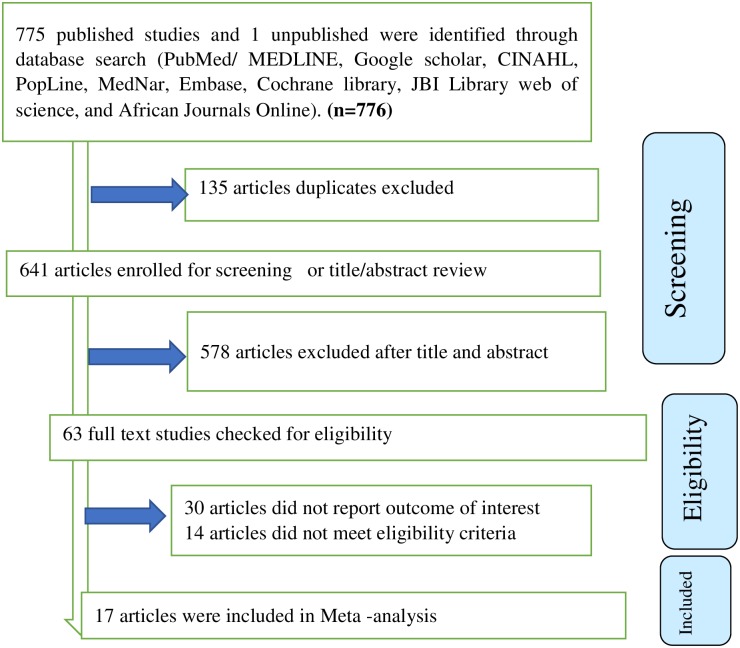
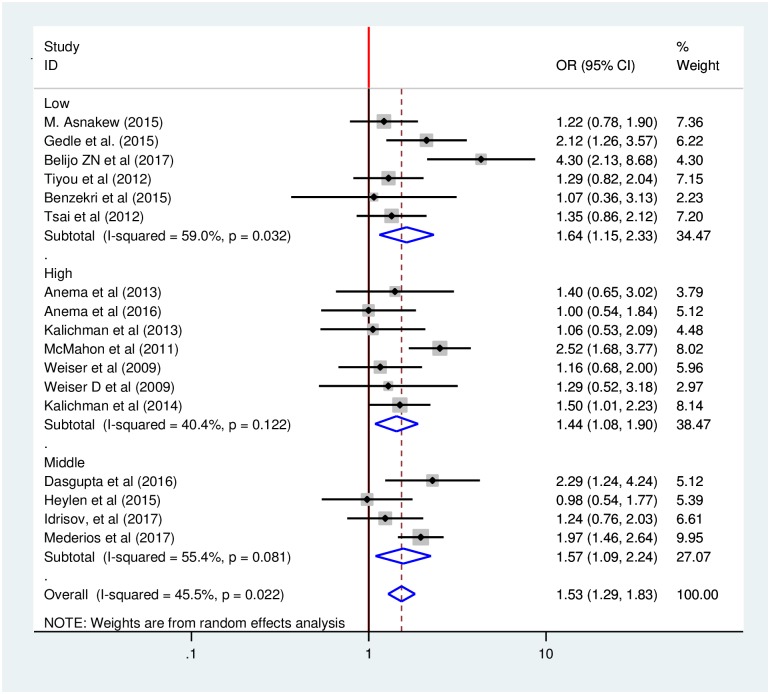
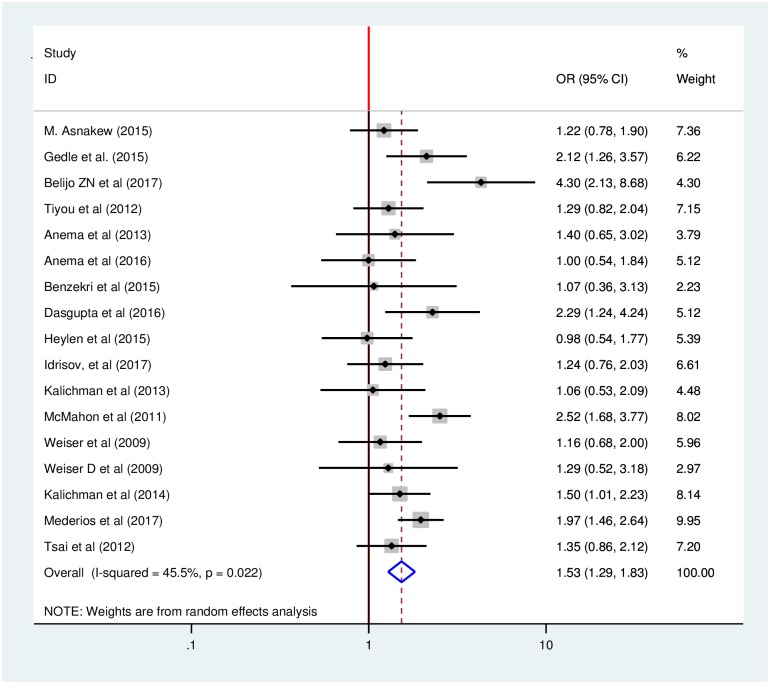
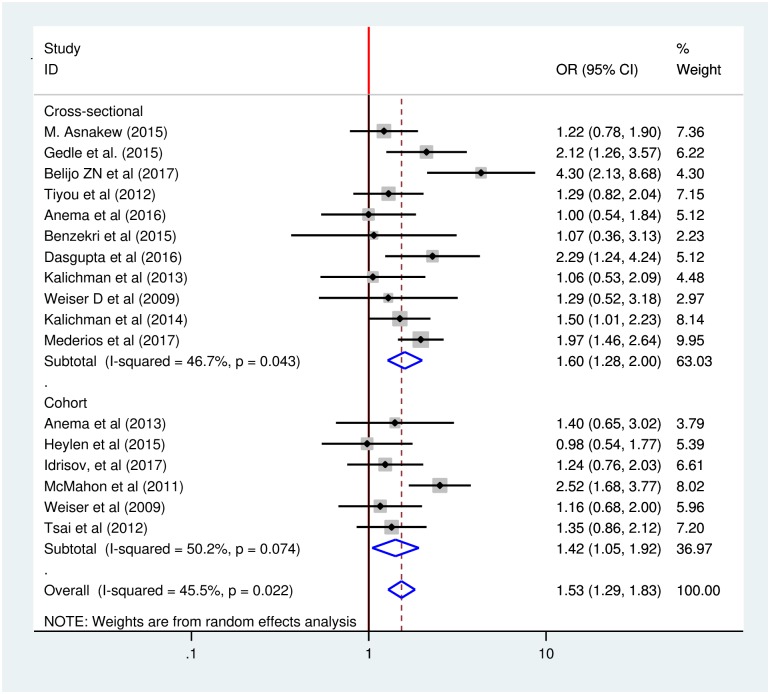
A total of 776 studies were identified of which seventeen studies were included in the meta-analysis, with a total of 5827 HIV infected adults receiving antiretroviral therapy. We found that the gender of HIV-infected adults receiving anti-retroviral therapy had statistically significant effects on food insecurity. The pooled odds of developing food insecurity among female HIV infected adults receiving anti-retroviral therapy was 53% higher than male HIV infected adults (OR: 1.53, 95% CI: 1.29, 1.83). Our analysis indicate the findings of studies conducted in the high-income countries showed weakest associations between gender and food insecurity than those conducted in low- and middle-income countries.
Our systematic review and meta-analysis showed statistically significant effect of gender on food insecurity among HIV-infected adults receiving anti-retroviral therapy in which odds of food insecurity was higher among female HIV infected adults compared to male HIV-infected adults. These findings suggest that the need to include within food and nutrition interventions for HIV-infected adults receiving antiretroviral treatment, culture- and context-specific gender-based policies to address the sex/gender related vulnerability to food insecurity.
在高收入和低收入环境中,接受抗逆转录病毒治疗的艾滋病毒感染者普遍存在粮食不安全问题。由于缺乏对资源的控制和对家庭粮食分配决策的控制,妇女承受着粮食不安全的不平等负担。少数针对艾滋病毒感染者中粮食不安全与性别之间关系的研究得出的结论尚无定论。因此,本系统评价和荟萃分析的目的是估计接受抗逆转录病毒治疗的艾滋病毒感染者中性别对粮食不安全的综合影响。
我们使用 PubMed、CINAHL、PopLine、MedNar、Embase、Cochrane 图书馆、JBI 图书馆、Web of Science 和 Google Scholar 进行了电子网络搜索。我们纳入了报告年龄大于 18 岁的接受抗逆转录病毒治疗的艾滋病毒感染者中粮食不安全与性别之间关联的研究。分析使用 STATA 14 软件进行。使用随机效应模型估计汇总效应和 95%置信区间(CI)。森林图用于可视化存在的异质性。漏斗图和 Egger 检验和 Begg 检验用于检查发表偏倚。
共确定了 776 项研究,其中 17 项研究纳入荟萃分析,共有 5827 名接受抗逆转录病毒治疗的艾滋病毒感染者。我们发现,接受抗逆转录病毒治疗的艾滋病毒感染者的性别对粮食不安全有统计学意义的影响。接受抗逆转录病毒治疗的女性艾滋病毒感染者发生粮食不安全的几率比男性艾滋病毒感染者高 53%(OR:1.53,95%CI:1.29,1.83)。我们的分析表明,在高收入国家开展的研究发现,性别与粮食不安全之间的关联比在中低收入国家开展的研究弱。
我们的系统评价和荟萃分析显示,接受抗逆转录病毒治疗的艾滋病毒感染者的性别对粮食不安全有统计学显著影响,其中女性艾滋病毒感染者发生粮食不安全的几率高于男性艾滋病毒感染者。这些发现表明,需要在为接受抗逆转录病毒治疗的艾滋病毒感染者提供的食物和营养干预措施中纳入针对粮食不安全的特定文化和背景的基于性别的政策,以解决与性别相关的易受粮食不安全影响的问题。