Division of Health Sciences, Department of Medical Physics and Engineering, Graduate School of Medicine, Osaka University, Osaka, Japan.
Department of Nutrition, Faculty of Medical and Health Sciences, Tsukuba International University, Tsuchiura, Japan.
Front Neural Circuits. 2018 Dec 17;12:112. doi: 10.3389/fncir.2018.00112. eCollection 2018.
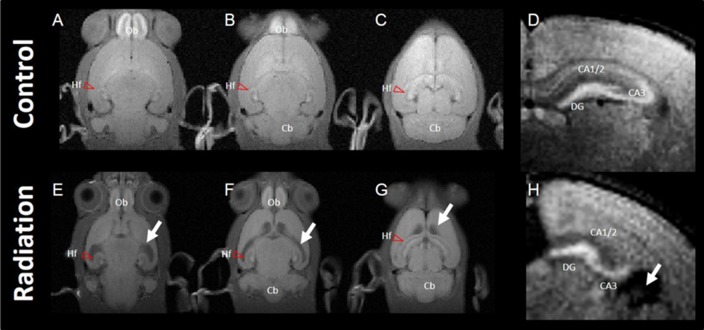
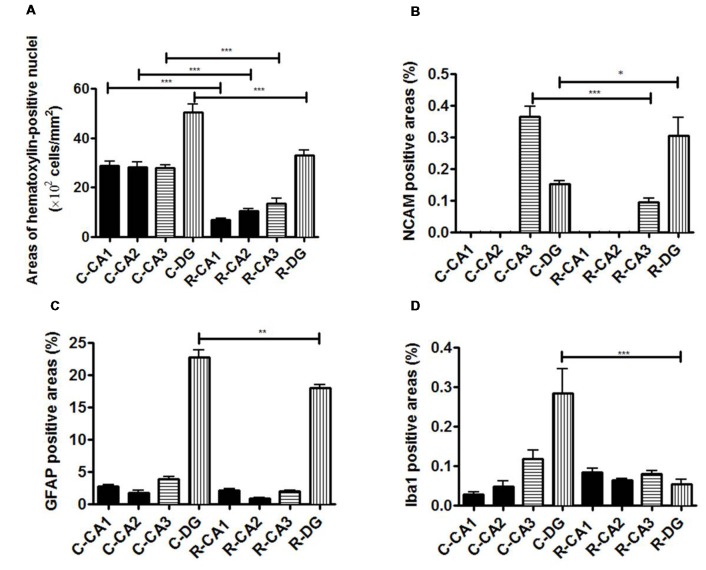
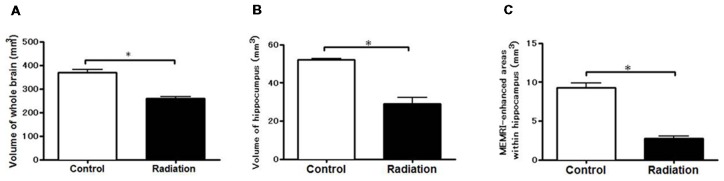
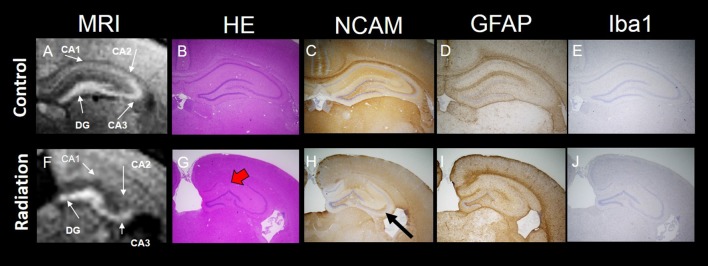
The aim of this study was to characterize hippocampal abnormalities in rats after prenatal x-ray irradiation using manganese-enhanced MRI (MEMRI). All radiation-exposed rat brains showed a reduced volume with prominent dilatation of lateral ventricles. Moreover, MEMRI-enhanced areas within the hippocampus were reduced in volumes by approximately 25% of controls, although the entire volume of hippocampus was decreased by approximately 50% of controls. MEMRI signals were enhanced strongly in the hilus and granular layer of the dentate gyrus (DG) and the pyramidal layer and infrapyramidal region of the CA3 region, and moderately along the CA1/2 pyramidal cell layer in the control rats. In radiation-exposed rats, MEMRI signals in the CA1/2 regions disappeared due to disrupting their laminar organization, although strong MEMRI signals were sustained in the DG and CA3 regions. Histopathological examinations in radiation-exposed rats revealed disorganizations of the DG granule cell layer and the CA3 pyramidal cell layer with reducing the cell density. The CA1/2 pyramidal cell layer was disrupted by invading ectopic cell mass. Neural cell adhesion molecule (NCAM)-positive fiber bundles were sustained in radiation-exposed rats, although they distributed aberrantly in the suprapyramidal CA3 region with a slight reduction of NCAM staining. Furthermore, glial components consisted largely by astrocytes and minor by microglia were densely distributed in the DG rather than in other hippocampal regions, and their density radiation-exposed rats. In conclusion, MEMRI signal enhancements could delineate different neuronal and/or glial components among hippocampal regions. We characterized microstructures of the deformed hippocampus as well as its macrostructures in a prenatally radiation-exposed rat model using MEMRI. The present findings provide advantageous information for detecting nondestructively hippocampal deformations in neurodevelopmental disorders.
本研究旨在利用锰增强磁共振成像(MEMRI)对产前 X 射线照射后的大鼠海马异常进行特征描述。所有受辐射的大鼠大脑显示出体积缩小,侧脑室明显扩张。此外,尽管海马体的整个体积减少了约 50%,但 MEMRI 增强区域的体积减少了约 25%。MEMRI 信号在齿状回(DG)的颗粒层和锥体细胞层以及 CA3 区域的锥体细胞层和下锥体细胞区强烈增强,在对照组大鼠的 CA1/2 锥体细胞层适度增强。在受辐射的大鼠中,由于层状结构破坏,CA1/2 区的 MEMRI 信号消失,尽管 DG 和 CA3 区仍保持强烈的 MEMRI 信号。受辐射大鼠的组织病理学检查显示 DG 颗粒细胞层和 CA3 锥体细胞层排列紊乱,细胞密度降低。CA1/2 锥体细胞层被异位细胞团破坏。神经细胞黏附分子(NCAM)阳性纤维束在受辐射的大鼠中得以维持,尽管它们在 CA3 上区的分布异常,NCAM 染色略有减少。此外,胶质细胞成分主要由星形胶质细胞和少量小胶质细胞组成,在 DG 中分布密集,而不是在其他海马区,其密度在受辐射的大鼠中增加。总之,MEMRI 信号增强可以描绘出海马区域中不同的神经元和/或神经胶质成分。我们使用 MEMRI 对产前辐射暴露大鼠模型中的变形海马体的微观结构及其宏观结构进行了特征描述。这些发现为非破坏性检测神经发育障碍中海马体变形提供了有益信息。