Department of Pathology.
Division of Nephrology, and.
J Am Soc Nephrol. 2019 Feb;30(2):277-292. doi: 10.1681/ASN.2018080815. Epub 2019 Jan 8.
CD4 CD8 double-negative (DN) T cells with innate-like properties represent a significant component of T cells in human and mouse kidneys. They spontaneously proliferate in the steady state and protect against ischemic AKI. However, the mechanisms regulating DN T cell homeostasis and responses to external danger signals from "sterile" inflammation remain poorly understood.
We used knockout mice, functional assays, and an established ischemic AKI model to investigate the role of various MHC class I and II molecules in regulating kidney DN T cells. We also studied human nephrectomy samples.
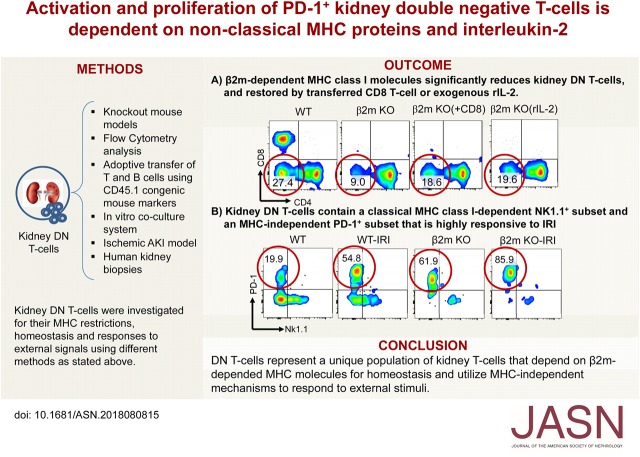
Deficiency of 2m-dependent MHC class I (but not MHC class II) molecules led to significant reduction in frequency or absolute numbers of kidney DN T cells due to impaired activation, proliferation, increased apoptosis, and loss of an NK1.1 subset of DN T cells. The remaining DN T cells in 2m knockout mice mainly comprised a programmed cell death protein-1 receptor (PD-1) subset that depends on IL-2 provided by conventional T cells for optimal homeostasis. However, this PD-1 subset remained highly responsive to changes in milieu, demonstrated by responses to infused lymphocytes. It was also the major responder to ischemic AKI; the NK1.1 subset and CD8 T cells had minimal responses. We found both DN T cell subsets in normal and cancerous human kidneys, indicating possible clinical relevance.
DN T cells, a unique population of kidney T cells, depend on nonclassical 2m molecules for homeostasis and use MHC-independent mechanisms to respond to external stimuli. These results have important implications for understanding the role these cells play during AKI and other immune cell-mediated kidney diseases.
具有先天样特性的 CD4 CD8 双阴性(DN)T 细胞是人类和小鼠肾脏 T 细胞的重要组成部分。它们在稳态下自发增殖,并可预防缺血性急性肾损伤(AKI)。然而,调节 DN T 细胞动态平衡和对“无菌”炎症的外部危险信号反应的机制仍知之甚少。
我们使用基因敲除小鼠、功能测定和已建立的缺血性 AKI 模型,研究各种 MHC Ⅰ类和Ⅱ类分子在调节肾脏 DN T 细胞中的作用。我们还研究了人类肾切除术样本。
缺乏 2m 依赖性 MHC Ⅰ类(而非 MHC Ⅱ类)分子会导致肾脏 DN T 细胞的频率或绝对数量显著减少,原因是激活、增殖受损,凋亡增加,以及 NK1.1 亚群 DN T 细胞丢失。2m 基因敲除小鼠中剩余的 DN T 细胞主要由程序性细胞死亡蛋白-1 受体(PD-1)亚群组成,该亚群依赖于常规 T 细胞提供的 IL-2 以维持最佳动态平衡。然而,该 PD-1 亚群对微环境的变化仍然高度敏感,表现在对输注淋巴细胞的反应上。它也是缺血性 AKI 的主要应答者;NK1.1 亚群和 CD8 T 细胞的应答最小。我们在正常和癌性人类肾脏中均发现了这两种 DN T 细胞亚群,表明其可能具有临床相关性。
DN T 细胞是肾脏 T 细胞的一个独特群体,其动态平衡依赖于非经典的 2m 分子,并利用 MHC 非依赖性机制对外部刺激做出反应。这些结果对于理解这些细胞在 AKI 和其他免疫细胞介导的肾脏疾病中所起的作用具有重要意义。