Department of Cardiovascular Center, The First Hospital of Jilin University, Changchun, Jilin 130021, China.
The Second Hospital of Jilin University, Changchun, Jilin 130000, China.
Oxid Med Cell Longev. 2018 Nov 28;2018:5783239. doi: 10.1155/2018/5783239. eCollection 2018.
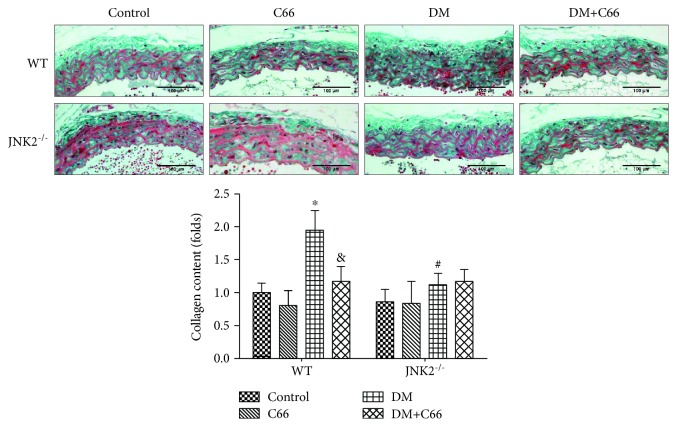
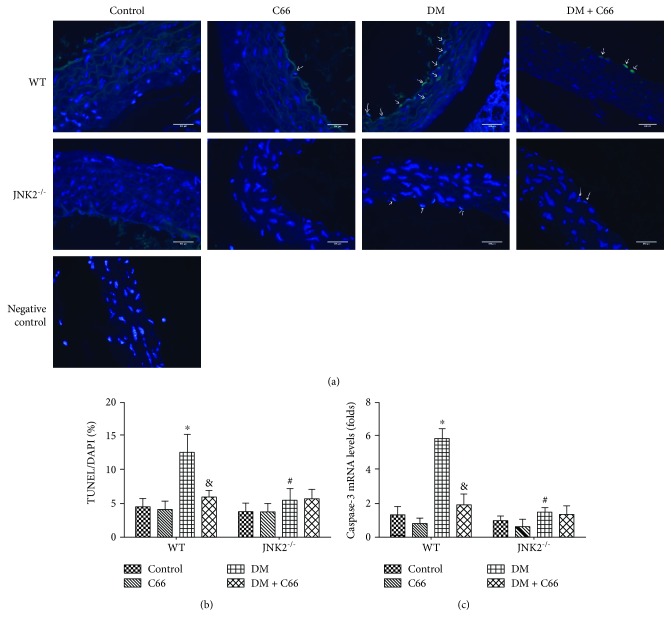
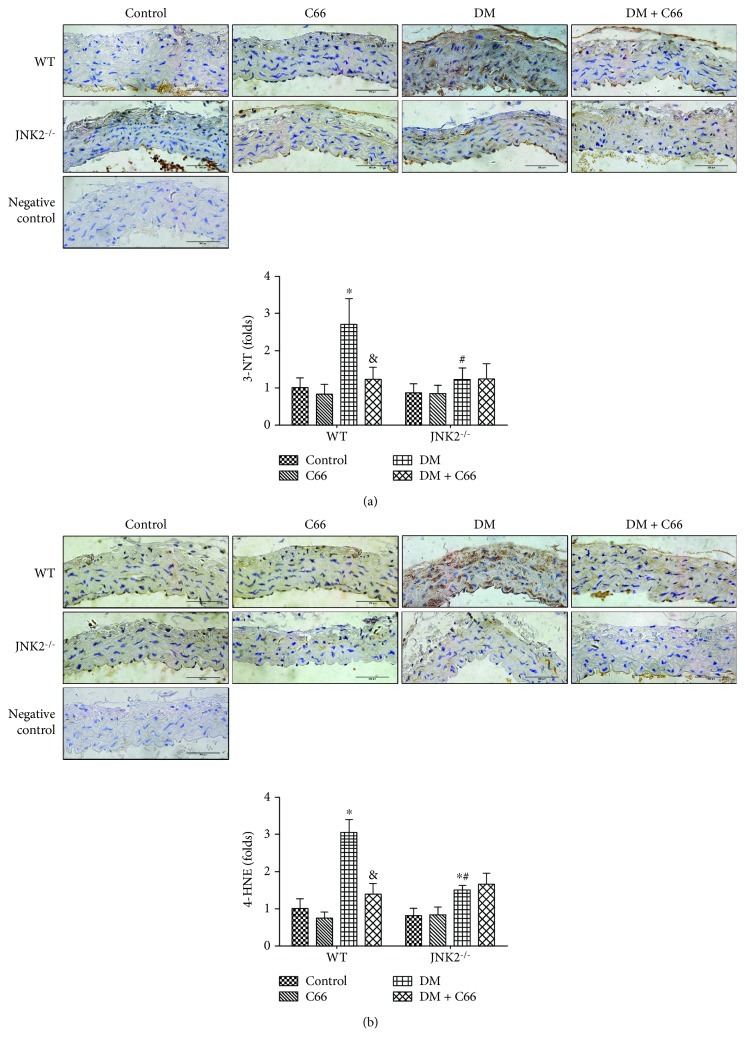
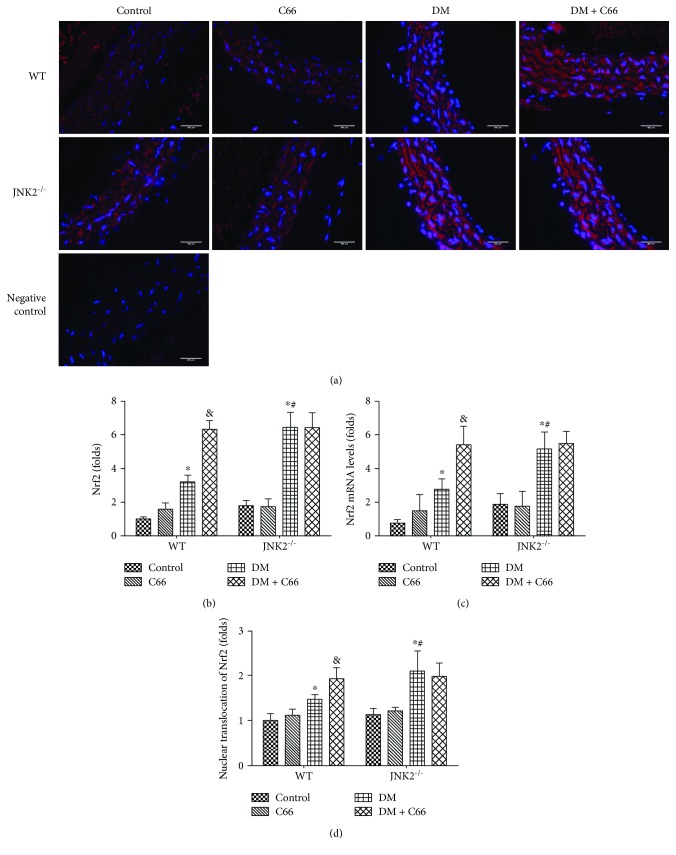
Diabetes-related cardiovascular diseases are leading causes of the mortality worldwide. Our previous study has explored the protective effect of curcumin analogue C66 on diabetes-induced pathogenic changes of the aorta. In the present study, we sought to reveal the underlying protective mechanisms of C66. Diabetes was induced in male WT and JNK2 mice with a single intraperitoneal injection of streptozotocin. Diabetic mice and age-matched nondiabetic mice were randomly treated with either vehicle (WT, WT DM, JNK2, and JNK2DM) or C66 (WT + C66, WT DM + C66, JNK2 + C66, and JNK2DM + C66) for three months. Aortic oxidative stress, cell apoptosis, inflammatory changes, fibrosis, and Nrf2 expression and function were assessed by immunohistochemical staining for the protein level and real-time PCR method for mRNA level. The results suggested that either C66 treatment or JNK2 deletion can reverse diabetes-induced aortic oxidative stress, cell apoptosis, inflammation, and fibrosis. Nrf2 was also found to be activated either by C66 or JNK2 deletion. However, C66 had no extra effect on diabetic aortic damage or Nrf2 activation without JNK2. These results suggest that diabetes-induced pathological changes in the aorta can be protected by C66 mainly via inhibition of JNK2 and accompanied by the upregulation of Nrf2 expression and function.
糖尿病相关的心血管疾病是全球死亡率的主要原因。我们之前的研究已经探讨了姜黄素类似物 C66 对糖尿病引起的主动脉病变的保护作用。在本研究中,我们试图揭示 C66 的潜在保护机制。通过单次腹腔注射链脲佐菌素诱导雄性 WT 和 JNK2 小鼠发生糖尿病。将糖尿病小鼠和年龄匹配的非糖尿病小鼠随机分为以下几组: vehicle(WT、WT DM、JNK2 和 JNK2DM)或 C66(WT+C66、WT DM+C66、JNK2+C66 和 JNK2DM+C66)处理 3 个月。通过免疫组化染色检测蛋白水平和实时 PCR 方法检测 mRNA 水平,评估主动脉氧化应激、细胞凋亡、炎症变化、纤维化以及 Nrf2 的表达和功能。结果表明,C66 治疗或 JNK2 缺失均可逆转糖尿病引起的主动脉氧化应激、细胞凋亡、炎症和纤维化。还发现 C66 或 JNK2 缺失均可激活 Nrf2。然而,在没有 JNK2 的情况下,C66 对糖尿病主动脉损伤或 Nrf2 激活没有额外作用。这些结果表明,C66 主要通过抑制 JNK2 并伴随 Nrf2 表达和功能的上调来保护糖尿病引起的主动脉病变。