Pitoia Fabián, Schmidt Angélica, Bueno Fernanda, Abelleira Erika, Jerkovich Fernando
Division of Endocrinology, University of Buenos Aires, Buenos Aires, Argentina.
Arch Endocrinol Metab. 2018;62(6):636-640. doi: 10.20945/2359-3997000000090.
The advent of multikinase inhibitor (MKI) therapy has led to a radical change in the treatment of patients with advanced thyroid carcinoma. The aim of this manuscript is to communicate rare adverse events that occurred in less than 5% of patients in clinical trials in a subset of patients treated in our hospital.
Out of 760 patients with thyroid cancer followed up with in our Division of Endocrinology, 29 (3.8%) received treatment with MKIs. The median age at diagnosis of these patients was 53 years (range 20-70), and 75.9% of them were women. Sorafenib was prescribed as first-line treatment to 23 patients with differentiated thyroid cancer and as second-line treatment to one patient with advanced medullary thyroid cancer (MTC). Vandetanib was indicated as first-line treatment in 6 patients with MTC and lenvatinib as second-line treatment in two patients with progressive disease under sorafenib treatment.
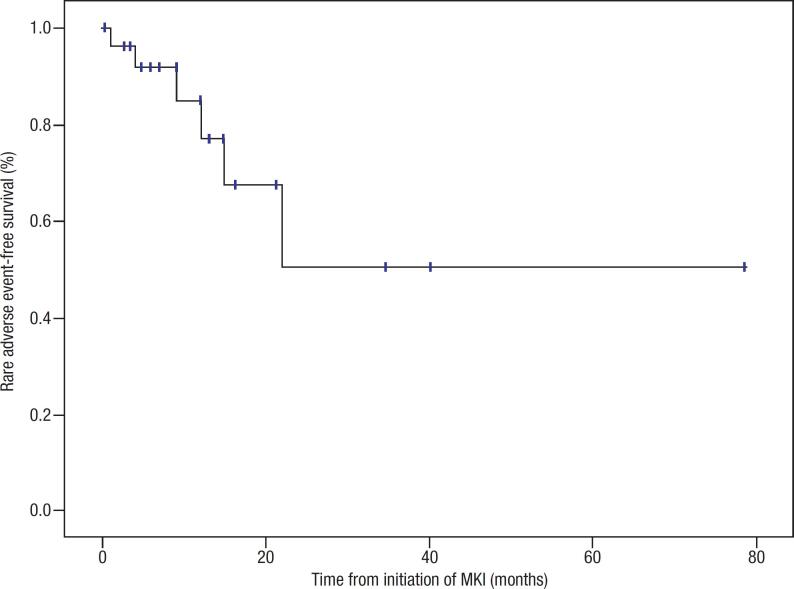
During the follow-up of treatment (mean 13.7 ± 7 months, median 12 months, range 6-32), 5/29 (17.2%) patients presented rare adverse events. These rare adverse effects were: heart failure, thrombocytopenia, and squamous cell carcinoma during sorafenib therapy and squamous cell carcinoma and oophoritis with intestinal perforation during vandetanib treatment.
About 3 to 5 years after the approval of MKI therapy, we learned that MKIs usually lead to adverse effects in the majority of patients. Although most of them are manageable, we still need to be aware of potentially serious and rare or unreported adverse effects that can be life-threatening.
多激酶抑制剂(MKI)疗法的出现使晚期甲状腺癌患者的治疗发生了根本性变化。本手稿的目的是交流在我院接受治疗的部分患者中,临床试验中发生率低于5%的罕见不良事件。
在我院内分泌科随访的760例甲状腺癌患者中,29例(3.8%)接受了MKIs治疗。这些患者诊断时的中位年龄为53岁(范围20 - 70岁),其中75.9%为女性。23例分化型甲状腺癌患者将索拉非尼作为一线治疗药物,1例晚期髓样甲状腺癌(MTC)患者将其作为二线治疗药物。6例MTC患者将凡德他尼作为一线治疗药物,2例在索拉非尼治疗期间病情进展的患者将乐伐替尼作为二线治疗药物。
在治疗随访期间(平均13.7±7个月,中位12个月,范围6 - 32个月),29例患者中有5例(17.2%)出现罕见不良事件。这些罕见不良反应为:索拉非尼治疗期间出现心力衰竭、血小板减少和鳞状细胞癌,凡德他尼治疗期间出现鳞状细胞癌和伴有肠穿孔的卵巢炎。
在MKI疗法获批约3至5年后,我们了解到MKIs通常会使大多数患者产生不良反应。尽管其中大多数是可控的,但我们仍需警惕可能危及生命的严重、罕见或未报告的不良反应。