From the Stroke Trials Unit, Division of Clinical Neuroscience, University of Nottingham, United Kingdom (J.P.A., L.J.W., N.S., P.M.B.).
Department of Stroke, Nottingham University Hospitals NHS Trust, United Kingdom (J.P.A., N.S., P.M.B.).
Stroke. 2019 Feb;50(2):405-412. doi: 10.1161/STROKEAHA.118.023190.
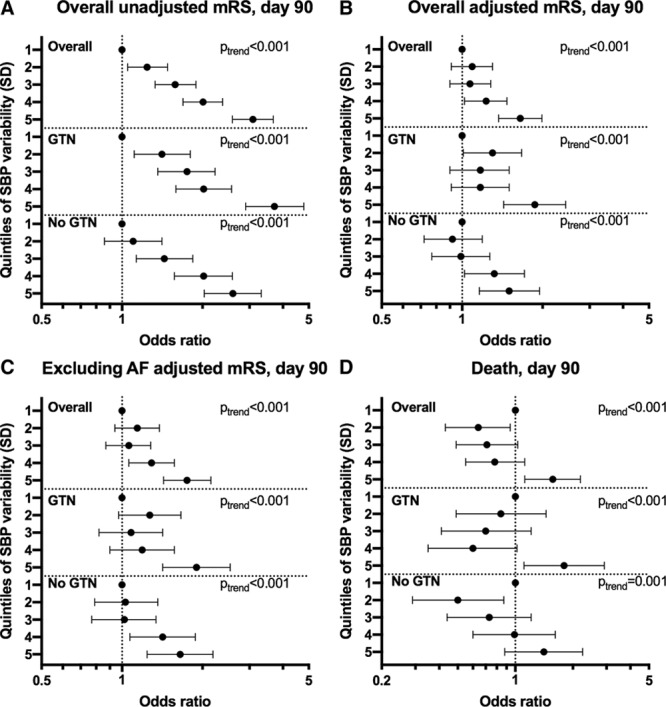
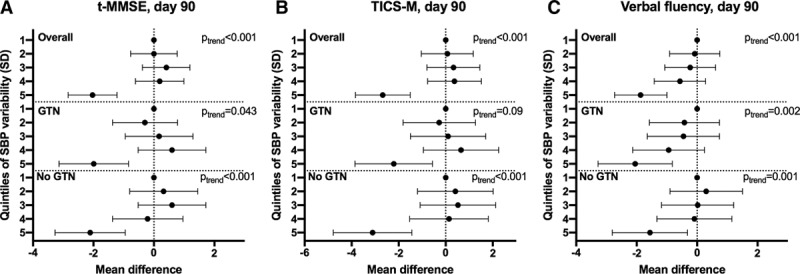
Background and Purpose- Increased blood pressure (BP), heart rate, and their derivatives (variability, pulse pressure, rate-pressure product) are associated with poor clinical outcome in acute stroke. We assessed the effects of glyceryl trinitrate (GTN) on hemodynamic parameters and these on outcome in participants in the ENOS trial (Efficacy of Nitric Oxide in Stroke). Methods- Four thousand and eleven patients with acute stroke and raised BP were randomized within 48 hours of onset to transdermal GTN or no GTN for 7 days. Peripheral hemodynamics were measured at baseline (3 measures) and daily (2 measures) during treatment. Between-visit BP variability over days 1 to 7 (as SD) was assessed in quintiles. Functional outcome was assessed as modified Rankin Scale and cognition as telephone mini-mental state examination at day 90. Analyses were adjusted for baseline prognostic variables. Data are mean difference or odds ratios with 95% CI. Results- Increased baseline BP (diastolic, variability), heart rate, and rate-pressure product were each associated with unfavorable functional outcome at day 90. Increased between-visit systolic BP variability was associated with an unfavourable shift in modified Rankin Scale (highest quintile adjusted odds ratio, 1.65; 95% CI, 1.37-1.99), worse cognitive scores (telephone mini-mental state examination: highest quintile adjusted mean difference, -2.03; 95% CI, -2.84 to -1.22), and increased odds of death at day 90 (highest quintile adjusted odds ratio, 1.57; 95% CI, 1.12-2.19). GTN lowered BP and rate-pressure product and increased heart rate at day 1 and reduced between-visit systolic BP variability. Conclusions- Increased between-visit BP variability was associated with poor functional and cognitive outcomes and increased death 90 days after acute stroke. In addition to lowering BP and rate-pressure product, GTN reduced between-visit systolic BP variability. Agents that lower BP variability in acute stroke require further study.
背景与目的-血压(BP)、心率及其衍生指标(变异性、脉压、心率-血压乘积)升高与急性脑卒中的临床预后不良相关。我们评估了硝化甘油(GTN)对血流动力学参数的影响及其对 ENOS 试验(一氧化氮在脑卒中的疗效)参与者结局的影响。方法-4110 例急性脑卒中且血压升高的患者在发病后 48 小时内随机分为接受透皮 GTN 或不接受 GTN 治疗 7 天。在治疗期间每天测量 2 次(共 3 次测量)基础外周血流动力学。在第 1 天至第 7 天(以标准差表示)评估治疗期间每日间 BP 变异性。使用五分位数评估第 1 天至第 7 天的基线间收缩压变异性。90 天采用改良 Rankin 量表评估功能结局,采用电话式简易精神状态检查评估认知功能。分析调整了基线预后变量。数据为均值差或比值比(95%可信区间)。结果-基线 BP(舒张压、变异性)、心率和心率-血压乘积升高均与 90 天的不良功能结局相关。每日间收缩压变异性增加与改良 Rankin 量表的不良变化相关(最高五分位数调整后的比值比为 1.65;95%可信区间,1.37-1.99)、认知评分更差(电话式简易精神状态检查:最高五分位数调整后的平均差值为-2.03;95%可信区间,-2.84 至-1.22)和 90 天死亡率增加(最高五分位数调整后的比值比为 1.57;95%可信区间,1.12-2.19)。GTN 可降低第 1 天的 BP 和心率-血压乘积并增加心率,减少每日间收缩压变异性。结论-每日间 BP 变异性增加与急性脑卒中后功能和认知结局不良及 90 天死亡率增加相关。除降低 BP 和心率-血压乘积外,GTN 还可降低每日间收缩压变异性。急性脑卒中患者需要进一步研究可降低血压变异性的药物。