Department of Fundamental Microbiology, Faculty of Biology and Medicine, University of Lausanne, Quartier UNIL/Sorge, Lausanne CH 1015, Switzerland.
Department of Fundamental Microbiology, Faculty of Biology and Medicine, University of Lausanne, Quartier UNIL/Sorge, Lausanne CH 1015, Switzerland
Biochem Soc Trans. 2019 Feb 28;47(1):187-196. doi: 10.1042/BST20180460. Epub 2019 Jan 9.
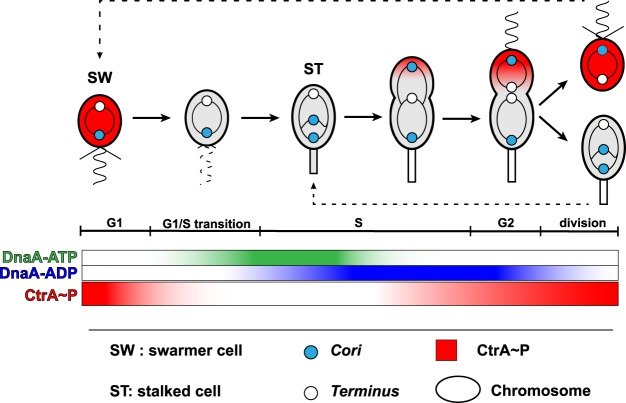
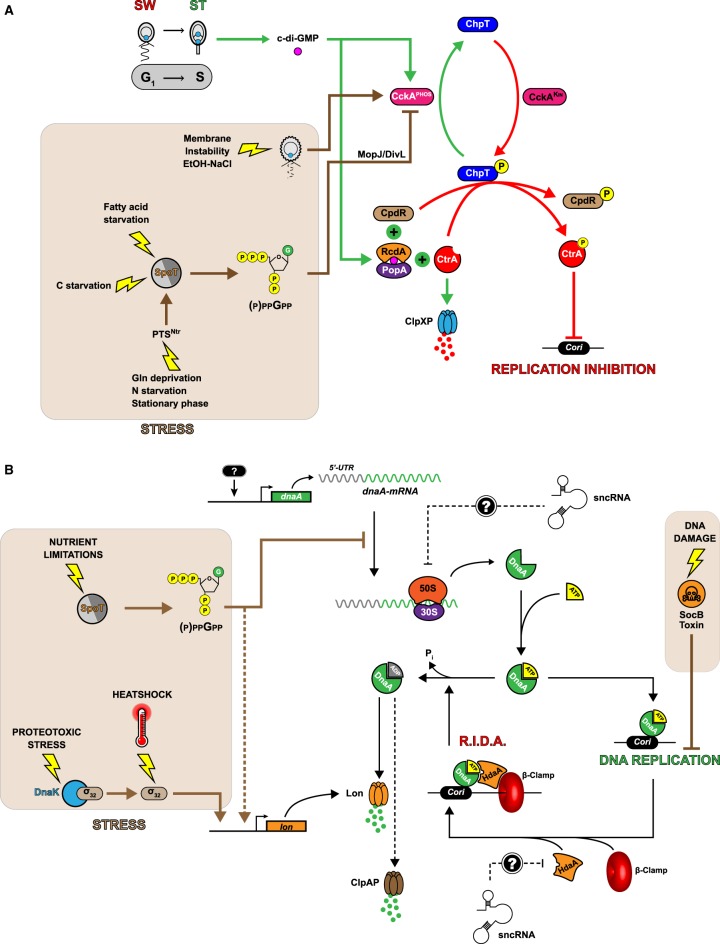
The environmental is a classical model to study the regulation of the bacterial cell cycle. It divides asymmetrically, giving a stalked cell that immediately enters S phase and a swarmer cell that stays in the G1 phase until it differentiates into a stalked cell. Its genome consists in a single circular chromosome whose replication is tightly regulated so that it happens only in stalked cells and only once cell cycle. Imbalances in chromosomal copy numbers are the most often highly deleterious, if not lethal. This review highlights recent discoveries on pathways that control chromosome replication when is exposed to optimal or less optimal growth conditions. Most of these pathways target two proteins that bind directly onto the chromosomal origin: the highly conserved DnaA initiator of DNA replication and the CtrA response regulator that is found in most The concerted inactivation and proteolysis of CtrA during the swarmer-to-stalked cell transition license cells to enter S phase, while a replisome-associated Regulated Inactivation and proteolysis of DnaA (RIDA) process ensures that initiation starts only once cell cycle. When is stressed, it turns on control systems that delay the G1-to-S phase transition or the elongation of DNA replication, most probably increasing its fitness and adaptation capacities.
环境是研究细菌细胞周期调控的经典模型。它不对称分裂,产生一个立即进入 S 期的柄细胞和一个停留在 G1 期的游动细胞,直到它分化为柄细胞。它的基因组由一个单一的圆形染色体组成,其复制受到严格的调控,只发生在柄细胞中,并且只在一个细胞周期中发生一次。染色体拷贝数的不平衡是最常见的高度有害的,如果不是致命的。这篇综述强调了最近关于当 处于最佳或较差生长条件下控制染色体复制的途径的发现。这些途径中的大多数都针对直接结合到染色体起始点的两种蛋白质:高度保守的 DNA 复制起始因子 DnaA 和在大多数 中发现的 CtrA 反应调节剂。在游动细胞到柄细胞的转变过程中,CtrA 的协同失活和蛋白水解使细胞有资格进入 S 期,而与复制体相关的 DnaA 调节失活和蛋白水解(RIDA)过程确保了只有在一个细胞周期中才开始起始。当 受到压力时,它会启动控制系统,延迟 G1 期到 S 期的转变或 DNA 复制的延长,这很可能增加了它的适应性和适应能力。