PHYTOLAB-DISIA-Department of Informatics, Statistics and Applications "G. Parenti", University of Florence, Viale Morgagni, 59-50134 Florence, Italy and QuMAP-PIN-Piazza Giovanni Ciardi, 25, 59100 Prato (PO), Italy.
Department of NEUROFARBA, University of Florence, Viale Pieraccini 6, 50139 Florence, Italy.
Molecules. 2019 Jan 9;24(2):226. doi: 10.3390/molecules24020226.
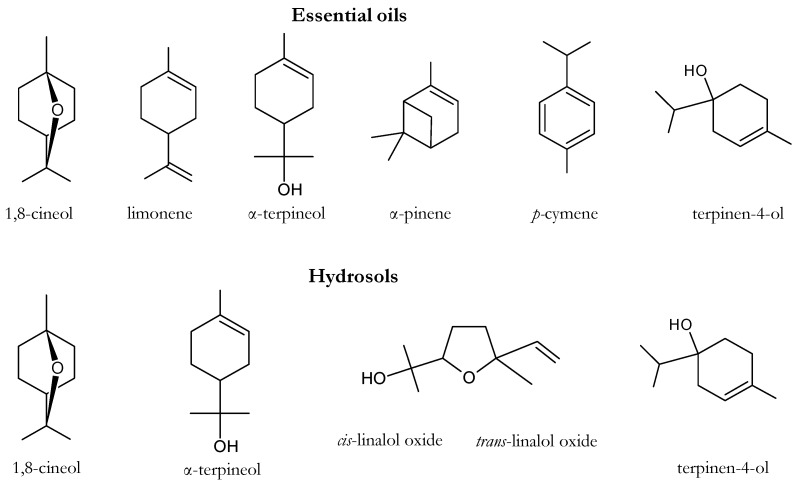
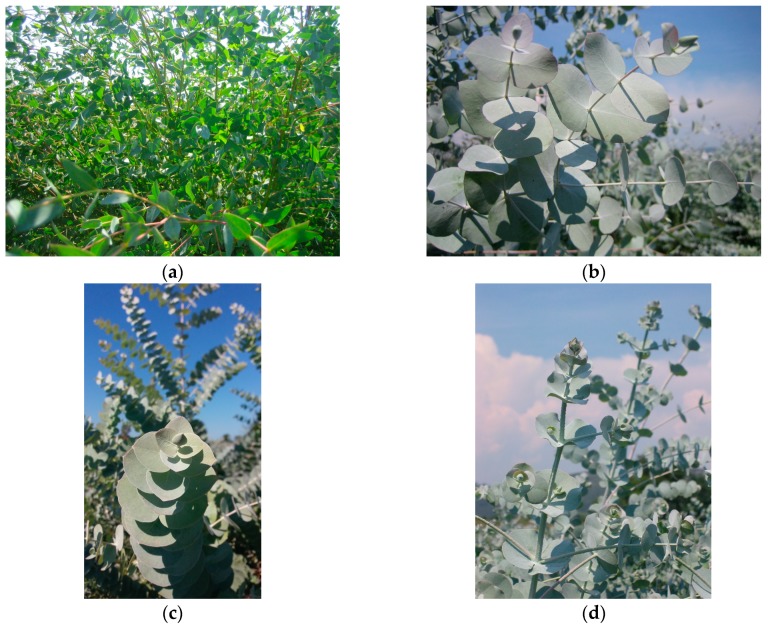
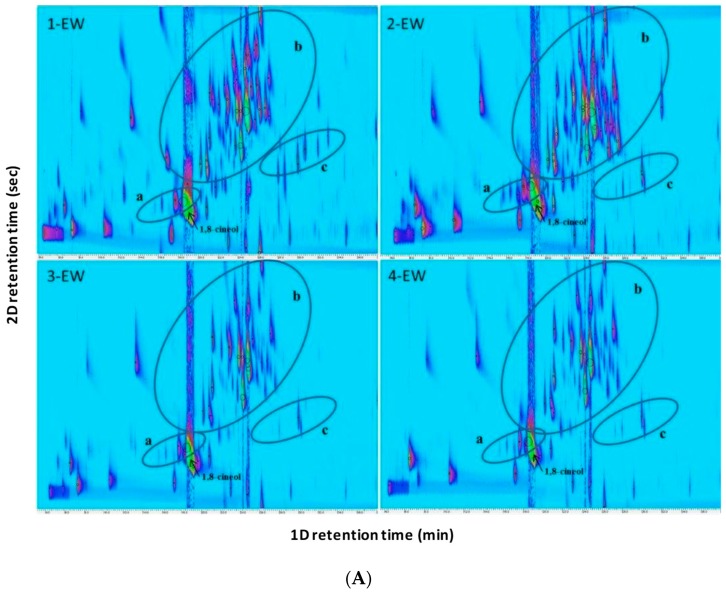
Essential oils are widely used as functional ingredients for potential multi-purpose functional uses. Hydrosols, co-products of the distillation of plant material, are used in food and cosmetic industries and in biological agriculture, but their volatile composition is poorly investigated. The volatile fractions of essential oils and hydrosols from four less-studied 1,8-cineol-rich species ( L.A.S. Johnson & K.D. Hill, F. Muell, Sims and baby blue Sims), cultivated in Tuscany in a system of organic farming, were characterized by solvent dilution (essential oils) or extraction (hydrosols) followed by GC-MS and by HS-SPME-GC×GC-TOFMS analysis. GC-MS analysis showed that essential oils were mainly constituted by oxygenated monoterpenes, particularly 1,8-cineole, with monoterpenes hydrocarbons up to 10.8%. Relative differences in the abundance of minor terpenes as limonene, α-pinene, γ-terpinene, -cymene, terpinen-4-ol, α-terpineol, and alloaromandrene were pointed out and seem to be suitable for differentiation among EOs of the four different species. Hydrosols of these species were characterized for the first time: they were mainly constituted by oxygenated monoterpenes (97.6⁻98.9%), with 1,8-cineole up to 1.6 g/L, while monoterpene and sesquiterpene hydrocarbons were detected only in traces. HS-SPME-GC×GC-TOFMS analysis also allowed providing metabolic profiling of hydrosols for the direct comparison and visualization of volatile components, pointing out the potentially different uses of these products as functional ingredients in food, beverage, and cosmetic industries.
精油作为具有多种潜在用途的功能性成分被广泛应用。水醇提物是植物材料蒸馏的副产物,用于食品和化妆品行业以及生物农业,但它们的挥发性成分研究甚少。本研究采用溶剂稀释(精油)或提取(水醇提物)法,结合 GC-MS 和 HS-SPME-GC×GC-TOFMS 分析了在托斯卡纳有机农业系统中种植的四种较少研究的含 1,8-桉叶素丰富的 1,8-桉叶素含量丰富的物种( L.A.S. Johnson & K.D. Hill、F. Muell、 Sims 和 蓝色 Sims 婴儿)的精油和水醇提物的挥发性成分。GC-MS 分析表明,精油主要由含氧单萜组成,特别是 1,8-桉叶素,萜烯烃含量高达 10.8%。指出了少量萜烯如柠檬烯、α-蒎烯、γ-松油烯、-对伞花烃、萜品-4-醇、α-松油醇和芳樟醇的相对丰度差异,这些差异似乎适合区分这四个不同物种的精油。这些物种的水醇提物也是首次被鉴定:它们主要由含氧单萜组成(97.6⁻98.9%),其中 1,8-桉叶素高达 1.6 g/L,而单萜和倍半萜烃仅痕量检测到。HS-SPME-GC×GC-TOFMS 分析还可以提供水醇提物的代谢图谱,用于挥发性成分的直接比较和可视化,指出这些产品作为食品、饮料和化妆品行业的功能性成分具有不同的潜在用途。