Mellanby Centre for Bone Research, University of Sheffield, Sheffield, UK.
Radius Health, Inc., Waltham, MA, USA.
Osteoporos Int. 2019 Mar;30(3):667-673. doi: 10.1007/s00198-018-04819-1. Epub 2019 Jan 11.
Early PINP changes correlate with 18-month lumbar spine BMD changes and the correlation was greater with abaloparatide versus teriparatide. The uncoupling index was similar between the two agents.
We evaluated the relationship between early PINP changes and subsequent changes in spine BMD following abaloparatide and teriparatide treatments. We also explored the use of an "uncoupling index" (UI), the balance between bone formation and bone resorption, which we hypothesised would be similar in response to these treatment groups.
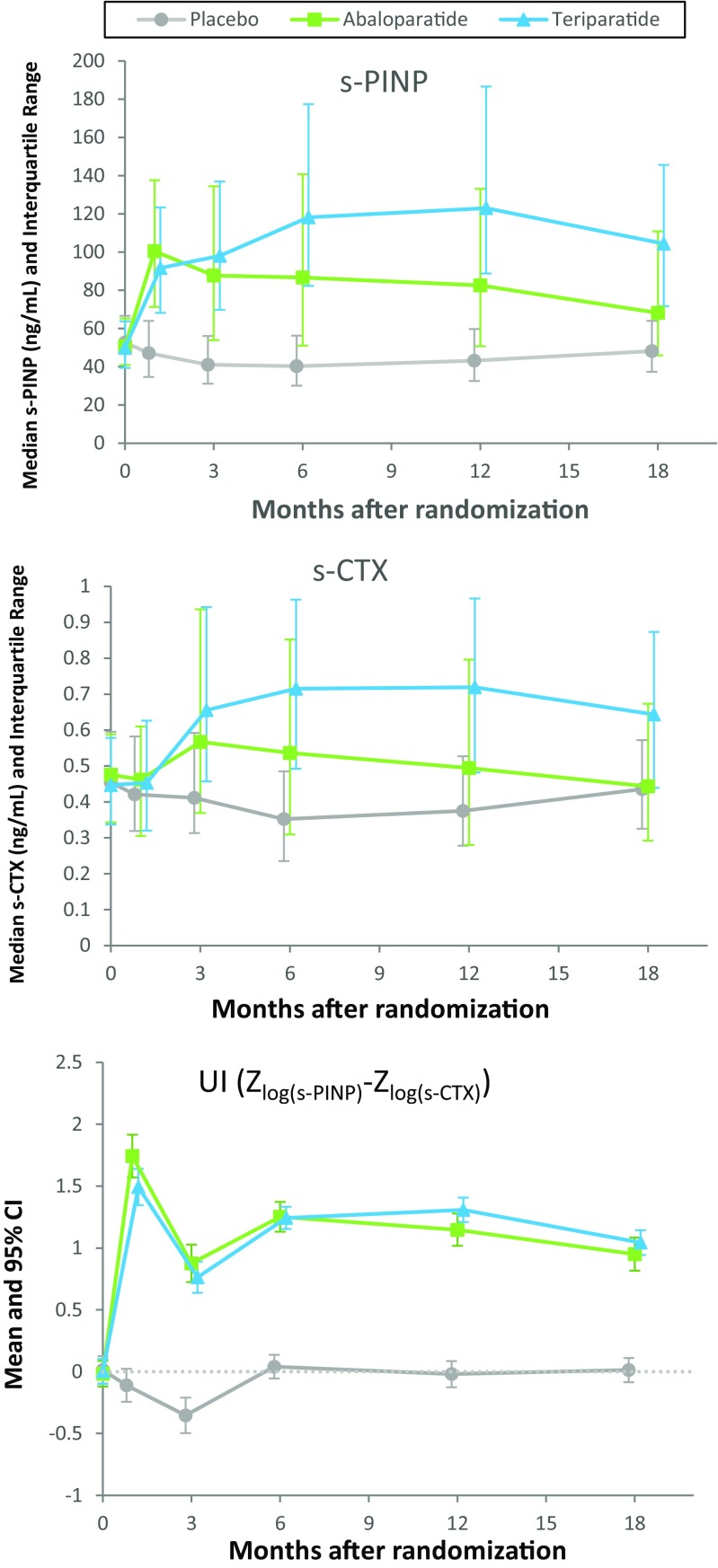
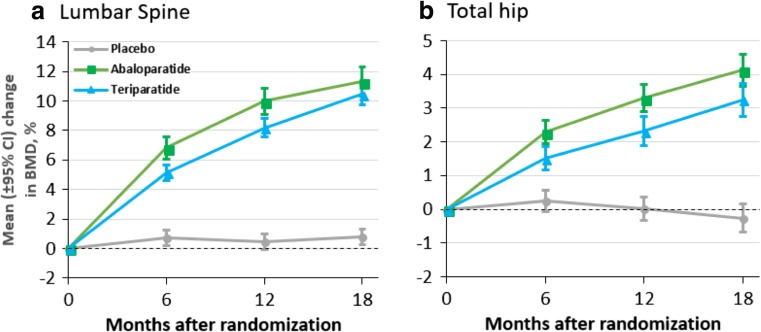
Blood samples were taken for measurement of bone turnover markers (BTMs) s-PINP and s-CTX at baseline, 1, 3, 6, 12, and 18 months from 189 abaloparatide patients and 227 teriparatide patients randomly selected from all participants who completed the study. BMD was measured by DXA at baseline, 6, 12, and 18 months. Correlations were calculated between log ratio of BTMs from baseline to 3 months and percent change from baseline in BMD at 18 months. A UI was calculated using log transformation and subtraction of the standard deviate for s-CTX from the standard deviate for s-PINP for each patient.
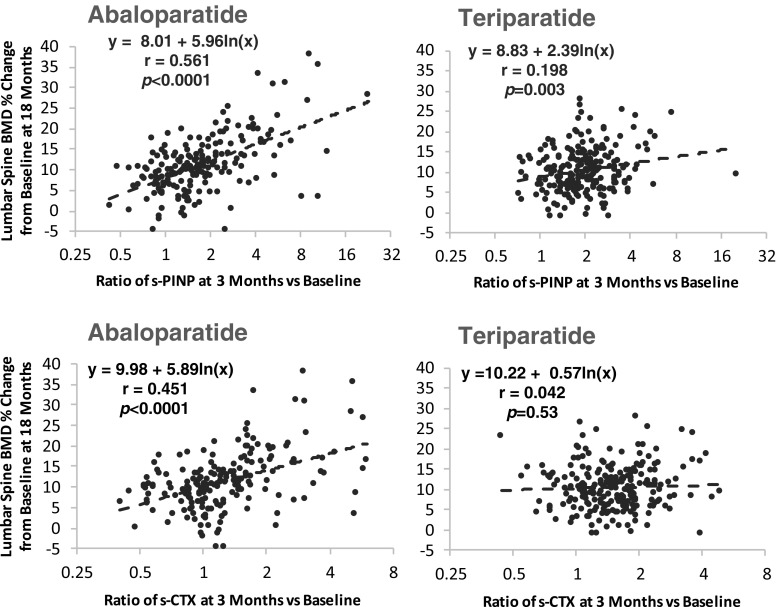
Early BTM changes were associated with subsequent BMD changes for both treatments. Pearson correlations for the log ratio of PINP over baseline at 3 months and BMD percent change from baseline at 18 months were larger (P < 0.0001) with abaloparatide (r = 0.561) than teriparatide (r = 0.198). The mean UI at 1 month was greater for abaloparatide versus teriparatide (1.743 and 1.493, respectively; P = 0.03) but was similar at 3 months or later time points.
Early s-PINP changes correlate with percentage change in lumbar spine BMD 18 months after treatment with both abaloparatide and teriparatide, though the correlation with abaloparatide was greater. The UI was similar between abaloparatide and teriparatide suggesting that the balance between formation and resorption markers was similar.
PINP 的早期变化与 18 个月时腰椎骨密度的变化相关,且与abaloparatide 相比,teriparatide 的相关性更大。两种药物的解偶联指数相似。
我们评估了 abaloparatide 和 teriparatide 治疗后 PINP 的早期变化与脊柱骨密度变化之间的关系。我们还探索了“解偶联指数”(UI)的应用,即骨形成和骨吸收之间的平衡,我们假设该指数在这两种治疗组中会相似。
从所有完成研究的参与者中随机选择 189 名 abaloparatide 患者和 227 名 teriparatide 患者,在基线、1、3、6、12 和 18 个月时采集血样,以测量骨转换标志物(BTMs)s-PINP 和 s-CTX。在基线、6、12 和 18 个月时通过 DXA 测量骨密度。计算基线至 3 个月时 BTM 对数比值与 18 个月时骨密度百分比变化之间的相关性。对于每个患者,使用 log 转换并从 s-CTX 的标准偏差中减去 s-PINP 的标准偏差来计算 UI。
两种治疗方法的早期 BTM 变化均与随后的 BMD 变化相关。abaloparatide 治疗组中,3 个月时 PINP 相对于基线的对数比值与 18 个月时骨密度百分比变化之间的 Pearson 相关性(P < 0.0001)较大(r = 0.561),而 teriparatide 治疗组中(r = 0.198)则较小。abaloparatide 治疗组的平均 UI 在 1 个月时大于 teriparatide 治疗组(分别为 1.743 和 1.493,P = 0.03),但在 3 个月或之后的时间点相似。
在 abaloparatide 和 teriparatide 治疗后 18 个月,早期 s-PINP 变化与腰椎骨密度百分比变化相关,与 abaloparatide 的相关性更大。abaloparatide 和 teriparatide 之间的 UI 相似,表明形成和吸收标志物之间的平衡相似。