Beijing Key Laboratory of Wetland Services and Restoration, Institute of Wetland Research, Chinese Academy of Forestry, Beijing, China.
Key Laboratory of Ecosystem Network Observation and Modeling, Institute of Geographic Sciences and Natural Resources Research, Chinese Academy of Sciences, Beijing, China.
PLoS One. 2019 Jan 14;14(1):e0210768. doi: 10.1371/journal.pone.0210768. eCollection 2019.
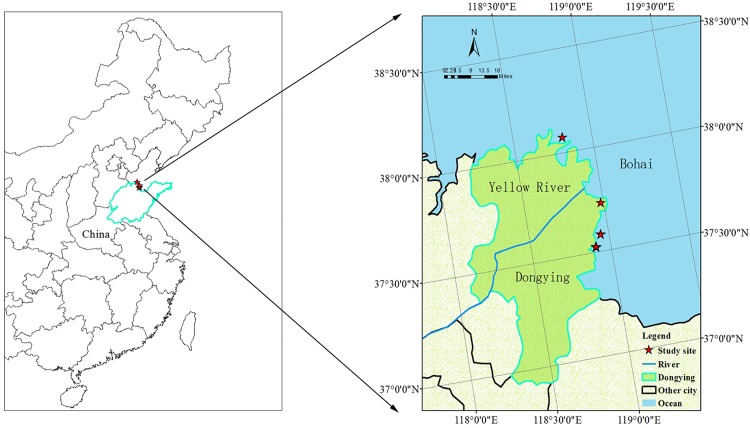
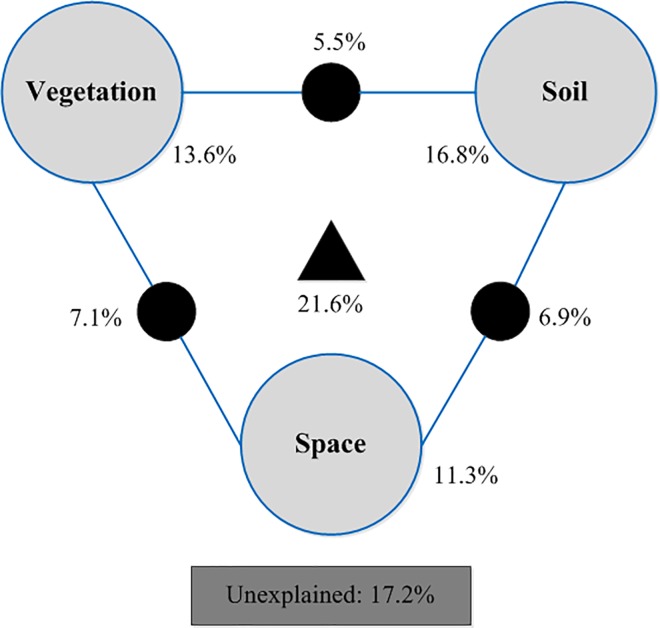
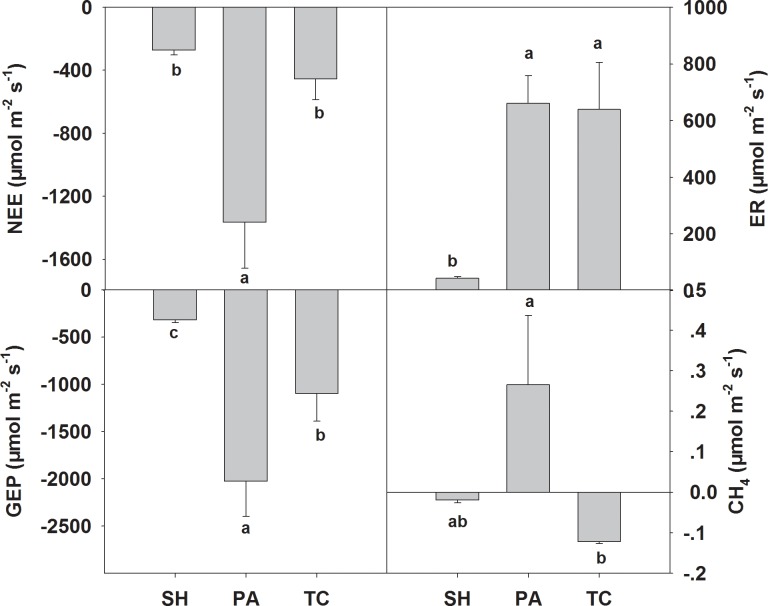
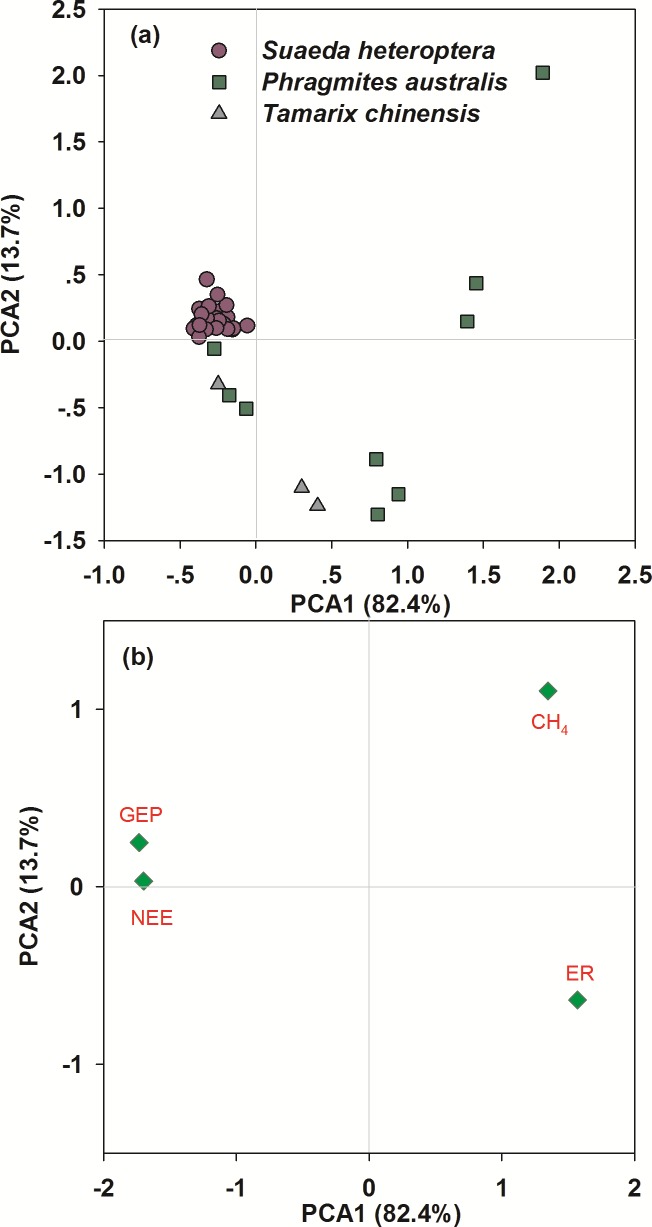
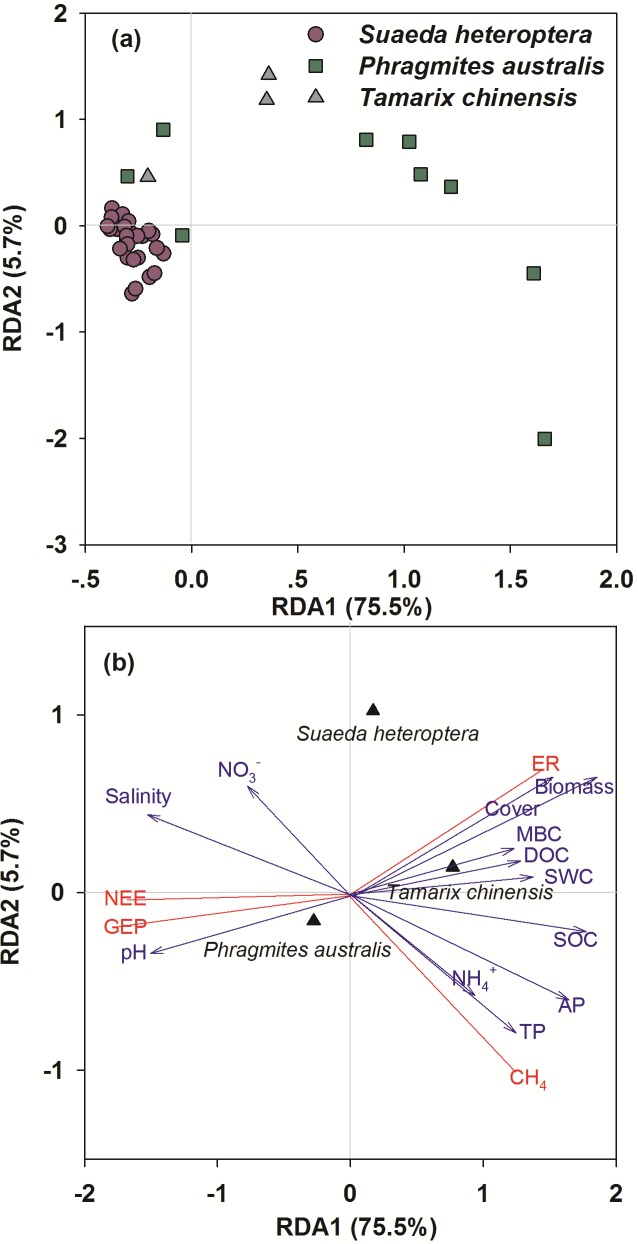
Coastal wetlands are considered as a significant sink of global carbon due to their tremendous organic carbon storage. Coastal CO2 and CH4 flux rates play an important role in regulating atmospheric CO2 and CH4 concentrations. However, the relative contributions of vegetation, soil properties, and spatial structure on dry-season ecosystem carbon (C) rates (net ecosystem CO2 exchange, NEE; ecosystem respiration, ER; gross ecosystem productivity, GEP; and CH4) remain unclear at a regional scale. Here, we compared dry-season ecosystem C rates, plant, and soil properties across three vegetation types from 13 locations at a regional scale in the Yellow River Delta (YRD). The results showed that the Phragmites australis stand had the greatest NEE (-1365.4 μmol m-2 s-1), ER (660.2 μmol m-2 s-1), GEP (-2025.5 μmol m-2 s-1) and acted as a CH4 source (0.27 μmol m-2 s-1), whereas the Suaeda heteroptera and Tamarix chinensis stands uptook CH4 (-0.02 to -0.12 μmol m-2 s-1). Stepwise multiple regression analysis demonstrated that plant biomass was the main factor explaining all of the investigated carbon rates (GEP, ER, NEE, and CH4); while soil organic carbon was shown to be the most important for explaining the variability in the processes of carbon release to the atmosphere, i.e., ER and CH4. Variation partitioning results showed that vegetation and soil properties played equally important roles in shaping the pattern of C rates in the YRD. These results provide a better understanding of the link between ecosystem C rates and environmental drivers, and provide a framework to predict regional-scale ecosystem C fluxes under future climate change.
滨海湿地因其巨大的有机碳储存量而被认为是全球碳的重要汇。滨海 CO2 和 CH4 通量在调节大气 CO2 和 CH4 浓度方面起着重要作用。然而,在区域尺度上,植被、土壤特性和空间结构对旱季生态系统碳(C)速率(净生态系统 CO2 交换,NEE;生态系统呼吸,ER;总生态系统生产力,GEP;和 CH4)的相对贡献仍不清楚。在这里,我们比较了黄河三角洲(YRD) 13 个地点 13 个植被类型的旱季生态系统 C 速率、植物和土壤特性。结果表明,芦苇(Phragmites australis)群落的 NEE(-1365.4 μmol m-2 s-1)、ER(660.2 μmol m-2 s-1)、GEP(-2025.5 μmol m-2 s-1)最大,并且是 CH4 的源(0.27 μmol m-2 s-1),而翅碱蓬(Suaeda heteroptera)和柽柳(Tamarix chinensis)群落吸收 CH4(-0.02 至-0.12 μmol m-2 s-1)。逐步多元回归分析表明,植物生物量是解释所有研究碳速率(GEP、ER、NEE 和 CH4)的主要因素;而土壤有机碳是解释向大气释放碳的过程(ER 和 CH4)变异性的最重要因素。变分分配结果表明,植被和土壤特性在塑造 YRD 碳速率格局方面发挥着同等重要的作用。这些结果更好地理解了生态系统碳速率与环境驱动因素之间的联系,并为预测未来气候变化下区域尺度生态系统 C 通量提供了框架。