Academic Geriatric Medicine, Faculty of Medicine, University of Southampton, Southampton SO16 6YD, UK.
NIHR Southampton Biomedical Research Centre, University of Southampton and University Hospital Southampton NHS Foundation Trust, Southampton SO16 6YD, UK.
Nutrients. 2019 Jan 11;11(1):144. doi: 10.3390/nu11010144.
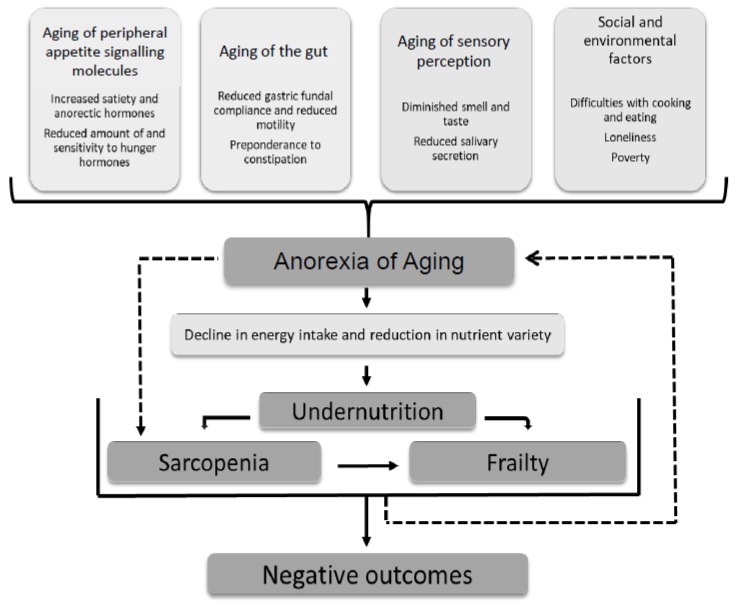
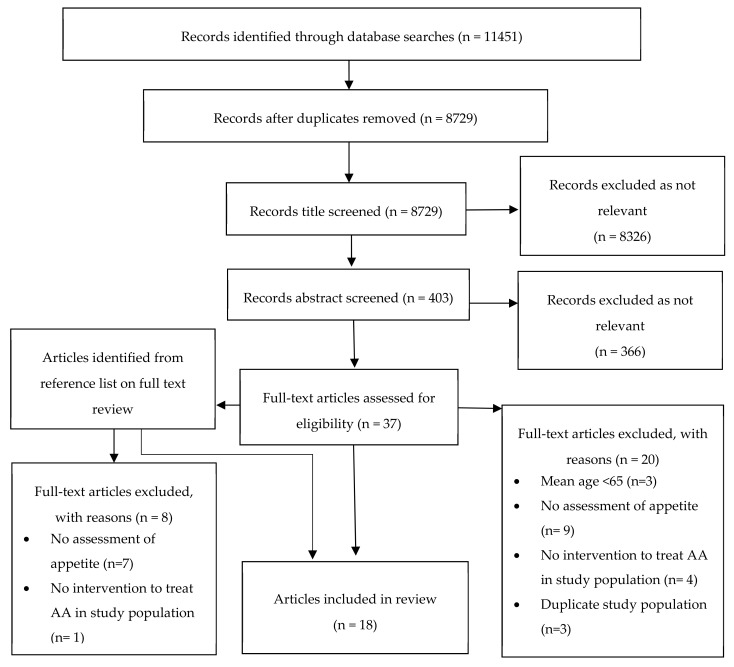
(1) Background: Appetite loss in older people, the 'Anorexia of Aging' (AA), is common, associated with under-nutrition, sarcopenia, and frailty and yet receives little attention. This review had two aims: describe interventions for AA and their effectiveness, and identify the methods of appetite assessment. (2) Methods: Study inclusion: participants aged ≥65, intervention for AA, and appetite assessment, any design, and comparator. Exclusion: studies on specific health cohorts. Searches in four databases with hand searching of references and citing works. Two researchers independently assessed eligibility and quality. (3) Results: Authors screened 8729 titles, 46 full texts. Eighteen articles were included describing nine intervention types: education ( = 1), exercise ( = 1), flavor enhancement ( = 2), increased meal variety ( = 1), mealtime assistance ( = 1), fortified food ( = 1), oral nutritional supplement (ONS) ( = 8), amino acids ( = 1), and medication ( = 2). Three studies evaluated combinations: education + exercise, ONS + exercise, and ONS + medication. Five intervention types exhibited favorable effects on appetite but in single datasets or not replicated. Appetite was assessed predominantly by Likert ( = 9), or visual analogue scales ( = 7). (4) Conclusions: A variety of interventions and methods of appetite assessments were used. There was a lack of clarity about whether AA or undernutrition was the intervention target. AA is important for future research but needs standardized assessment so that effectiveness of a range of interventions can be fully explored.
(1)背景:老年人食欲下降,即“衰老性厌食”(AA)较为常见,与营养不足、肌肉减少症和虚弱有关,但却很少受到关注。本次综述有两个目的:描述针对 AA 的干预措施及其效果,并确定食欲评估方法。
(2)方法:研究纳入标准:年龄≥65 岁、针对 AA 的干预措施以及食欲评估,任何设计和对照组。排除标准:特定健康队列的研究。在四个数据库中进行检索,并对手头参考资料和引用文献进行了检索。两位研究人员独立评估了合格性和质量。
(3)结果:作者筛选了 8729 篇标题,46 篇全文。有 18 篇文章符合纳入标准,描述了 9 种干预类型:教育(=1)、运动(=1)、增强风味(=2)、增加餐食种类(=1)、就餐协助(=1)、强化食品(=1)、口服营养补充剂(ONS)(=8)、氨基酸(=1)和药物(=2)。有 3 项研究评估了组合干预措施:教育+运动、ONS+运动和 ONS+药物。有 5 种干预类型对食欲有积极影响,但仅在单个数据集或未被复制。食欲主要通过李克特量表(=9)或视觉模拟量表(=7)进行评估。
(4)结论:使用了多种干预措施和食欲评估方法。对于 AA 或营养不足是干预目标,并不明确。AA 是未来研究的重点,但需要进行标准化评估,以便充分探索一系列干预措施的效果。