School of Environmental and Life Sciences, University of Newcastle, Callaghan, Newcastle, 2300, NSW, Australia.
James Cook University, Townsville, 4811, Qld, Australia.
Sci Rep. 2019 Jan 14;9(1):83. doi: 10.1038/s41598-018-35874-7.
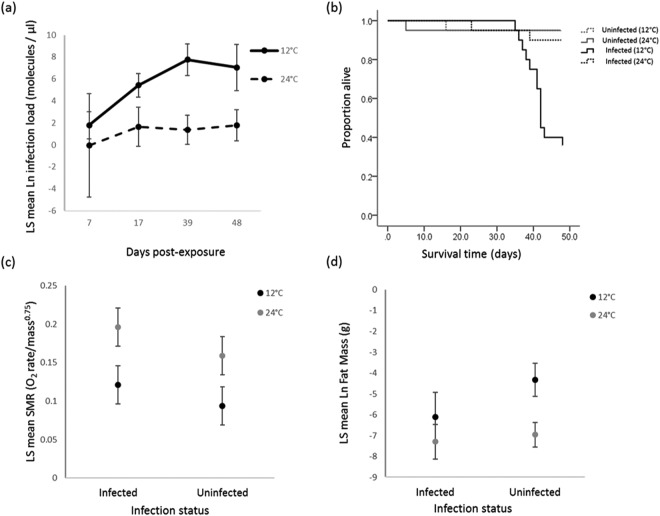
The amphibian chytrid fungus Batrachochytrium dendrobatidis is an emerging infectious pathogen present on every continent except Antarctica. It causes the disease chytridiomycosis in a subset of species but does not always result in disease or death for every host. Ambient temperature influences both amphibian metabolism and chytrid pathogenicity, however the interactive effects on host physiology is not well understood. We investigated the sublethal effect of B. dendrobatidis infection on a susceptible host, Litoria aurea to test (1) whether the infection load, metabolic activity, body fat and gonad size differed in L. aurea at either 24 °C or 12 °C ambient temperatures and (2) whether previous Bd infection caused long-term changes to body fat and gonad size. Litoria aurea in 12 °C treatments had higher infection loads of B. dendrobatidis and lower survivorship. Metabolic rate was higher and fat mass was lower in infected individuals and in animals in 24 °C treatments. Male L. aurea previously infected with B. dendrobatidis had smaller testes 5 months-post clearance of infection, an effect likely to translate to fitness costs in wild populations. These experiments demonstrate a physiological cost to sublethal B. dendrobatidis infection, which suggests a reduction in host fitness mediated by temperature in the host's environment regardless of whether infection leads to mortality.
两栖类壶菌真菌(Batrachochytrium dendrobatidis)是一种新兴的传染性病原体,存在于除南极洲以外的每个大陆。它会引起一部分物种的壶菌病,但并非对每个宿主都会导致疾病或死亡。环境温度会影响两栖类的新陈代谢和壶菌的致病性,但宿主生理学的相互作用影响还不太清楚。我们研究了易感染宿主(Litoria aurea)中 B. dendrobatidis 感染的亚致死效应,以检验:(1)在 24°C 或 12°C 的环境温度下,L. aurea 的感染负荷、代谢活性、体脂和性腺大小是否存在差异;(2)先前的 Bd 感染是否会对体脂和性腺大小产生长期影响。在 12°C 处理中,L. aurea 的 B. dendrobatidis 感染负荷更高,存活率更低。感染个体和 24°C 处理组的代谢率更高,体脂更少。先前感染过 B. dendrobatidis 的雄性 L. aurea 的睾丸在清除感染后 5 个月变小,这一效应可能会对野生种群的适应性造成代价。这些实验表明,亚致死的 B. dendrobatidis 感染会带来生理代价,这表明宿主环境中的温度会降低宿主的适应性,无论感染是否导致死亡。