
载银磺胺嘧啶纳米混悬剂的温敏水凝胶作为局部抗菌剂。
Silver sulfadiazine nanosuspension-loaded thermosensitive hydrogel as a topical antibacterial agent.
机构信息
Department of Pharmaceutical Sciences, Beijing Institute of Radiation Medicine, Beijing 100850, People's Republic of China,
出版信息
Int J Nanomedicine. 2018 Dec 28;14:289-300. doi: 10.2147/IJN.S187918. eCollection 2019.
BACKGROUND
Silver sulfadiazine (AgSD) is widely employed as an antibacterial agent for surface burn management. However, the antibacterial activity of AgSD was restrained because of the lower drug solubility and possible cytotoxicity.
OBJECTIVE
This study aimed to formulate stable silver sulfadiazine/nanosuspensions (AgSD/NSs) with improved AgSD solubility and prepare a suitable carrier for AgSD/NS delivery. Nanotechnology was used to overcome the low drug dissolution rate of AgSD, while the new carrier loaded with AgSD/NS was assumed to decrease the possible cytotoxicity, enhance antibacterial activity, and promote wound healing.
METHODS
AgSD/NSs were prepared by high pressure homogenization method. Poloxamer 407-based thermoresponsive hydrogels were prepared by cold method as carriers of AgSD/NS to obtain AgSD/NS-loaded thermoresponsive hydrogel. Scanning electron microscope (SEM), Fourier transform infrared spectroscopy (FTIR) and X-ray diffraction (XRD) were used to measure the physicalchemical properties of AgSD/NSs and AgSD/NS-loaded gel. The cytotoxicity of the AgSD/NS-loaded gel was evaluated using methyl thiazolyltetrazolium assay with L929 mouse fibroblast cell lines. In vitro antibacterial activities of AgSD/NSs and AgSD/NS loaded gel were also measured.
RESULTS
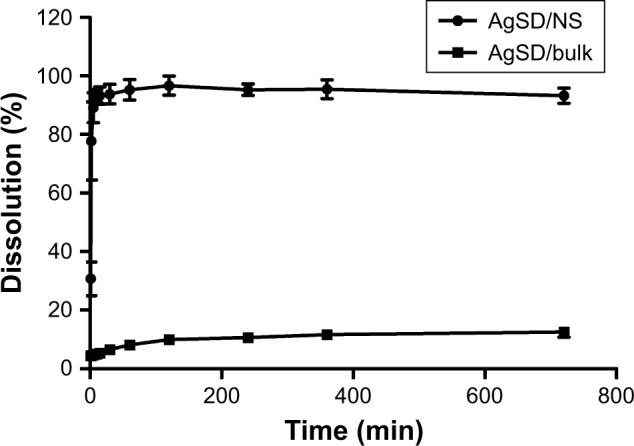
Stable AgSD/NSs with an average particle size of 369 nm were formulated while 1.5% P407 was selected as a stabilizer. The optimized AgSD/NS thermoresponsive hydrogel exhibited the gelation temperature of approximately 30°C. A significant improvement in solubility was observed for AgSD nanoparticles (96.7%) compared with AgSD coarse powders (12.5%). The results of FTIR and XRD revealed that the physicochemical properties of AgSD/NS were reserved after incorporating into the hydrogel. The cell viability after incubation with AgSD/NS-loaded thermoresponsive hydrogel improved from 60.7% to 90.6% compared with incubation with AgSD/NS directly. Drug release profiles from the thermoresponsive hydrogel increased compared with the commercial AgSD cream, implying less application frequency of AgSD cream clinically. In vitro antibacterial studies manifested that AgSD nanocrystallization significantly enhanced the antibacterial activity compared with the AgSD coarse powder.
CONCLUSION
The combination of AgSD nanosuspensions and thermoresponsive hydrogel effectively improved the AgSD antibacterial activity and decreased the cytotoxicity. This study also suggested that a poloxamer thermoresponsive hydrogel could be used as a delivery system for other nanocrystals to decrease possible nanotoxicity.
背景
磺胺嘧啶银(AgSD)被广泛用作治疗表面烧伤的抗菌剂。然而,由于药物溶解度低和可能的细胞毒性,AgSD 的抗菌活性受到了限制。
目的
本研究旨在制备具有更好的 AgSD 溶解度的稳定磺胺嘧啶银/纳米混悬剂(AgSD/NSs),并为 AgSD/NS 的输送制备合适的载体。纳米技术被用于克服 AgSD 低药物溶解速率的问题,而负载 AgSD/NS 的新载体有望降低可能的细胞毒性、增强抗菌活性和促进伤口愈合。
方法
AgSD/NSs 通过高压匀质法制备。通过冷法制备泊洛沙姆 407 为基础的温敏水凝胶作为 AgSD/NS 的载体,以获得负载 AgSD/NS 的温敏水凝胶。扫描电子显微镜(SEM)、傅里叶变换红外光谱(FTIR)和 X 射线衍射(XRD)用于测量 AgSD/NSs 和负载 AgSD/NS 的凝胶的物理化学性质。使用 L929 小鼠成纤维细胞系通过噻唑蓝比色法评估负载 AgSD/NS 的凝胶的细胞毒性。还测量了 AgSD/NSs 和负载 AgSD/NS 的凝胶的体外抗菌活性。
结果
制备了平均粒径为 369nm 的稳定 AgSD/NS,其中 1.5% P407 被选为稳定剂。优化的 AgSD/NS 温敏水凝胶的胶凝温度约为 30°C。与 AgSD 粗粉(12.5%)相比,AgSD 纳米粒子的溶解度显著提高(96.7%)。FTIR 和 XRD 的结果表明,AgSD/NS 掺入水凝胶后其物理化学性质得以保留。与直接孵育 AgSD/NS 相比,孵育负载 AgSD/NS 的温敏水凝胶后细胞活力从 60.7%提高到 90.6%。与市售磺胺嘧啶银乳膏相比,温敏水凝胶的药物释放曲线增加,这意味着临床上磺胺嘧啶银乳膏的应用频率降低。体外抗菌研究表明,与磺胺嘧啶粗粉相比,AgSD 纳米结晶显著增强了抗菌活性。
结论
AgSD 纳米混悬剂与温敏水凝胶的结合有效提高了 AgSD 的抗菌活性,降低了细胞毒性。本研究还表明,泊洛沙姆温敏水凝胶可用作其他纳米晶体的递送系统,以降低可能的纳米毒性。




 Zotero 插件