Experimental Transplantation and Immunology Branch, National Cancer Institute, Bethesda, Maryland.
School of Medicine, University of Pittsburgh, Pittsburgh, Pennsylvania.
JAMA Netw Open. 2018 Jul 6;1(3):e180706. doi: 10.1001/jamanetworkopen.2018.0706.
Clinical trials are testing vaccines that target human papillomavirus 16 (HPV-16) oncoproteins for the treatment of cervical cancer regardless of the HPV type of the tumor. For patients with HPV-18-positive cancers, this strategy relies on cross-reactivity of HPV-16-reactive T cells against the HPV-18 oncoproteins.
To determine the prevalence of HPV-16 and HPV-18 metastatic cervical cancers in women enrolling in clinical trials at a US medical center and to assess whether HPV oncoprotein-targeting tumor-infiltrating lymphocytes (TILs) and T-cell receptors (TCRs) possess HPV-16/HPV-18 oncoprotein cross-reactivity.
DESIGN, SETTING, AND PARTICIPANTS: This study was conducted at the National Institutes of Health Clinical Center, a tertiary care research hospital in the United States. The HPV type of the tumors from 65 consecutive patients with cervical cancer who were evaluated for participation in clinical trials was determined by retrospective medical record review. Immunological assays testing HPV cross-reactivity were conducted on all available archived samples of oncoprotein-reactive TILs from HPV-positive tumors (n = 16) and on a library of previously identified TCRs (n = 10).
The HPV genotype of each patient's tumor was determined. The cross-reactivity of archived TILs and a library of TCRs was assessed.
The main outcomes were the prevalence of each HPV genotype and the frequency of TILs or TCRs with HPV oncoprotein-T-cell cross-reactivity. Cross-reactivity was assessed by enzyme-linked immunospot assays and interferon-γ production assays.
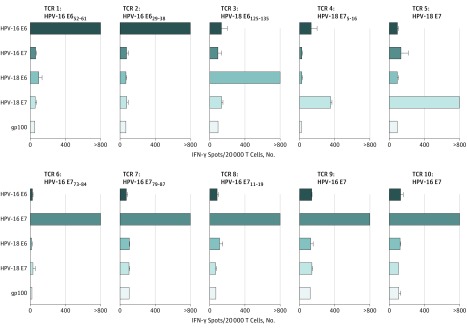
The median (range) age of 65 referred patients was 44 (24-64) years. Ethnicity was recorded for 39 of 65 patients; 35 (89.7%) were white, 3 (7.7%) were Asian, and 1 (2.6%) was American Indian/Alaskan Native. Histologic tumor subtype was recorded for 41 of 65 patients; 25 (61.0%) were squamous cell carcinomas, 12 (29.3%) were adenocarcinomas, 2 (4.9%) were adenosquamous cell carcinomas, and 2 (4.9%) were neuroendocrine tumors. Thirty-nine of 65 patients (60.0%) had HPV-16-positive tumors and 21 patients (32.3%) had HPV-18-positive tumors. In the analysis of cross-reactivity, 1 of 16 oncoprotein-reactive archived TILs (9 from cervical cancers and 7 from other cancers) displayed HPV-16/HPV-18 cross-reactivity. None of the 10 oncoprotein-reactive TCRs displayed HPV-16/HPV-18 cross-reactivity.
Cervical cancers that tested positive for HPV-18 were common in this study and may be common in other US clinical trial populations. Results showed that HPV-16/HPV-18 intergenotype T-cell cross-reactivity of T cells from HPV-16-positive and HPV-18-positive cancers was uncommon. These findings support clinical trial designs in which the HPV type targeted by a therapeutic vaccine is matched with the HPV type of a cancer and suggest a change is necessary in the design of active clinical trials.

临床试验正在测试针对人乳头瘤病毒 16(HPV-16)致癌蛋白的疫苗,用于治疗宫颈癌,而不论肿瘤的 HPV 类型如何。对于 HPV-18 阳性癌症患者,这种策略依赖于 HPV-16 反应性 T 细胞对 HPV-18 致癌蛋白的交叉反应性。
确定美国医疗中心临床试验入组患者中 HPV-16 和 HPV-18 转移性宫颈癌的流行率,并评估 HPV 致癌蛋白靶向肿瘤浸润淋巴细胞(TIL)和 T 细胞受体(TCR)是否具有 HPV-16/HPV-18 致癌蛋白的交叉反应性。
设计、地点和参与者:本研究在美国国立卫生研究院临床中心进行,这是一家美国的三级保健研究医院。通过回顾性病历审查,确定了 65 例连续评估参加临床试验的宫颈癌患者肿瘤的 HPV 类型。对所有 HPV 阳性肿瘤的 HPV 反应性 TIL 存档样本(n=16)和之前鉴定的 TCR 文库(n=10)进行 HPV 交叉反应性的免疫测定。
确定每位患者肿瘤的 HPV 基因型。评估存档 TIL 和 TCR 文库的交叉反应性。
主要结局是每个 HPV 基因型的流行率,以及 HPV 致癌蛋白 T 细胞交叉反应性的 TIL 或 TCR 的频率。通过酶联免疫斑点测定法和干扰素-γ产生测定法评估交叉反应性。
入组的 65 例患者的中位(范围)年龄为 44(24-64)岁。记录了 65 例患者中的 39 例的种族;35 例(89.7%)为白人,3 例(7.7%)为亚洲人,1 例(2.6%)为美洲印第安人/阿拉斯加原住民。记录了 65 例患者中的 41 例的组织学肿瘤亚型;25 例(61.0%)为鳞状细胞癌,12 例(29.3%)为腺癌,2 例(4.9%)为腺鳞癌,2 例(4.9%)为神经内分泌肿瘤。65 例患者中的 39 例(60.0%)HPV-16 阳性肿瘤,21 例(32.3%)HPV-18 阳性肿瘤。在交叉反应性分析中,16 个 HPV 反应性存档 TIL 中的 1 个(9 个来自宫颈癌,7 个来自其他癌症)显示 HPV-16/HPV-18 交叉反应性。10 个 HPV 反应性 TCR 中没有一个显示 HPV-16/HPV-18 交叉反应性。
本研究中 HPV-18 阳性宫颈癌很常见,在其他美国临床试验人群中可能也很常见。结果表明,HPV-16/HPV-18 型 HPV 阳性和 HPV-18 阳性癌症 T 细胞的 T 细胞之间的 HPV 基因型间的 T 细胞交叉反应性并不常见。这些发现支持治疗性疫苗靶向 HPV 类型与癌症 HPV 类型相匹配的临床试验设计,并表明需要改变正在进行的临床试验的设计。