Tran Phu V
Department of Pediatrics, University of Minnesota, Minneapolis, Minnesota, USA.
Neuroreport. 2019 Feb 6;30(3):213-216. doi: 10.1097/WNR.0000000000001186.
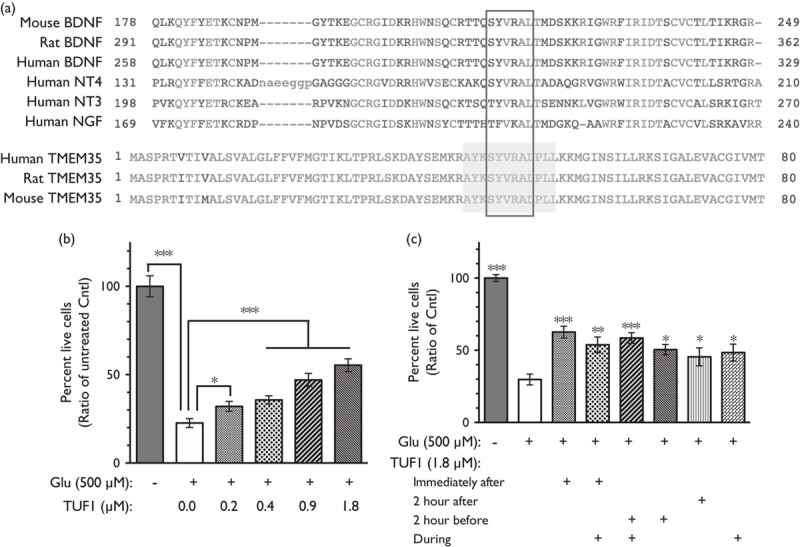
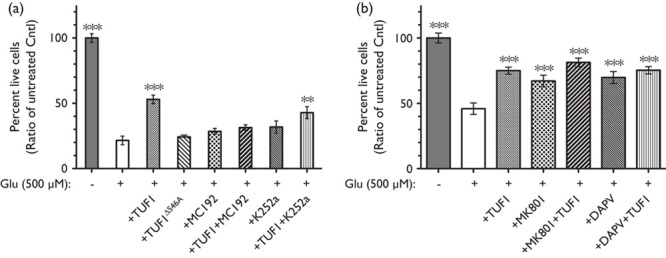
In vitro excitotoxic cell death experiments can be considered a screening model of stroke to evaluate the neuroprotective property of specific compounds. Survival of neurons following excitotoxicity is influenced by the neurotrophic factors (nerve growth factor and brain-derived neurotrophic factor). Here, a novel 12 amino-acid peptide [AYKSYVRALPLL (TUF1)] with a high level of evolutionary conservation was assessed for its neuroprotective property in an in vitro model of glutamate-induced N-methyl-D-aspartic acid receptor hyperactivation and excitotoxicity. This peptide shares 100% homology to the conserved motif (SYVRAL) of the neurotrophic factors, which is found in numerous US patents. Following exposure to toxic levels of glutamate (500 µM), cultured primary rat forebrain neurons treated with TUF1 showed a dose-dependent survival rate compared with untreated neurons. The neuroprotective effect was blocked by p75 neurotrophic receptor (p75) inhibitor (MC192), but not by tyrosine kinase receptor inhibitor (K252a) or N-methyl-D-aspartic acid receptor antagonists (MK801 and D-amino-5-phosphonovaleric acid). Serine to alanine substitution that abolishes p75 interaction showed a loss of neuroprotective effect. Collectively, the findings showed that TUF1 can protect cultured primary cortical neurons from excitotoxic cell death through the p75-dependent pathway. Given that TUF1 is derived from TMEM35 (NACHO), which is required for the assembly and expression of nicotinic acetylcholine receptors, mechanism of TUF1 action may involve organization of nicotinic acetylcholine receptor and p75 neurotrophin receptor to modulate neuronal responses, including Ca signaling, to cytotoxic events. Unlike nerve growth factor, which requires a pre-insult exposure, TUF1 has neuroprotective properties even with post-insult administration, making it a potential target for therapeutic development in mitigating neuronal damage due to stroke and brain injury.
体外兴奋性毒性细胞死亡实验可被视为中风的筛选模型,用于评估特定化合物的神经保护特性。兴奋性毒性作用后神经元的存活受神经营养因子(神经生长因子和脑源性神经营养因子)影响。在此,我们评估了一种具有高度进化保守性的新型12氨基酸肽[AYKSYVRALPLL(TUF1)]在谷氨酸诱导的N-甲基-D-天冬氨酸受体过度激活和兴奋性毒性体外模型中的神经保护特性。该肽与神经营养因子的保守基序(SYVRAL)具有100%的同源性,此保守基序在众多美国专利中都有发现。在暴露于毒性水平的谷氨酸(500μM)后,与未处理的神经元相比,用TUF1处理的原代培养大鼠前脑神经元显示出剂量依赖性的存活率。神经保护作用被p75神经营养因子受体(p75)抑制剂(MC192)阻断,但未被酪氨酸激酶受体抑制剂(K252a)或N-甲基-D-天冬氨酸受体拮抗剂(MK801和D-氨基-5-磷酸戊酸)阻断。消除p75相互作用的丝氨酸到丙氨酸的取代显示神经保护作用丧失。总体而言,研究结果表明TUF1可通过p75依赖性途径保护原代培养的皮质神经元免受兴奋性毒性细胞死亡。鉴于TUF1源自跨膜蛋白35(NACHO),而跨膜蛋白35是烟碱型乙酰胆碱受体组装和表达所必需的,TUF1的作用机制可能涉及烟碱型乙酰胆碱受体和p-75神经营养因子受体的组织,以调节神经元对细胞毒性事件的反应,包括钙信号传导。与需要损伤前暴露的神经生长因子不同,即使在损伤后给药,TUF1也具有神经保护特性,这使其成为减轻中风和脑损伤所致神经元损伤的治疗开发的潜在靶点。