Shin Tae Gun, Kim Youn-Jung, Ryoo Seung Mok, Hwang Sung Yeon, Jo Ik Joon, Chung Sung Phil, Choi Sung-Hyuk, Suh Gil Joon, Kim Won Young
Departm and nd t of Emergency Medicine, Samsung Medical Center, Sungkyunkwan University School of Medicine, Seoul 06351, Korea.
Department of Emergency Medicine, Asan Medical Center, University of Ulsan College of Medicine, Seoul 05505, Korea.
J Clin Med. 2019 Jan 16;8(1):102. doi: 10.3390/jcm8010102.
Intravenous vitamin C and thiamine administration may be a potential adjuvant therapy for septic shock. We aimed to investigate the impact of early vitamin C and thiamine administration in septic shock patients.
This retrospective before-and-after cohort study used data extracted from the Korean Shock Society's prospective septic shock registry. We compared 28-day and in-hospital mortality rates between patients treated with intravenous vitamin C (3 g/12 h or 1.5 g/6 h) and thiamine (200 mg/12 h) <6 hours after shock recognition from July through December 2017 ( = 229) and control patients from October 2015 through June 2017 ( = 915) using propensity score matching.
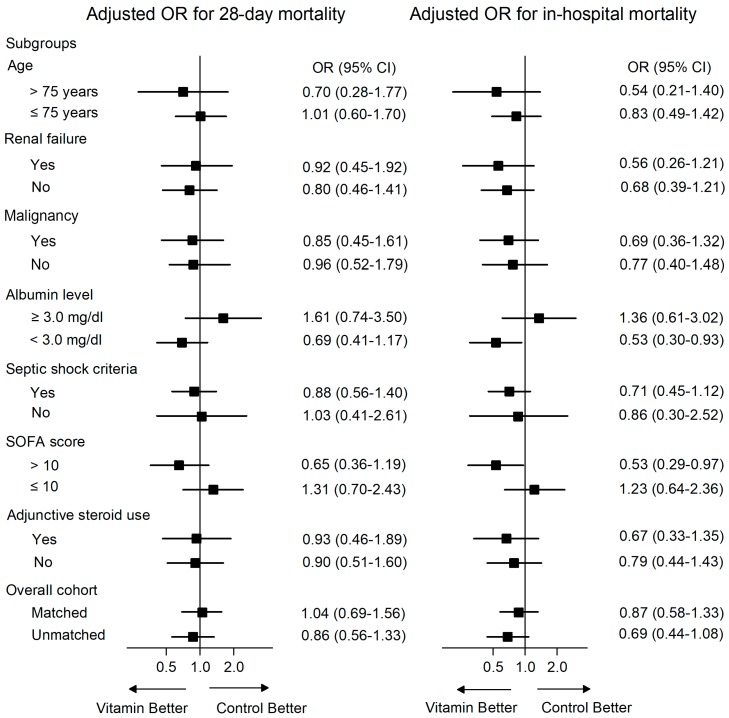
The 28-day (18.3% vs. 17.5%; = 0.76) and in-hospital (16.6% vs. 18.3%; = 0.55) mortality rates did not differ between treatment and control groups, nor did 28-day (18.5% vs. 17.5%; = 0.84) and in-hospital (16.7% vs. 18.4%; = 0.54) mortality rates after matching. In the subgroup analysis, treatment was associated with lower in-hospital mortality rates in patients with albumin <3.0 mg/dL or a Sequential Organ Failure Assessment (SOFA) score >10.
Early vitamin C and thiamine administration in patients with septic shock did not improve survival; however, administration could benefit conditions that are more severe, such as hypoalbuminemia or severe organ failure.
静脉注射维生素C和硫胺素可能是脓毒性休克的一种潜在辅助治疗方法。我们旨在研究早期给予维生素C和硫胺素对脓毒性休克患者的影响。
这项回顾性前后队列研究使用了从韩国休克协会前瞻性脓毒性休克登记处提取的数据。我们比较了2017年7月至12月休克识别后<6小时接受静脉注射维生素C(3g/12小时或1.5g/6小时)和硫胺素(200mg/12小时)治疗的患者(n = 229)与2015年10月至2017年6月的对照患者(n = 915)的28天和住院死亡率,采用倾向评分匹配法。
治疗组和对照组之间的28天死亡率(18.3%对17.5%;P = 0.76)和住院死亡率(16.6%对18.3%;P = 0.55)没有差异,匹配后的28天死亡率(18.5%对17.5%;P = 0.84)和住院死亡率(16.7%对18.4%;P = 0.54)也没有差异。在亚组分析中,对于白蛋白<3.0mg/dL或序贯器官衰竭评估(SOFA)评分>10的患者,治疗与较低的住院死亡率相关。
脓毒性休克患者早期给予维生素C和硫胺素并不能提高生存率;然而,给药可能对更严重的情况有益,如低白蛋白血症或严重器官衰竭。