Department of Food Science, Faculty of Food Science and Technology, Universiti Putra Malaysia, 43400 UPM Serdang, Selangor Darul Ehsan, Malaysia.
Department of Food Technology, Faculty of Food Science and Technology, Universiti Putra Malaysia, 43400 UPM Serdang, Selangor Darul Ehsan, Malaysia.
Molecules. 2019 Jan 16;24(2):320. doi: 10.3390/molecules24020320.
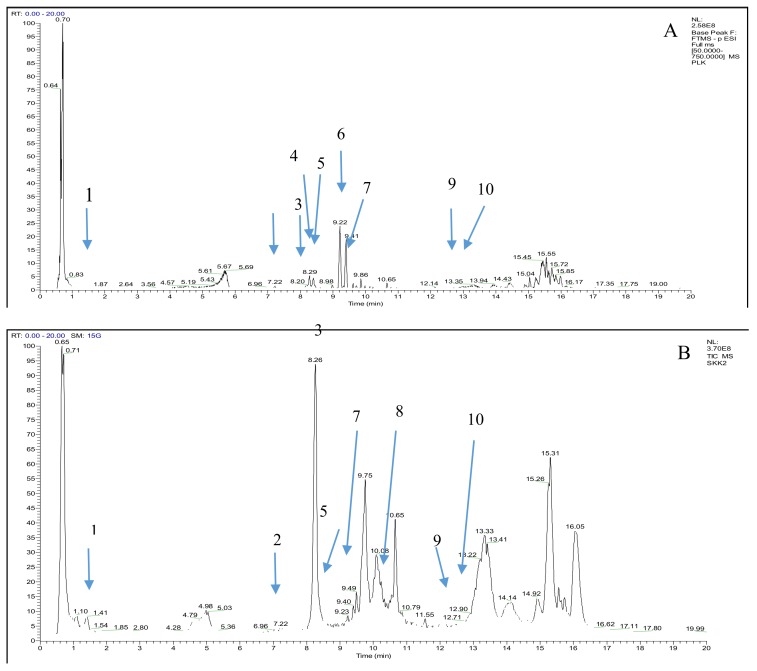
fruit, the hybrid forms between (mango) and (), has been shown to exhibit potential antioxidant activity, and the fruit waste could demonstrate functional and nutritional potential. In the present study, the nutritional composition (proximate, sugars, vitamins and minerals analyses), the anti-diabetic activities and phytochemical profile of peel and seed kernel were investigated for the first time. The results indicated that seed kernel rich in fat, protein, carbohydrate, and ash while peel contained significantly greater amount of fiber, minerals, β-Carotene and ascorbic acid compared to seed kernel. The samples were then extracted using different solvents (acetone, ethanol, methanol at 60%, / and pure deionized water) and their anti-diabetic activities (-amylase and -glucosidase inhibition assay) were determined. Seed kernel had the lowest IC values for α-amylase and -glucosidase inhibition assay in 60% ethanol and 60% acetone, respectively. Due to the toxic effect and high volatility of acetone, the ethanolic extracts of samples were further analyses for their phytochemical profile using high performance liquid chromatography-mass spectrometry (LC-MS) and ultra-high-performance liquid chromatography electrospray ionization orbitrap tandem mass spectrometry (UHPLC-ESI-Orbitrap-MS/MS). The most abundant compounds identified were phenolic acid, ellagic acid, and flavonoid. These findings suggest that fruit wastes, especially the seed kernel possesses promising ability to be used as functional ingredient in the food industry.
水果,芒果和番荔枝的杂交品种,已被证明具有潜在的抗氧化活性,而水果废料可能具有功能性和营养潜力。本研究首次对 果皮和种子仁的营养成分(常规分析、糖、维生素和矿物质分析)、抗糖尿病活性和植物化学特征进行了研究。结果表明,种子仁富含脂肪、蛋白质、碳水化合物和灰分,而果皮中纤维、矿物质、β-胡萝卜素和抗坏血酸的含量明显高于种子仁。然后,使用不同溶剂(丙酮、乙醇、甲醇 60%、/和纯水)提取样品,并测定其抗糖尿病活性(-淀粉酶和 -葡萄糖苷酶抑制试验)。种子仁在 60%乙醇和 60%丙酮中的α-淀粉酶和 -葡萄糖苷酶抑制试验的 IC 值最低。由于丙酮的毒性作用和高挥发性,使用高效液相色谱-质谱联用仪(LC-MS)和超高效液相色谱-电喷雾离子轨道阱串联质谱联用仪(UHPLC-ESI-Orbitrap-MS/MS)对样品的乙醇提取物进行了进一步的植物化学特征分析。鉴定出的最丰富的化合物是酚酸、鞣花酸和类黄酮。这些发现表明,番荔枝废料,特别是种子仁具有作为食品工业功能性成分的应用潜力。