Gbagbo Fred Yao, Nkrumah Jacqueline
Department of Health Administration and Education, University of Education Winneba, Faculty of Science Education, P.O. Box 25, Winneba, Ghana.
BMC Womens Health. 2019 Jan 17;19(1):12. doi: 10.1186/s12905-019-0708-3.
Globally, the rate of unplanned pregnancies among students at institutions of higher education, continue to increase annually despite the universal awareness and availability of contraceptives to the general population. This study examined family planning among undergraduate university students focusing on their knowledge, use and attitudes towards contraception in the University of Education Winneba.
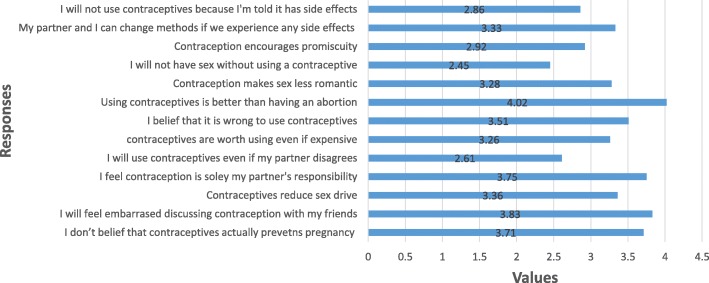
The study was a descriptive cross-sectional survey using a structured self-administered questionnaire. One hundred undergraduate students from the University of Education Winneba were selected using a multistage simple random sampling technique. A Likert scale was used to assess the attitude of the respondents towards family planning methods.
Findings show that the respondents had a positive attitude towards family planning with an average mean score of about 4.0 using a contraceptive attitude Likert scale. Knowledge of contraception, awareness and benefits however do not commensurate contraceptive use among undergraduate students since availability, accessibility and preference influence usage. Emergency Contraception (Lydia) was reported as easy to get contraceptive, hence the most frequently used contraceptive (31%) among young female students aged 21-24 years who appeared as the most vulnerable in accessing and using contraceptives due to perceived social stigma.
The observation that levels of Family Planning awareness levels do not commensurate knowledge and usage levels calls for more innovative strategies for contraceptive promotion, and Education on the various university campus. The study recommends that public Universities in Ghana should consider a possible curriculum restructuring to incorporate family planning updates. In this regard, a nationwide mixed method study targeting other tertiary institutions including colleges of education in Ghana is required to explore the topic further to inform policy and programme decisions.
在全球范围内,尽管普通民众对避孕措施普遍知晓且易于获取,但高等教育机构学生中的意外怀孕率仍逐年上升。本研究调查了温尼巴教育大学本科大学生的计划生育情况,重点关注他们对避孕的知识、使用情况和态度。
本研究是一项描述性横断面调查,采用结构化自填式问卷。使用多阶段简单随机抽样技术从温尼巴教育大学选取了100名本科学生。采用李克特量表评估受访者对计划生育方法的态度。
研究结果表明,受访者对计划生育持积极态度,使用避孕态度李克特量表的平均得分约为4.0。然而,本科生对避孕知识、认知和益处的了解与避孕措施的使用并不匹配,因为可获得性、可及性和偏好会影响使用情况。紧急避孕药(丽迪亚)被报告为易于获得的避孕药,因此在21至24岁的年轻女学生中是最常用的避孕药(31%),这些女学生由于感受到社会耻辱感,在获取和使用避孕药方面似乎最为脆弱。
计划生育意识水平与知识和使用水平不匹配的观察结果表明,需要在各大学校园采取更具创新性的避孕推广和教育策略。该研究建议加纳的公立大学应考虑可能的课程重组,以纳入计划生育的最新内容。在这方面,需要在全国范围内针对包括加纳教育学院在内的其他高等院校开展一项混合方法研究,以进一步探讨该主题,为政策和项目决策提供信息。