Zhang Lei, Wang Wei, Qiao Qian-Qian, Bu Xue-Shan, Tang Ling-Hua, Jia Yi-Fan, Xia Zhong-Yuan, Meng Qing-Tao
Wuhan University, Renmin Hospital, Department of Anesthesiology, Wuhan, China; Wuhan University, Renmin Hospital, Laboratory of Anesthesiology and Critical Care Medicine, Wuhan, China.
Wuhan University, Renmin Hospital, Department of Anesthesiology, Wuhan, China; Wuhan University, Renmin Hospital, Laboratory of Anesthesiology and Critical Care Medicine, Wuhan, China.
Braz J Anesthesiol. 2019 Mar-Apr;69(2):160-167. doi: 10.1016/j.bjan.2018.09.011. Epub 2019 Jan 14.
Dexmedetomidine has demonstrated protective effects against lung injury in vitro. Here, we investigated whether dexmedetomidine preconditioning protected against lung injury in hemorrhagic shock rats.
Male Sprague-Dawley rats were randomly divided into four groups ( = 8): control group, hemorrhagic shock group, 5 ug.kg dexmedetomidine (DEX1) group, and 10 ug.kg dexmedetomidine (DEX2) group. Saline or dexmedetomidine were administered over 20 min. 30 min after injection, hemorrhage was initiated in the hemorrhagic shock, DEX1 and DEX2 group. Four hours after resuscitation, protein and cellular content in bronchoalveolar lavage fluid, and the lung histopathology were measured. The malondialdehyde, superoxide dismutase, Bcl-2, Bax and caspase-3 were also tested in the lung tissue.
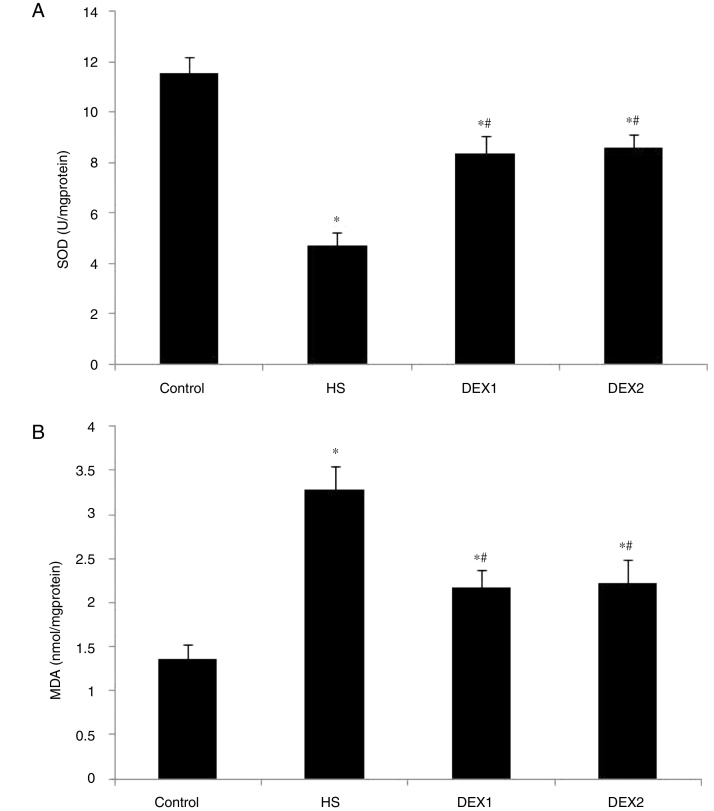
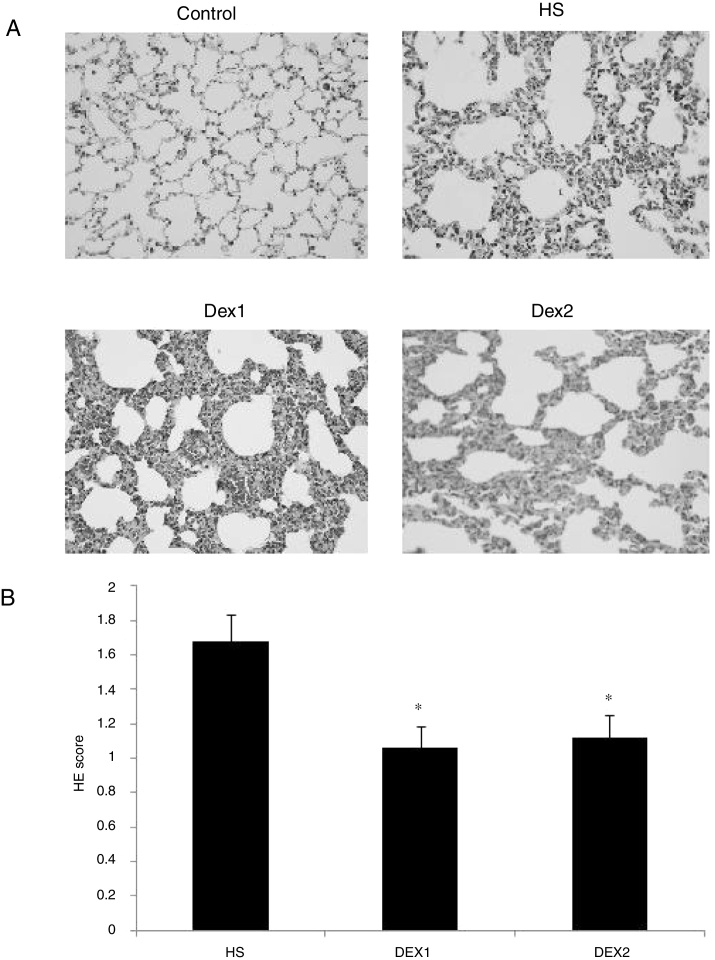
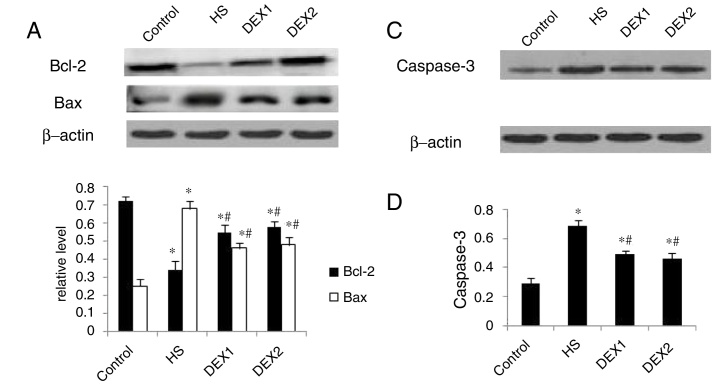
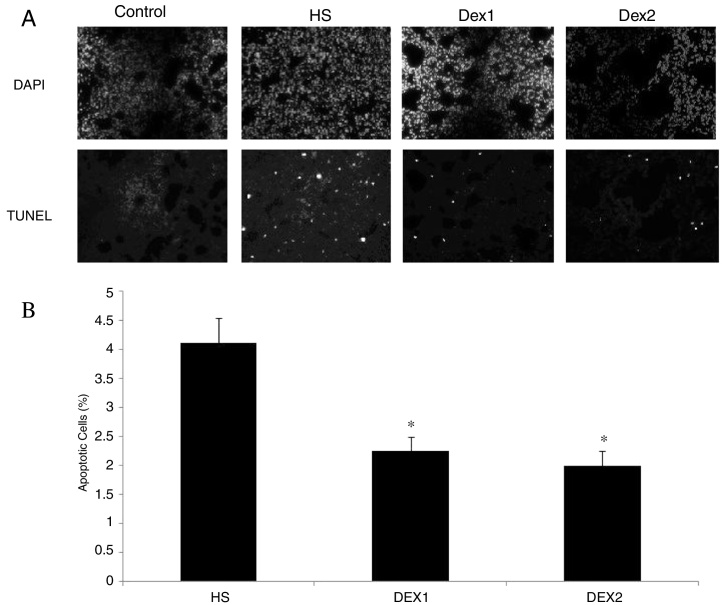
Compare with hemorrhagic shock group, 5 ug.kg dexmedetomidine pretreatment reduced the apoptosis (2.25 ± 0.24 vs. 4.12 ± 0.42%, < 0.05), histological score (1.06 ± 0.12 vs. 1.68 ± 0.15, < 0.05) and protein (1.92 ± 0.38 vs. 3.95 ± 0.42 mg.mL, < 0.05) and WBC (0.42 ± 0.11 vs. 0.92 ± 0.13 × 10/L, < 0.05) in bronchoalveolar lavage fluid. Which is correlated with increased superoxide dismutase activity (8.35 ± 0.68 vs. 4.73 ± 0.44 U.mg protein, < 0.05) and decreased malondialdehyde (2.18 ± 0.19 vs. 3.28 ± 0.27 nmoL.mg protein, < 0.05). Dexmedetomidine preconditioning also increased the Bcl-2 level (0.55 ± 0.04 vs. 0.34 ± 0.05, < 0.05) and decreased the level of Bax (0.46 ± 0.03 vs. 0.68 ± 0.04, < 0.05), caspase-3 (0.49 ± 0.03 vs. 0.69 ± 0.04, < 0.05). However, we did not observe any difference between the DEX1 and DEX2 groups for these ( > 0.05).
Dexmedetomidine preconditioning has a protective effect against lung injury caused by hemorrhagic shock in rats. The potential mechanisms involved are the inhibition of cell death and improvement of antioxidation. But did not show a dose-dependent effect.
右美托咪定在体外已显示出对肺损伤的保护作用。在此,我们研究了右美托咪定预处理是否能保护失血性休克大鼠免受肺损伤。
雄性Sprague-Dawley大鼠随机分为四组(每组n = 8):对照组、失血性休克组、5 μg·kg右美托咪定(DEX1)组和10 μg·kg右美托咪定(DEX2)组。在20分钟内给予生理盐水或右美托咪定。注射后30分钟,对失血性休克组、DEX1组和DEX2组开始进行出血。复苏4小时后,测量支气管肺泡灌洗液中的蛋白质和细胞成分,以及肺组织病理学。还对肺组织中的丙二醛、超氧化物歧化酶、Bcl-2、Bax和半胱天冬酶-3进行了检测。
与失血性休克组相比,5 μg·kg右美托咪定预处理降低了细胞凋亡(2.25±0.24%对4.12±0.42%,P<0.05)、组织学评分(1.06±0.12对1.68±0.15,P<0.05)、蛋白质(1.92±0.38对3.95±0.42 mg·mL,P<0.05)以及支气管肺泡灌洗液中的白细胞(0.42±0.11对0.92±0.13×10⁹/L,P<0.05)。这与超氧化物歧化酶活性增加(8.35±0.68对4.73±0.44 U·mg蛋白质,P<0.05)和丙二醛降低(2.18±0.19对3.28±0.27 nmol·mg蛋白质,P<0.05)相关。右美托咪定预处理还增加了Bcl-2水平(0.55±0.04对0.34±0.05,P<0.05),并降低了Bax水平(0.46±0.03对0.68±0.04,P<0.05)、半胱天冬酶-3水平(0.49±0.03对0.69±0.04,P<0.05)。然而,我们未观察到DEX1组和DEX2组在这些方面存在任何差异(P>0.05)。
右美托咪定预处理对大鼠失血性休克所致肺损伤具有保护作用。其潜在机制包括抑制细胞死亡和改善抗氧化作用。但未显示出剂量依赖性效应。