Jiang Dandan, Song Yuhua, Cao Weihong, Wang Xingang, Jiang Danni, Lv Zhidong, Yang Zhaochuan, Li Funian
Breast Center, The Affiliated Hospital of Qingdao University, Qingdao, Shandong 266003, P.R. China.
Imaging Department, The Affiliated Hospital of Qingdao University, Qingdao, Shandong 266003, P.R. China.
Oncol Lett. 2019 Jan;17(1):1071-1079. doi: 10.3892/ol.2018.9688. Epub 2018 Nov 12.
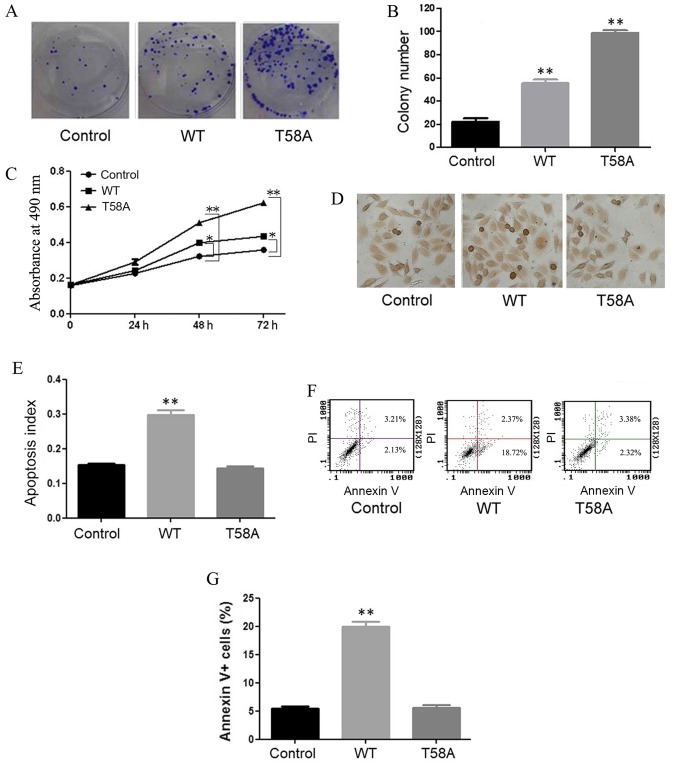
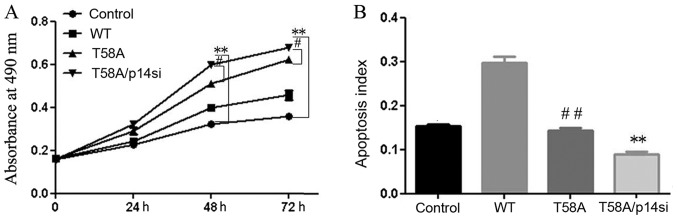
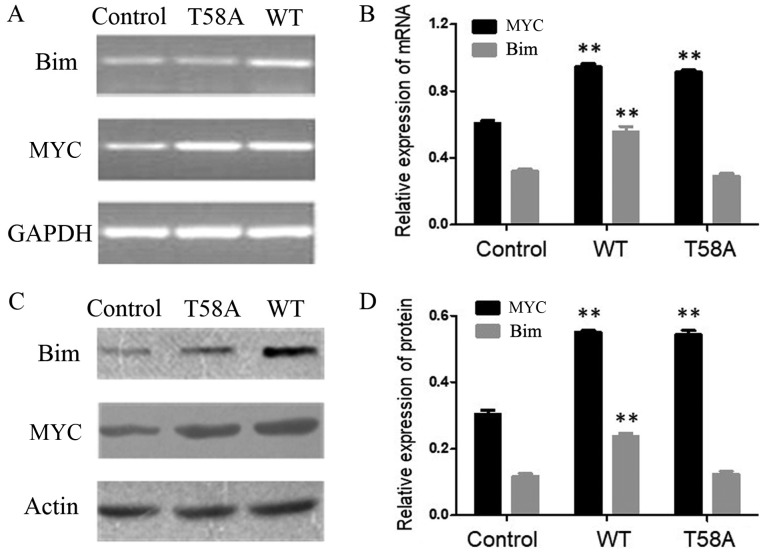
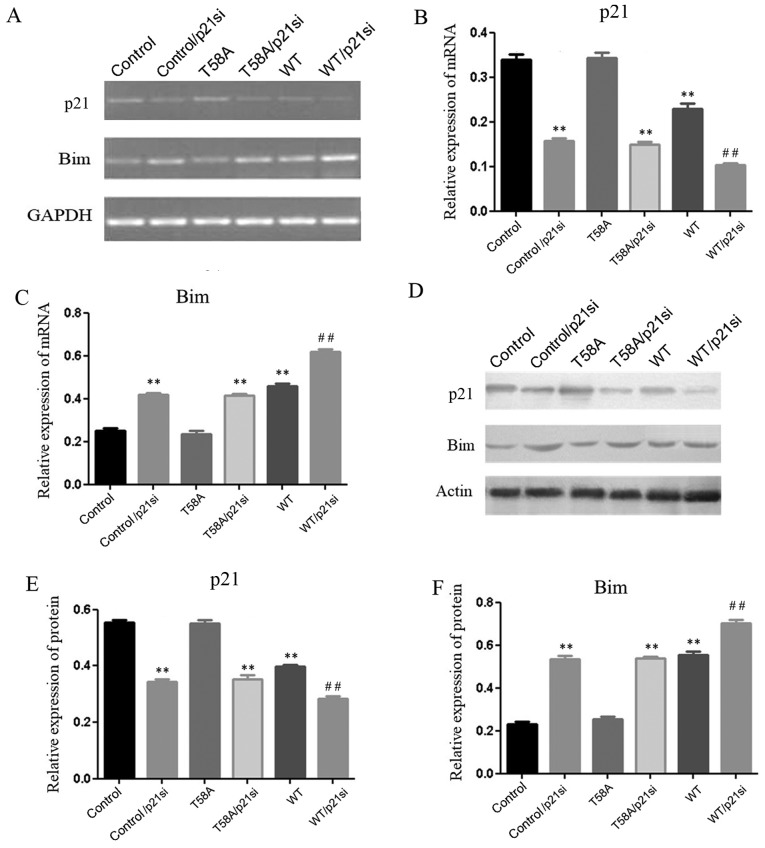
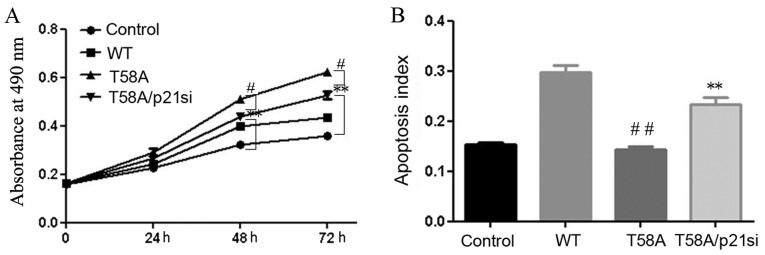
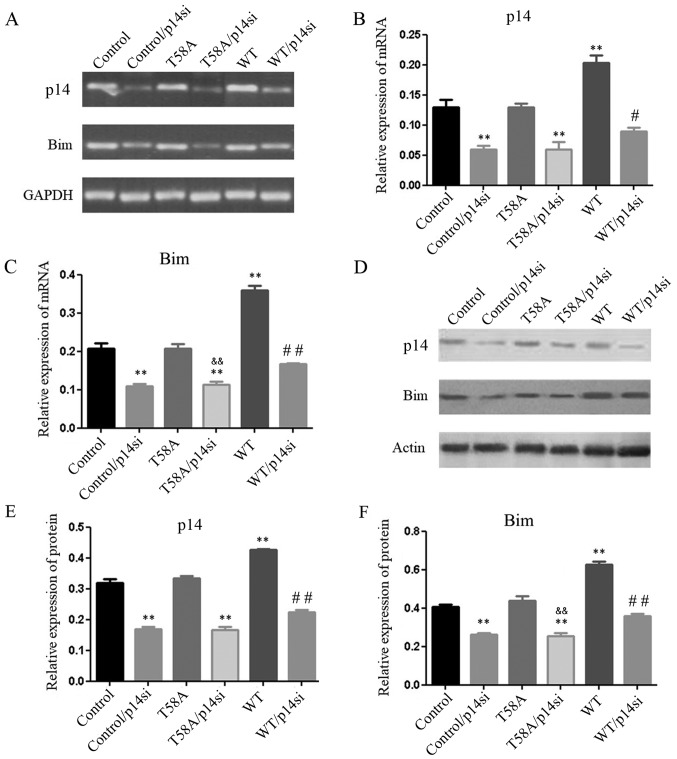
Myc proto-oncogene (MYC) is an oncoprotein that promotes proliferation and apoptosis. MYC mutations frequently disrupt the apoptotic processes during tumorigenesis. In the present study, the effects of the MYC point mutation T58A on the progression of a cellular tumor antigen p53 (p53) human breast cancer cell line was analyzed, and the mechanism of p53-independent MYC-induced apoptosis was investigated. HCC1937 cells were transfected with mutant (T58A) or wild-type (WT) MYC using lentiviral vectors. The proliferation of transfected cells was evaluated by colony formation and MTT assays, and apoptosis was analyzed by flow cytometry and terminal deoxynucleotidyl transferase-mediated dUTP nick end labeling assays. WT MYC was transfected into HCC1937 cells exhibiting p14/p21 silencing through lentivirus-mediated RNA interference. The expression levels of Bim were detected by reverse transcription-quantitative polymerase chain reaction and western blot analyses. Mutant MYC proteins retained the ability to stimulate the proliferation of HCC1937 cells, although they were defective at promoting apoptosis due to a failure to induce the Bcl-2 homology 3 domain-only protein Bim. When p14 was silenced, the effects of mutant MYC on proliferation and apoptosis were weakened. When p21 was silenced, the effects of mutant MYC were strengthened. Breast cancer-derived T58A MYC mutations are unable to activate Bim due to their failure to regulate p14/p21. It was concluded that mutant MYC was more effective compared with WT MYC at promoting the progression of breast cancer.
Myc原癌基因(MYC)是一种促进细胞增殖和凋亡的癌蛋白。MYC突变在肿瘤发生过程中经常破坏凋亡进程。在本研究中,分析了MYC点突变T58A对细胞肿瘤抗原p53(p53)人乳腺癌细胞系进展的影响,并研究了p53非依赖性MYC诱导凋亡的机制。使用慢病毒载体将突变型(T58A)或野生型(WT)MYC转染至HCC1937细胞。通过集落形成和MTT试验评估转染细胞的增殖,并通过流式细胞术和末端脱氧核苷酸转移酶介导的dUTP缺口末端标记试验分析凋亡情况。通过慢病毒介导的RNA干扰将WT MYC转染至表现出p14/p21沉默的HCC1937细胞中。通过逆转录定量聚合酶链反应和蛋白质印迹分析检测Bim的表达水平。突变型MYC蛋白保留了刺激HCC1937细胞增殖的能力,尽管由于未能诱导仅含Bcl-2同源结构域3的蛋白Bim而在促进凋亡方面存在缺陷。当p14沉默时,突变型MYC对增殖和凋亡的影响减弱。当p21沉默时,突变型MYC的影响增强。乳腺癌来源的T58A MYC突变由于无法调节p14/p21而无法激活Bim。得出的结论是,与WT MYC相比,突变型MYC在促进乳腺癌进展方面更有效。