National Advanced School of Engineering, University of Yaounde I, PO Box 8390, Yaounde, Cameroon.
Department of Paediatrics, Faculty of Medicine and Biomedical Sciences, University of Yaounde I, Yaounde, Cameroon.
Drugs R D. 2019 Mar;19(1):1-14. doi: 10.1007/s40268-018-0259-3.
Artemisinin-based combination therapies (ACTs) are the first-line antimalarial drugs used to treat uncomplicated Plasmodium falciparum alaria in many endemic countries worldwide. The present work reviewed the therapeutic efficacy of ACT in Cameroon more than 10 years after the initial change in national drug policy in 2004.
A PubMed literature search was performed to analyse clinical trials conducted in Cameroon from 2001 to May 2017. Clinical studies that evaluated ACT for the treatment of uncomplicated falciparum malaria in children or adults, and reported efficacy and/or safety, were included. In addition, a small network meta-analysis (NMA) with a frequentist approach was performed.
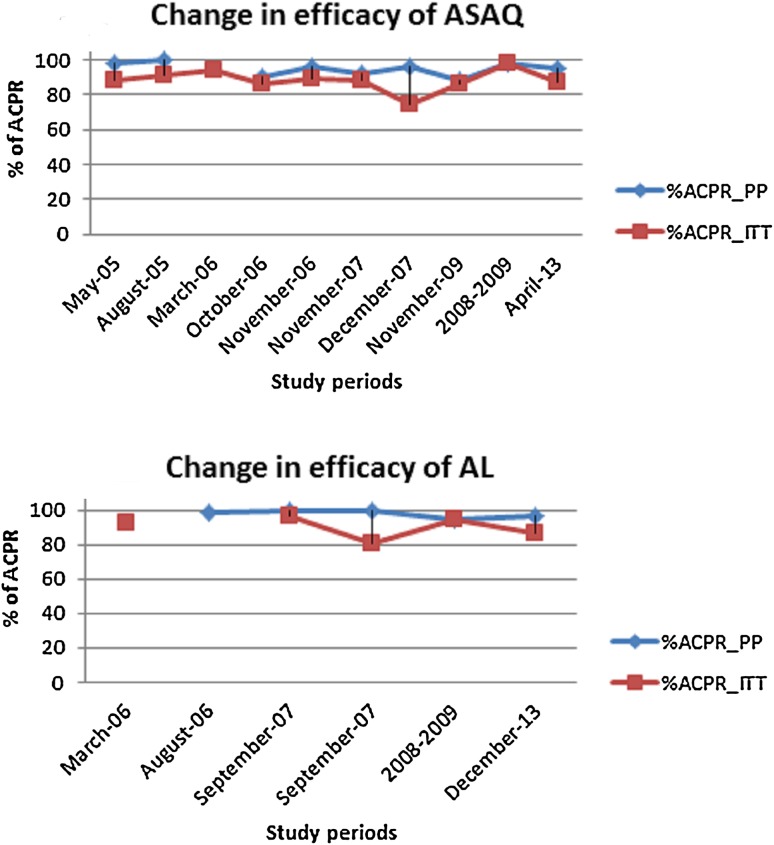
Six papers were selected from 48 articles screened and were full-text reviewed. The efficacy of both artemether-lumefantrine (AL) and artesunate-amodiaquine (ASAQ) ranged from moderate to high, with polymerase chain reaction-corrected cure rates ranging from 96.7 to 100% and 88.2 to 100%, respectively, in per-protocol analysis, and 86.2 to 96.7% and 74.0 to 90.6%, respectively, in intention-to-treat analysis. The malaria evidence network suggested that AL and ASAQ efficacies were comparable. The highest day 3 parasite positivity rate was 8.2% for ASAQ and 4% for AL. A novel ACT, artesunate-atovaquoneproguanil (ASATPG) was tested once and showed a cure rate of 100%. Based on an ITT approach, the NMA revealed that AL was more efficacious than ASAQ, but the difference was not statistical significant (706 participants, three randomised clinical trials (RCT); OR 1.25, 95%CI 0.78-2.00). Adverse events ranged from mild to moderate severity but were not directly attributed to drug intake.
ACTs are still effective and safe in Cameroon; however, there are insufficient data on their efficacy, safety and tolerability, therefore more RCTs should be conducted, including novel ACTs.
在全球许多流行疟疾的国家,青蒿素类复方疗法(ACT)是治疗无并发症恶性疟原虫疟疾的一线抗疟药物。本研究回顾了 2004 年国家药物政策改变 10 多年后,在喀麦隆使用 ACT 的治疗效果。
通过 PubMed 文献检索,对 2001 年至 2017 年 5 月在喀麦隆进行的临床试验进行了分析。纳入评估儿童或成人无并发症恶性疟原虫疟疾治疗的 ACT 的临床研究,并报告了疗效和/或安全性。此外,还进行了一项基于频繁主义的小网络荟萃分析(NMA)。
从筛选出的 48 篇文章中选择了 6 篇全文进行了回顾。青蒿琥酯-咯萘啶(AL)和青蒿琥酯-阿莫地喹(ASAQ)的疗效均为中高度,聚合酶链反应校正后的治愈率分别为 96.7%至 100%和 88.2%至 100%,意向治疗分析中分别为 86.2%至 96.7%和 74.0%至 90.6%。疟疾证据网络表明,AL 和 ASAQ 的疗效相当。ASAQ 的第 3 天寄生虫阳性率最高为 8.2%,AL 为 4%。一种新型 ACT,青蒿琥酯-阿托伐醌-丙氨酸(ASATPG)曾被测试过一次,治愈率为 100%。基于意向治疗分析,NMA 显示 AL 比 ASAQ 更有效,但差异无统计学意义(706 名参与者,3 项随机临床试验(RCT);OR 1.25,95%CI 0.78-2.00)。不良事件的严重程度从轻度到中度不等,但不能直接归因于药物摄入。
ACT 在喀麦隆仍然有效且安全;然而,关于其疗效、安全性和耐受性的数据不足,因此应开展更多的 RCT,包括新型 ACT。