Section of Plastic Surgery, Department of Surgery, University of Michigan Medical School, Ann Arbor.
Center for Statistical Consulting and Research, University of Michigan, Ann Arbor.
JAMA Netw Open. 2019 Jan 4;2(1):e187053. doi: 10.1001/jamanetworkopen.2018.7053.
Complications affect treatment outcomes and quality of life in addition to increasing treatment costs.
To evaluate complication rates after the treatment of a distal radius fracture, to determine whether the rate or complication type is associated with treatment method, and to determine predictors of complications.
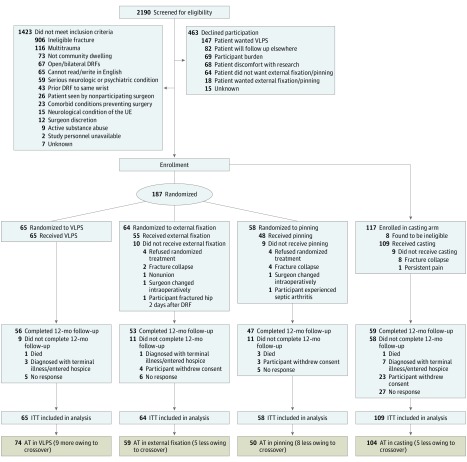
DESIGN, SETTING, AND PARTICIPANTS: The multicenter Wrist and Radius Injury Surgical Trial (WRIST), a randomized clinical trial, enrolled participants from April 10, 2012, to December 31, 2016. The study included 304 adults 60 years or older with isolated unstable distal radius fractures; 187 were randomized and 117 opted for casting. The study was conducted at 24 health systems in the United States, Canada, and Singapore. Data for this secondary analysis were collected from April 24, 2012, to February 28, 2018.
Participants opting for surgery were randomized to receive the volar locking plate system (n = 65), percutaneous pinning (n = 58), or bridging external fixation with or without supplemental pinning (n = 64). Patients who chose not to have surgery (n = 117) were not randomized and were enrolled for casting.
Complication rate.
The WRIST enrolled a total of 304 participants, of whom 8 casting group participants were later found to be ineligible and were excluded from the analysis, leaving 296 participants. Randomized participants' mean (SD) age was 68 (7.2) years, 163 (87%) were female, and 165 (88%) were white. Casting participants' mean (SD) age was 75.6 (9.6) years, 93 (84%) were female, and 85 (85%) were white. The most common type of complications varied by treatment. Twelve of 65 participants (18.5%) in the internal fixation group reported a median nerve compression, while 16 of 26 participants (25.8%) who received external fixation and 13 of 56 participants (23.2%) who received pinning sustained pin site infections. Compared with the internal fixation group, complication rate for any severity complication was higher in participants who initially received casting (adjusted rate ratio, 1.88; 95% CI, 1.22-2.88), whereas the rate for moderate complications was higher in the external fixation group (adjusted rate ratio, 2.52; 95% CI, 1.25-5.09).
The distal radius fracture treatment decision-making process for older patients should incorporate a complication profile for each treatment type. For example, external fixation and pinning could be used for patients after apprising them of pin site infection risk. Internal fixation can be done in patients with high functional demands who are willing to receive surgery. Internal fixation use should be substantiated owing to the time and cost involved.
ClinicalTrials.gov Identifier: NCT01589692.
并发症除了增加治疗成本外,还会影响治疗效果和生活质量。
评估桡骨远端骨折治疗后的并发症发生率,确定并发症的类型和发生率是否与治疗方法有关,并确定并发症的预测因素。
设计、地点和参与者:多中心腕关节和桡骨损伤手术试验(WRIST)是一项随机临床试验,于 2012 年 4 月 10 日至 2016 年 12 月 31 日期间从美国、加拿大和新加坡的 24 个医疗系统中招募参与者。研究包括 304 名 60 岁及以上的孤立性不稳定桡骨远端骨折患者;其中 187 名随机分组,117 名选择石膏固定。这项二次分析的数据收集于 2012 年 4 月 24 日至 2018 年 2 月 28 日进行。
选择手术治疗的患者被随机分配接受掌侧锁定钢板系统(n=65)、经皮钢针固定(n=58)或桥接外固定加或不加辅助钢针固定(n=64)。选择不手术治疗的(n=117)患者未进行随机分组,纳入石膏固定组。
并发症发生率。
WRIST 共纳入 304 名参与者,其中 8 名石膏固定组参与者后来被发现不符合纳入标准并被排除在分析之外,最终纳入 296 名参与者。随机分组参与者的平均(标准差)年龄为 68(7.2)岁,163 名(87%)为女性,165 名(88%)为白人。石膏固定组参与者的平均(标准差)年龄为 75.6(9.6)岁,93 名(84%)为女性,85 名(85%)为白人。最常见的并发症类型因治疗方法而异。掌侧钢板内固定组 65 名参与者中有 12 名(18.5%)报告正中神经受压,而外固定组 26 名参与者中有 16 名(25.8%)和经皮钢针固定组 56 名参与者中有 13 名(23.2%)发生钢针部位感染。与掌侧钢板内固定组相比,初始接受石膏固定的参与者发生任何严重程度并发症的几率更高(调整后的发生率比,1.88;95%CI,1.22-2.88),而外固定组发生中度并发症的几率更高(调整后的发生率比,2.52;95%CI,1.25-5.09)。
对于老年患者,桡骨远端骨折的治疗决策过程应综合考虑每种治疗类型的并发症情况。例如,外固定和钢针固定可用于告知患者存在针道感染风险的患者。对于功能要求高且愿意接受手术的患者,可以进行内固定治疗。鉴于内固定治疗涉及的时间和成本,应合理使用内固定治疗。
ClinicalTrials.gov 标识符:NCT01589692。
