Center for the Study of Traumatic Stress, Department of Psychiatry, Uniformed Services University of the Health Sciences, 4301 Jones Bridge Road, Bethesda, MD, 20814, USA.
Department of Health Care Policy, Harvard Medical School, 180 Longwood Avenue, Boston, MA, 02115, USA.
BMC Psychiatry. 2019 Jan 18;19(1):31. doi: 10.1186/s12888-018-1978-2.
Although the majority of active duty U.S. Army soldiers are full-time personnel in the Active Component (AC), a substantial minority of soldiers on active duty are in the Reserve Components (RCs). These "citizen-soldiers" (Army National Guard and Army Reserve) represent a force available for rapid activation in times of national need. RC soldiers experience many of the same stressors as AC soldiers as well as stressors that are unique to their intermittent service. Despite the important role of RC soldiers, the vast majority of military mental health research focuses on AC soldiers. One important goal of the Army Study to Assess Risk and Resilience in Servicemembers (Army STARRS) is to address this gap. Here we examine predictors of suicide attempts among activated RC soldiers.
This longitudinal, retrospective cohort study used individual-level person-month records from Army and Department of Defense administrative data systems to examine socio-demographic, service-related, and mental health predictors of medically documented suicide attempts among activated RC soldiers during 2004-2009. Data from all 1103 activated RC suicide attempters and an equal-probability sample of 69,867 control person-months were analyzed using a discrete-time survival framework.
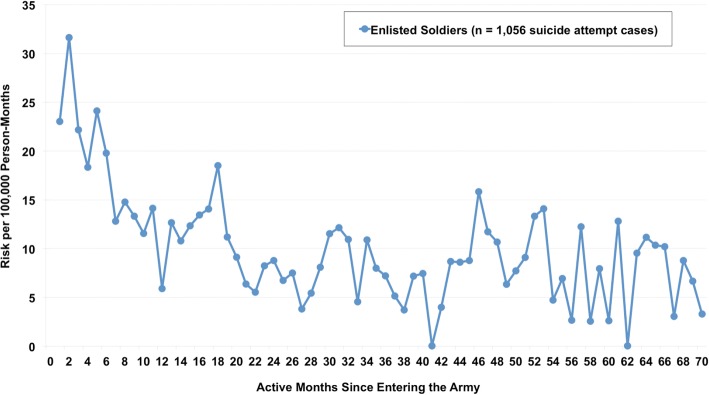
Enlisted soldiers comprised 84.3% of activated RC soldiers and accounted for 95.7% of all activated RC suicide attempts (overall rate = 108/100,000 person-years, more than four times the rate among officers). Multivariable predictors of enlisted RC suicide attempts included being female, entering Army service at age ≥ 25, current age < 30, non-Hispanic white, less than high school education, currently married, having 1-2 years of service, being previously deployed (vs. currently deployed), and history of mental health diagnosis (particularly when documented in the previous month). Predictors among RC officers (overall rate = 26/100,000 person-years) included being female and receiving a mental health diagnosis in the previous month. Discrete-time hazard models showed suicide attempt risk among enlisted soldiers was inversely associated with time in service.
Risk factors for suicide attempt in the RCs were similar to those previously observed in the AC, highlighting the importance of research and prevention focused on RC enlisted soldiers in the early phases of Army service and those with a recent mental health diagnosis.
尽管大多数现役美国陆军士兵是现役部队(AC)的全职人员,但仍有相当一部分现役士兵在预备役部队(RCs)中服役。这些“公民士兵”(陆军国民警卫队和陆军预备役)代表了在国家需要时可迅速动员的力量。RC 士兵与 AC 士兵一样,面临着许多相同的压力源,同时也面临着其间断性服役特有的压力源。尽管 RC 士兵扮演着重要的角色,但绝大多数军事心理健康研究都集中在 AC 士兵身上。陆军士兵风险与复原力评估研究(Army STARRS)的一个重要目标就是解决这一差距。在这里,我们研究了激活的 RC 士兵自杀企图的预测因素。
本纵向回顾性队列研究使用来自陆军和国防部行政数据系统的个体水平人月记录,来研究 2004-2009 年期间,激活的 RC 士兵中与社会人口统计学、服务相关和心理健康有关的自杀企图预测因素。使用离散时间生存框架分析了所有 1103 名激活的 RC 自杀未遂者和 69867 名具有相同概率的对照人月数据。
enlisted 士兵占激活的 RC 士兵的 84.3%,占所有激活的 RC 自杀企图的 95.7%(总体发生率为 108/100000 人年,是军官的四倍多)。 enlisted RC 自杀企图的多变量预测因素包括女性、25 岁及以上入伍、当前年龄<30 岁、非西班牙裔白人、未完成高中学业、已婚、服役 1-2 年、以前部署过(与当前部署相比)和以前有心理健康诊断史(特别是在前一个月记录的)。RC 军官的预测因素(总体发生率为 26/100000 人年)包括女性和在前一个月接受过心理健康诊断。离散时间危险模型显示, enlisted 士兵的自杀企图风险与服役时间呈反比。
RC 中自杀企图的风险因素与在 AC 中观察到的风险因素相似,这突出了专注于 RC enlisted 士兵在陆军早期服务阶段和最近有心理健康诊断史的研究和预防的重要性。