Mailhot Vega Raymond B, Barbee David, Talcott Wesley, Duckworth Tamara, Shah Bhartesh A, Ishaq Omar F, Small Christina, Yeung Anamaria R, Perez Carmen A, Schiff Peter B, Ginsburg Ophira, Small William, Abdel-Wahab May, Bardales Gustavo Sarria, Harkenrider Matthew
Department of Radiation Oncology, NYU School of Medicine New York, New York, USA.
Department of Radiation Oncology, University of Florida College of Medicine, Jacksonville, FL, USA.
J Contemp Brachytherapy. 2018 Dec;10(6):503-509. doi: 10.5114/jcb.2018.79928. Epub 2018 Dec 28.
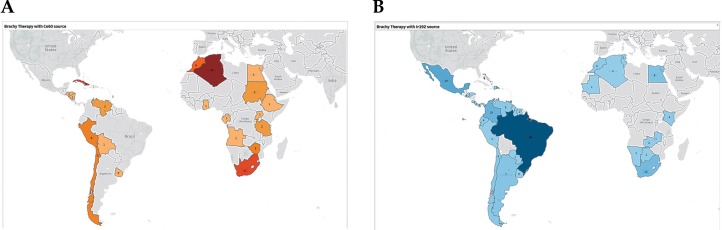
While Ir-192 remains the mainstay isotope for gynecologic high-dose-rate (HDR) brachytherapy in the U.S., Co-60 is used abroad. Co-60 has a longer half-life than Ir-192, which may lead to long-term cost savings; however, its higher energy requires greater shielding. This study analyzes Co-60 acceptability based on a one-time expense of additional shielding and reports the financial experience of Co-60 in Peru's National Cancer Institute, which uses both isotopes.
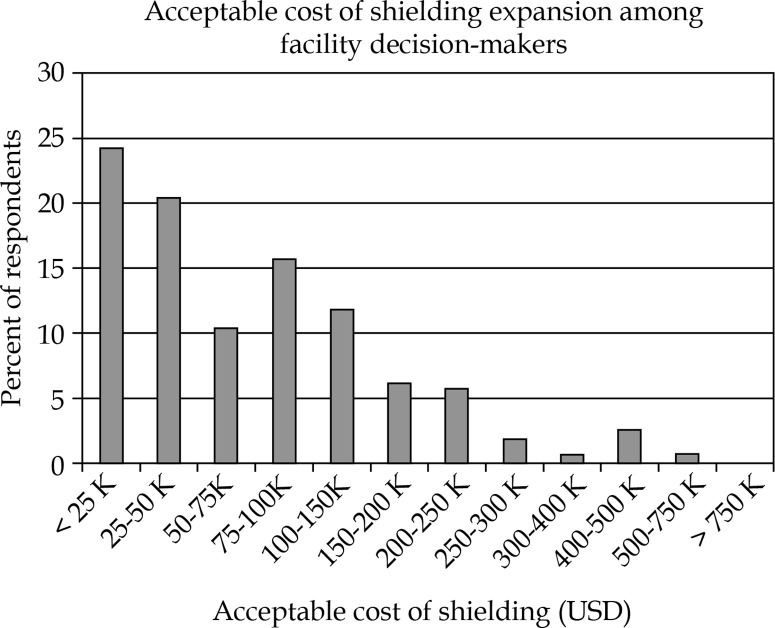
A nationwide survey was undertaken assessing physician knowledge of Co-60 and willingness-to-pay (WTP) for additional shielding, assuming a source more cost-effective than Ir-192 was available. With 440 respondents, 280 clinicians were decision-makers and provided WTPs, with results previously reported. After completing a shielding report, we estimated costs for shielding expansion, noting acceptability to decision makers' WTP. Using activity-based costing, we note the Peruvian fiscal experience.
Shielding estimates ranged from $173,000 to $418,000. The percentage of respondents accepting high-density modular or lead shielding (for union and non-union settings) were 17.5%, 11.4%, 3.9%, and 3.2%, respectively. Shielding acceptance was associated with greater number of radiation oncologists in a respondent's department but not time in practice or the American Brachytherapy Society membership. Peru's experience noted cost savings with Co-60 of $52,400 annually.
By comparing the cost of additional shielding for a sample institution's HDR suite with radiation oncologists' WTP, this multi-institutional collaboration noted < 20% of clinicians would accept additional shielding. Despite low acceptability in the US, Co-60 demonstrates cost-favorability in Peru and may similarly in other locations.
在美国,铱 - 192仍然是妇科高剂量率(HDR)近距离放射治疗的主要同位素,而钴 - 60在国外被使用。钴 - 60的半衰期比铱 - 192长,这可能会带来长期成本节约;然而,其较高的能量需要更多的屏蔽。本研究基于额外屏蔽的一次性费用分析了钴 - 60的可接受性,并报告了秘鲁国家癌症研究所使用这两种同位素时钴 - 60的财务经验。
进行了一项全国性调查,评估医生对钴 - 60的了解以及在假设有一种比铱 - 192更具成本效益的放射源可用的情况下,为额外屏蔽支付意愿(WTP)。在440名受访者中,280名临床医生是决策者并提供了支付意愿,结果已在之前报告。在完成一份屏蔽报告后,我们估计了屏蔽扩展的成本,并指出决策者支付意愿的可接受性。使用基于活动的成本核算,我们记录了秘鲁的财政经验。
屏蔽估计成本从173,000美元到418,000美元不等。接受高密度模块化或铅屏蔽(适用于联合和非联合设置)的受访者百分比分别为17.5%、11.4%、3.9%和3.2%。屏蔽接受度与受访者所在部门放射肿瘤学家的数量较多有关,但与从业时间或美国近距离放射治疗学会会员资格无关。秘鲁的经验表明,使用钴 - 60每年可节省成本52,400美元。
通过将样本机构HDR套房的额外屏蔽成本与放射肿瘤学家的支付意愿进行比较,这种多机构合作发现不到20%的临床医生会接受额外屏蔽。尽管在美国可接受性较低,但钴 - 60在秘鲁显示出成本优势,在其他地区可能也类似。