Department of Periodontics and Oral Biology, School of Stomatology, Jinzhou Medical University, Jinzhou, Liaoning 121000, P.R. China.
Department of Periodontics and Oral Biology, School of Stomatology, China Medical University, Shenyang, Liaoning 110002, P.R. China.
Int J Mol Med. 2019 Mar;43(3):1430-1440. doi: 10.3892/ijmm.2019.4069. Epub 2019 Jan 21.
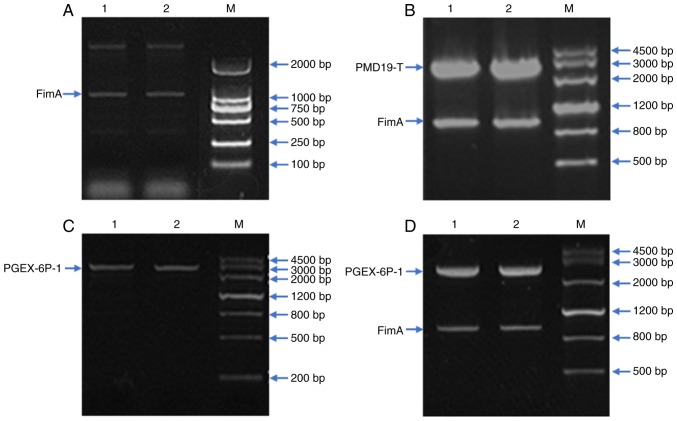
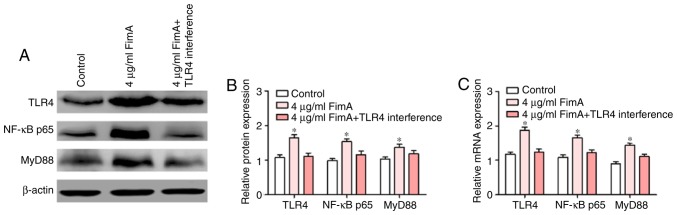
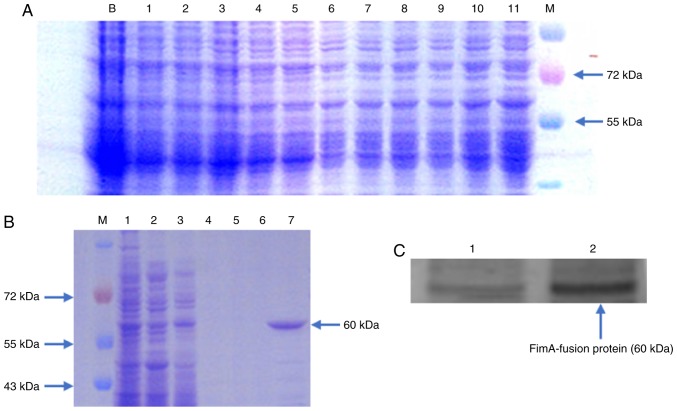
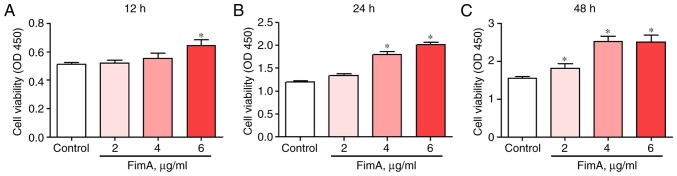
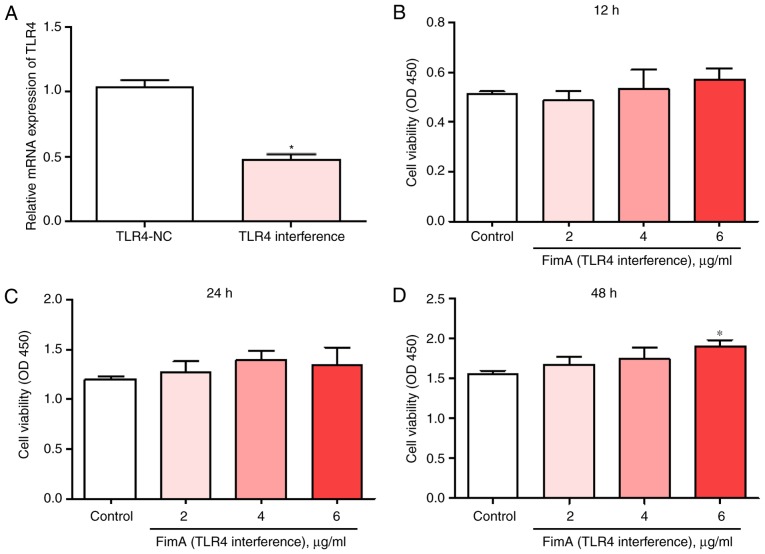
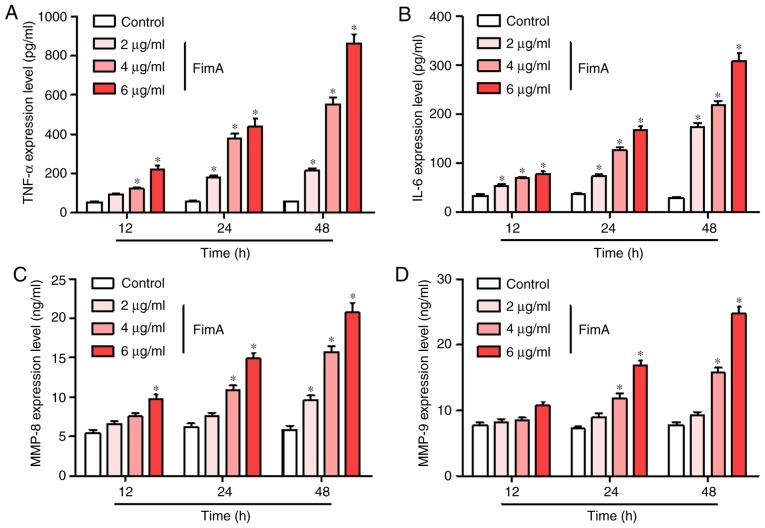
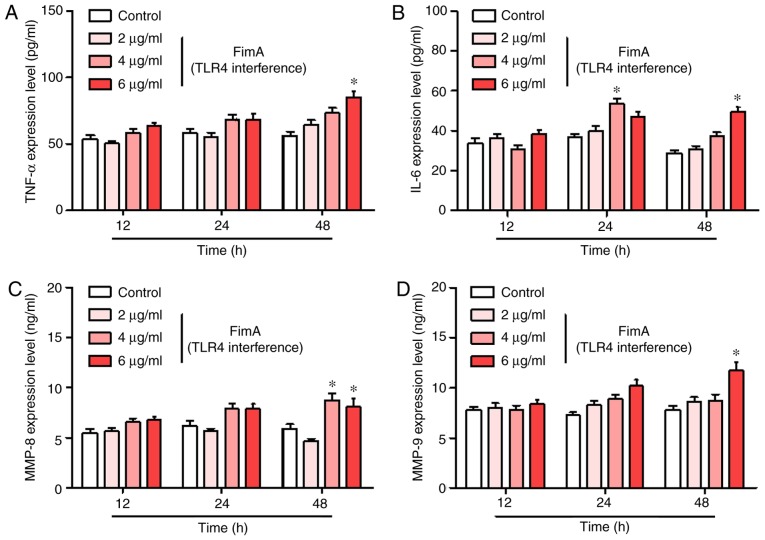
Porphyromonas gingivalis (P. gingivalis) is a periodontal pathogen that may accumulate with other organisms in subgingival plaque biofilms and is associated with periodontal disease. P. gingivalis fimbriae (FimA) is a filamentous structure on the surface of bacteria that is closely associated with bacterial adhesion to and colonization of host tissues, and serves an essential role in biofilm formation. The present study aimed to construct P. gingivalis FimA prokaryotic expression plasmids, purify a FimA fusion protein and explore the effect of a recombinant FimA protein on the inflammatory response in human peripheral blood mononuclear cells (PBMCs). P. gingivalis FimA prokaryotic expression plasmids were constructed by gene cloning and recombination technology. SDS‑PAGE was used to evaluate the purified recombinant FimA protein. The cell proliferation rate and inflammatory cytokine expression of PBMCs treated with the FimA fusion protein with or without transfection with toll‑like receptor 4 (TLR4) small interfering (si)RNA were detected by CCK‑8 assays and ELISAs, respectively. The expression levels of TLR4, nuclear factor kappa‑light‑chain‑enhancer of activated B cells (NF‑κB) and myeloid differentiation primary response 88 (MyD88) in PBMCs were detected by western blot analysis and reverse transcription quantitative polymerase chain reaction. A FimA fusion protein with high purity was obtained. FimA fusion protein treatment significantly increased PBMC proliferation and promoted the release of tumor necrosis factor‑α (TNF‑α), interleukin (IL)‑6, matrix metalloproteinase (MMP)‑8 and MMP‑9 in PBMCs. TLR4 interference reversed the effects of the FimA fusion protein on PBMC proliferation and inflammatory cytokine release. The expression levels of TLR4, NF‑κB and MyD88 in PBMCs were significantly increased following treatment with the FimA fusion protein, while the expression levels of these genes at the mRNA and protein levels decreased significantly in PBMCs following FimA fusion protein treatment and TLR4 interference. The FimA fusion protein increased PBMC proliferation and promoted the release of the inflammatory cytokines TNF‑α, IL‑6, MMP‑8 and MMP‑9 via the TLR4/NF‑κB signaling pathway. FimA may serve as a promising therapeutic strategy for periodontal disease.
牙龈卟啉单胞菌(P. gingivalis)是一种牙周病原体,可能与龈下菌斑生物膜中的其他生物体一起积聚,并与牙周病有关。牙龈卟啉单胞菌菌毛(FimA)是细菌表面的丝状结构,与细菌对宿主组织的粘附和定植密切相关,在生物膜形成中起重要作用。本研究旨在构建牙龈卟啉单胞菌 FimA 原核表达质粒,纯化 FimA 融合蛋白,并探讨重组 FimA 蛋白对人外周血单个核细胞(PBMC)炎症反应的影响。通过基因克隆和重组技术构建牙龈卟啉单胞菌 FimA 原核表达质粒。SDS-PAGE 用于评估纯化的重组 FimA 蛋白。通过 CCK-8 测定和 ELISA 分别检测 FimA 融合蛋白转染或未转染 Toll 样受体 4(TLR4)小干扰(si)RNA 后 PBMC 的细胞增殖率和炎症细胞因子表达。通过 Western blot 分析和逆转录定量聚合酶链反应检测 PBMC 中 TLR4、核因子 kappa-轻链增强子的活化 B 细胞(NF-κB)和髓样分化初级反应 88(MyD88)的表达水平。获得高纯度的 FimA 融合蛋白。FimA 融合蛋白处理显着增加 PBMC 增殖,并促进 PBMC 中肿瘤坏死因子-α(TNF-α)、白细胞介素(IL)-6、基质金属蛋白酶(MMP)-8 和 MMP-9 的释放。TLR4 干扰逆转了 FimA 融合蛋白对 PBMC 增殖和炎症细胞因子释放的影响。FimA 融合蛋白处理后,PBMC 中 TLR4、NF-κB 和 MyD88 的表达水平显着升高,而 FimA 融合蛋白处理和 TLR4 干扰后 PBMC 中这些基因的 mRNA 和蛋白水平表达显着降低。FimA 融合蛋白通过 TLR4/NF-κB 信号通路增加 PBMC 增殖并促进炎症细胞因子 TNF-α、IL-6、MMP-8 和 MMP-9 的释放。FimA 可能成为牙周病有前途的治疗策略。