Sun Yat-sen University Cancer Center, State Key Laboratory of Oncology in South China; Collaborative Innovation Center for Cancer Medicine, Guangdong Key Laboratory of Nasopharyngeal Carcinoma Diagnosis and Therapy, Guangzhou, 510060, China.
Department of Nasopharyngeal Carcinoma, Sun Yat-sen University Cancer Center, 651 Dongfeng Road East, Guangzhou, 510060, People's Republic of China.
BMC Cancer. 2019 Jan 21;19(1):92. doi: 10.1186/s12885-019-5281-5.
To evaluate the clinical outcome in patients with de novo metastatic nasopharyngeal carcinoma (NPC) treated or not treated with locoregional radiotherapy (LRRT) based on plasma Epstein-Barr virus (EBV) DNA level and tumor response after palliative chemotherapy (PCT).
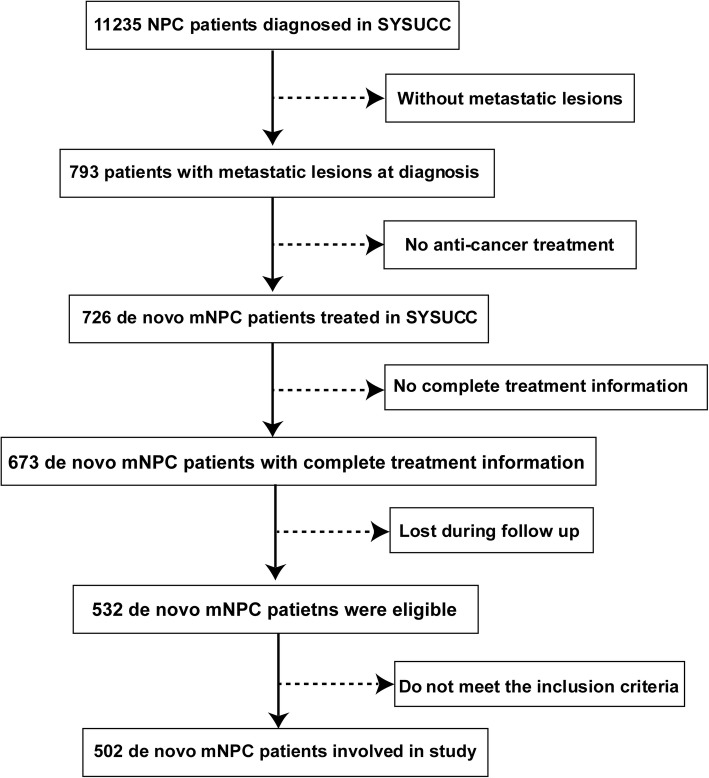
From 2007 to 2016, 502 patients with de novo metastatic NPC were included in this study. All patients were treated with PCT and 315 patients received LRRT. Our primary study endpoint was overall survival (OS).
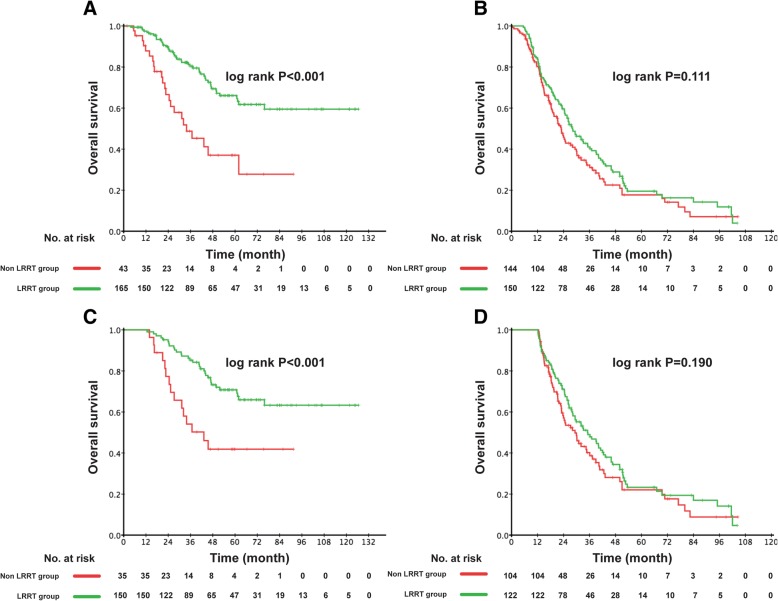
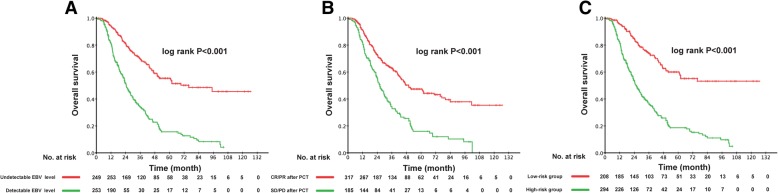
EBV DNA was detected in 461 patients (91.8%) before treatment but was undetectable in 249 patients (49.6%) after PCT. Three hundred and seventeen patients (63.1%) achieved satisfactory response (complete response or partial response) to PCT. Both the post-PCT EBV DNA level and tumor response were independent prognostic factors. Among low-risk patients (patients with undetectable EBV DNA and satisfactory tumor response after PCT), the 3-year OS rate was 80.4% in LRRT-treated patients and 45.3% in patients not treated with LRRT (P < 0.001). Multivariate analyses demonstrated that LRRT was an independent prognostic factor of OS in the low-risk patients (P < 0.001). However, among the high-risk patients (patients with detectable EBV DNA and/or unsatisfactory response after PCT), no statistically significant survival differences were observed between the LRRT and non-LRRT groups.
EBV DNA level and tumor response after PCT both correlate with the prognosis of de novo metastatic NPC. In such cases, LRRT may benefit the patients with undetectable EBV DNA levels and satisfactory tumor response after PCT.
评估新诊断转移性鼻咽癌(NPC)患者是否接受局部区域放疗(LRRT)基于血浆 EBV DNA 水平和姑息化疗(PCT)后肿瘤反应的临床结果。
2007 年至 2016 年,502 例新诊断转移性 NPC 患者纳入本研究。所有患者均接受 PCT 治疗,315 例患者接受 LRRT。我们的主要研究终点是总生存(OS)。
治疗前 461 例(91.8%)患者检测到 EBV DNA,但 249 例(49.6%)患者 PCT 后检测不到 EBV DNA。317 例(63.1%)患者对 PCT 有满意的反应(完全缓解或部分缓解)。PCT 后 EBV DNA 水平和肿瘤反应均为独立预后因素。在低危患者(PCT 后 EBV DNA 检测不到且肿瘤反应满意的患者)中,LRRT 治疗组 3 年 OS 率为 80.4%,未行 LRRT 治疗组为 45.3%(P<0.001)。多因素分析表明,LRRT 是低危患者 OS 的独立预后因素(P<0.001)。然而,在高危患者(PCT 后 EBV DNA 可检测到且/或反应不满意的患者)中,LRRT 组与非 LRRT 组之间未观察到生存差异有统计学意义。
PCT 后 EBV DNA 水平和肿瘤反应均与新诊断转移性 NPC 的预后相关。在这种情况下,LRRT 可能对 PCT 后 EBV DNA 水平检测不到且肿瘤反应满意的患者有益。