a School of Biomedical Engineering , Dalhousie University , Halifax , Nova Scotia , Canada ;
b Division of Orthopaedics, Department of Surgery , Dalhousie University and QEII Health Sciences Centre, Nova Scotia Health Authority , Halifax , Nova Scotia , Canada ;
Acta Orthop. 2019 Apr;90(2):172-178. doi: 10.1080/17453674.2018.1562633. Epub 2019 Jan 23.
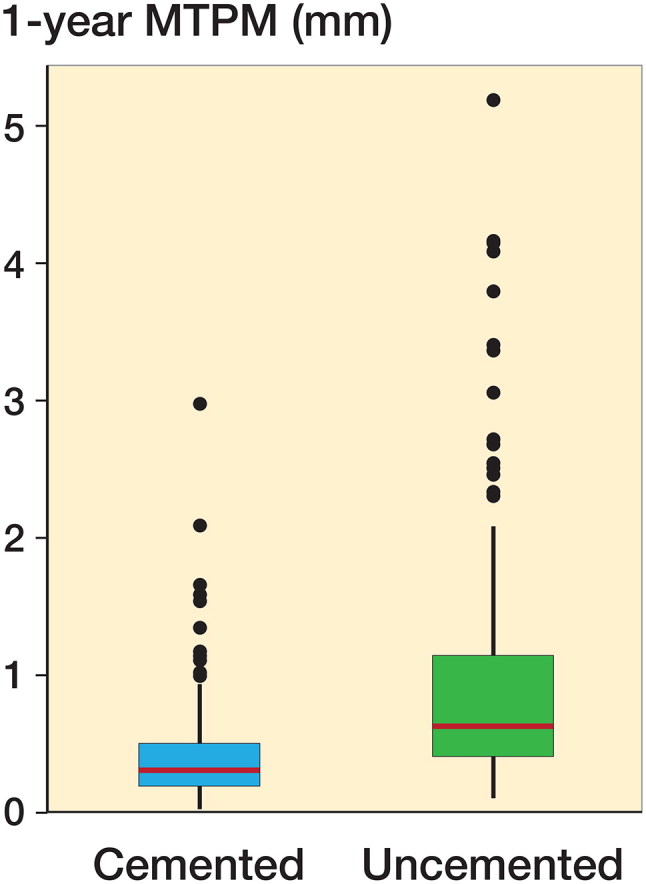
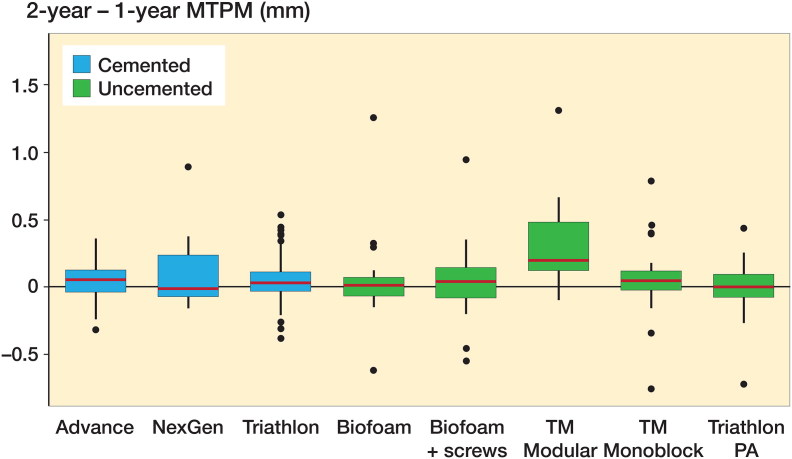
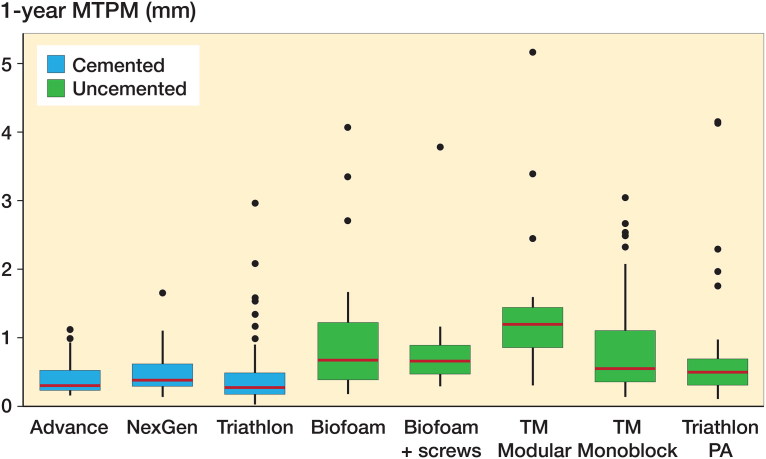
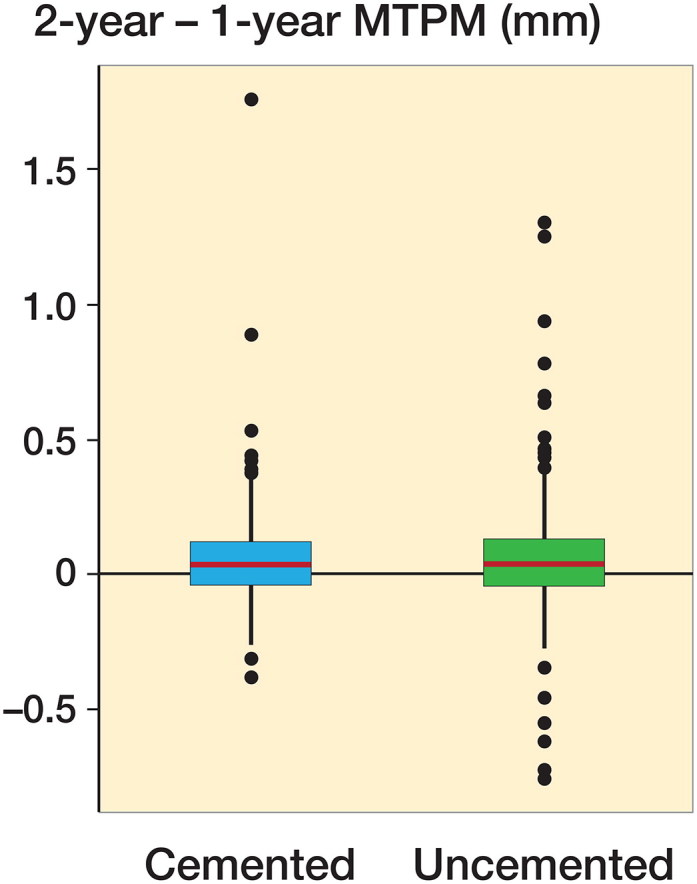
Background and purpose - Thresholds of implant migration for predicting long-term successful fixation of tibial components in total knee arthroplasty have not separated cemented and uncemented fixation. We compared implant migration of cemented and uncemented components at 1 year and as the change in migration from 1 to 2 years. Patients and methods - Implant migration of 360 tibial components measured using radiostereometric analysis was compared at 1 year and as the change in migration from 1 to 2 years in 222 cemented components (3 implant designs) and 138 uncemented components (5 implant designs). Results - 1-year maximum total point motion was lower for the cemented tibial components compared with the uncemented components (median = 0.31 mm [0.03-2.98] versus 0.63 mm [0.11-5.19] respectively, p < 0.001, mixed model). The change in migration from 1 to 2 years, however, was equivalent for cemented and uncemented components (mean [SD] 0.06 mm [0.19] and 0.07 mm [0.27] mm respectively, p = 0.6, mixed model). Interpretation - These findings suggest that current thresholds of acceptable migration at 1 year may be better optimized by considering cemented and uncemented tibial components separately as higher early migration of uncemented components was not associated with decreased stability from 1 to 2 years.
背景与目的 - 尚未区分骨水泥固定和非骨水泥固定的植入物迁移阈值,以预测全膝关节置换中胫骨部件的长期固定成功。我们比较了骨水泥固定和非骨水泥固定组件在 1 年和从 1 年到 2 年的迁移变化。
患者和方法 - 使用放射立体测量分析比较了 360 个胫骨组件的植入物迁移,比较了 222 个骨水泥组件(3 种植入物设计)和 138 个非骨水泥组件(5 种植入物设计)在 1 年和从 1 年到 2 年的迁移变化。
结果 - 与非骨水泥固定组件相比,骨水泥固定胫骨组件的 1 年最大总点运动较低(中位数分别为 0.31mm [0.03-2.98]和 0.63mm [0.11-5.19],p<0.001,混合模型)。然而,从 1 年到 2 年的迁移变化在骨水泥固定和非骨水泥固定组件之间是等效的(平均[SD]分别为 0.06mm [0.19]和 0.07mm [0.27],p=0.6,混合模型)。
解释 - 这些发现表明,当前可接受的 1 年迁移阈值可能需要单独考虑骨水泥固定和非骨水泥固定胫骨组件进行更好的优化,因为非骨水泥固定组件的早期较高迁移并不与从 1 年到 2 年的稳定性降低相关。