Yang Xiujie, Peng Peng, Meng Xiangzhi
Department of Psychology, The Chinese University of Hong Kong, Hong Kong, China.
Department of Special Education, The University of Texas at Austin, Austin, TX, United States.
Front Psychol. 2019 Jan 8;9:2670. doi: 10.3389/fpsyg.2018.02670. eCollection 2018.
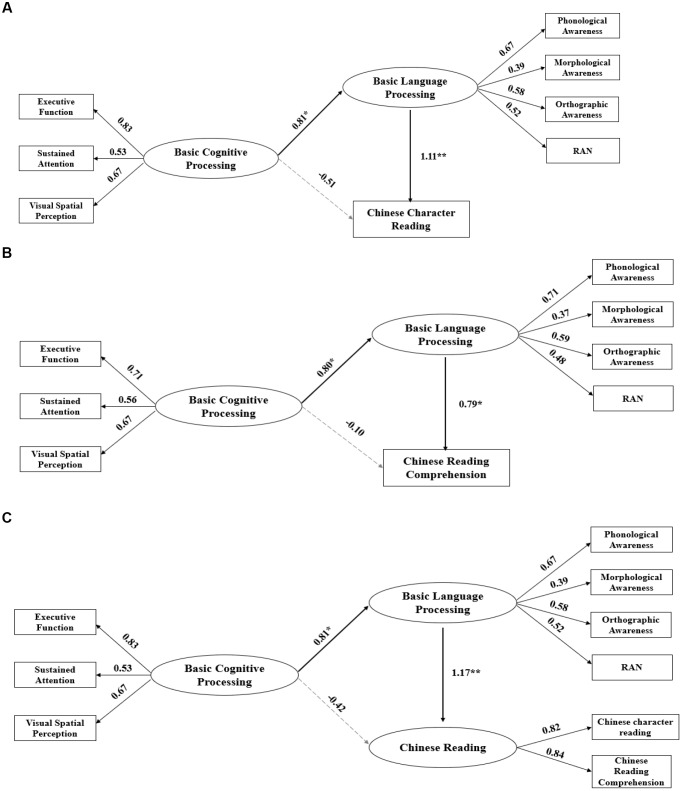
Prior research has mostly focused on either basic language or basic cognitive precursors of reading development, but relatively little is known about their relative importance for reading, especially for Chinese beginning readers. The present study examined whether and how basic cognitive processing (executive function, attention, and visual-spatial perception) and basic language processing (phonological awareness, morphological awareness, orthographic awareness, and RAN) measured at kindergarten influence Chinese character reading and reading comprehension in the first grade. Results showed that basic language abilities including morphological awareness and rapid automatized naming predicted later Chinese character reading. Only one basic cognitive skill, sustained attention, predicted later reading comprehension. Mediation analysis showed that the overall effects of basic cognitive skills on later character reading and reading comprehension were mediated by basic language skills. These findings supported an integration reading model for early Chinese reading and basic language processing at kindergarten plays an important role in explaining the relation between basic cognitive processing and grade one reading performance.
先前的研究大多集中在阅读发展的基础语言或基础认知前提上,但对于它们在阅读中的相对重要性,尤其是对中国初学阅读者而言,人们了解得相对较少。本研究考察了幼儿园阶段测量的基础认知加工(执行功能、注意力和视觉空间感知)和基础语言加工(语音意识、词法意识、正字法意识和快速自动命名)是否以及如何影响一年级的汉字阅读和阅读理解。结果表明,包括词法意识和快速自动命名在内的基础语言能力能够预测后期的汉字阅读。只有一项基础认知技能,即持续注意力,能够预测后期的阅读理解。中介分析表明,基础认知技能对后期汉字阅读和阅读理解的总体影响是由基础语言技能介导的。这些发现支持了早期汉语阅读的综合阅读模型,并且幼儿园阶段的基础语言加工在解释基础认知加工与一年级阅读表现之间的关系中起着重要作用。