Bocchile Rafael Ladeira Rosa, Cazati Denise Carnieli, Timenetsky Karina Tavares, Serpa Neto Ary
Departamento de Terapia Intensiva, Hospital Israelita Albert Einstein - São Paulo (SP), Brasil.
Departamento de Terapia Intensiva e Laboratório Experimental de Terapia Intensiva e Anestesiologia, Centro Médico Acadêmico, Universidade de Amsterdã - Amsterdã, Holanda.
Rev Bras Ter Intensiva. 2018 Oct-Dec;30(4):487-495. doi: 10.5935/0103-507X.20180070.
To evaluate the efficacy of high-flow nasal cannula in the prevention of intubation and re-intubation in critically ill patients compared to conventional oxygen therapy or noninvasive ventilation.
This systematic review was performed through an electronic database search of articles published from 1966 to April 2018. The primary outcome was the need for intubation or re-intubation. The secondary outcomes were therapy escalation, mortality at the longest follow-up, hospital mortality and the need for noninvasive ventilation.
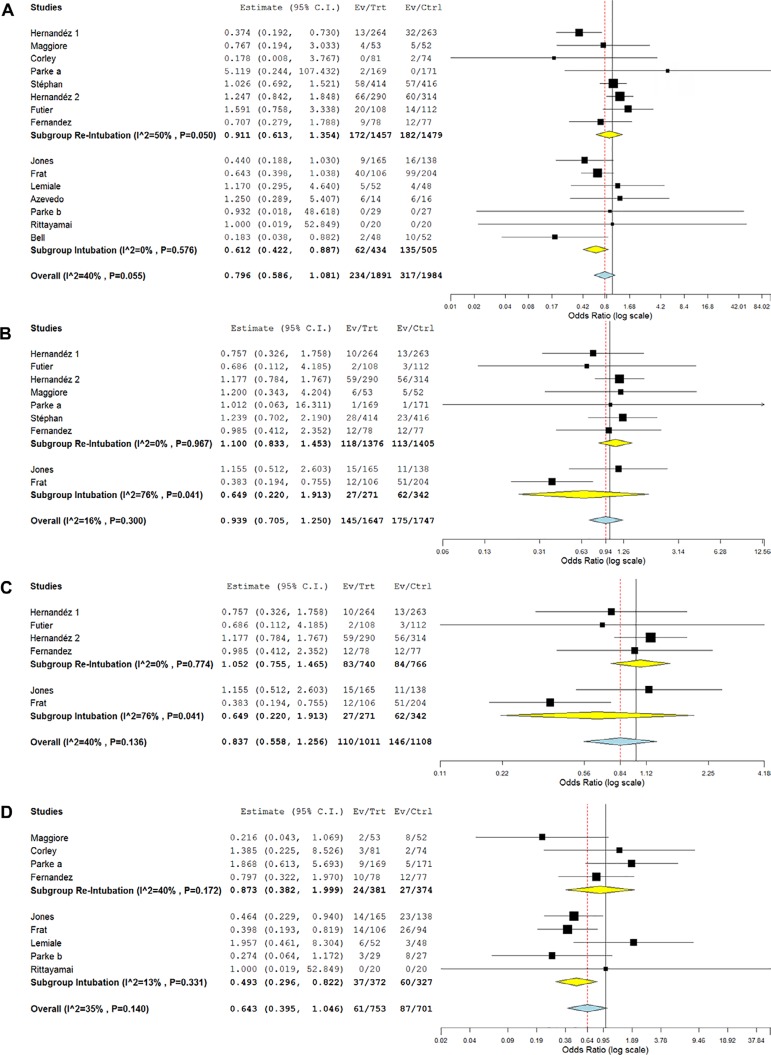
Seventeen studies involving 3,978 patients were included. There was no reduction in the need for intubation or re-intubation with high-flow nasal cannula (OR 0.72; 95%CI 0.52 - 1.01; p = 0.056). There was no difference in the need for therapy escalation (OR 0.80, 95% CI 0.59 - 1.08, p = 0.144), mortality at the longest follow-up (OR 0.94; 95%CI 0.70 - 1.25; p = 0.667), hospital mortality (OR 0.84; 95%CI 0.56 - 1.26; p = 0.391) or noninvasive ventilation (OR 0.64, 95%CI 0.39 - 1.05, p = 0.075). In the trial sequential analysis, the number of events included was lower than the optimal information size with a global type I error > 0.05.
In the present study and setting, high-flow nasal cannula was not associated with a reduction of the need for intubation or re-intubation in critically ill patients.
与传统氧疗或无创通气相比,评估高流量鼻导管在预防重症患者插管及再次插管方面的疗效。
通过电子数据库检索1966年至2018年4月发表的文章进行该系统评价。主要结局是插管或再次插管的需求。次要结局包括治疗升级、最长随访期的死亡率、医院死亡率以及无创通气的需求。
纳入了17项研究,涉及3978例患者。高流量鼻导管并未降低插管或再次插管的需求(比值比0.72;95%置信区间0.52 - 1.01;p = 0.056)。在治疗升级需求(比值比0.80,95%置信区间0.59 - 1.08,p = 0.144)、最长随访期的死亡率(比值比0.94;95%置信区间0.70 - 1.25;p = 0.667)、医院死亡率(比值比0.84;95%置信区间0.56 - 1.26;p = 0.391)或无创通气需求(比值比0.64,95%置信区间0.39 - 1.05,p = 0.075)方面均无差异。在试验序贯分析中,纳入的事件数量低于最优信息规模,总体I类错误>0.05。
在本研究及背景下,高流量鼻导管与降低重症患者插管或再次插管的需求无关。