Ramli Yetty, Alwahdy Ahmad Sulaiman, Kurniawan Mohammad, Juliandi Berry, Wuyung Puspita Eka
Neurology Department , Medical Faculty University of Indonesia/Ciptomangunkusumo National Hospital, Indonesia.
These authors contributed equally to this work.
J Stem Cells Regen Med. 2018 Dec 30;14(2):69-79. doi: 10.46582/jsrm.1402011. eCollection 2018.
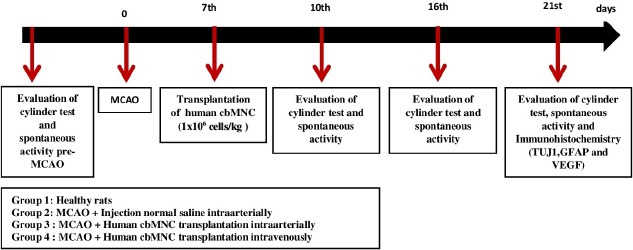
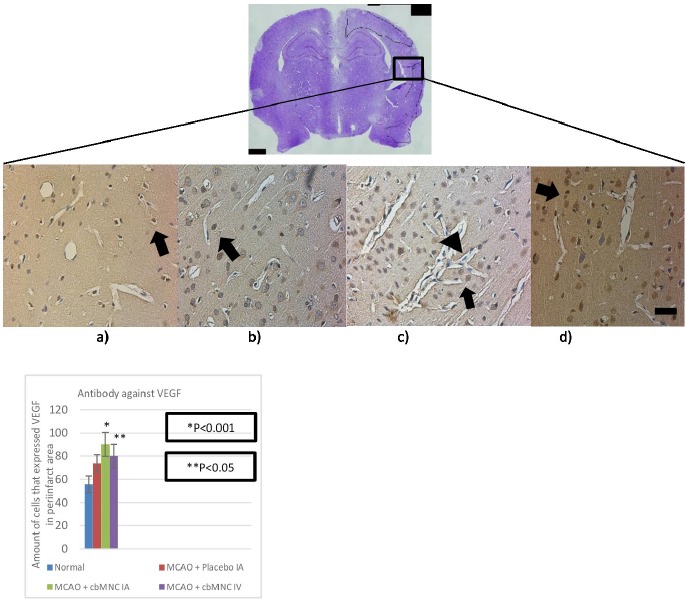
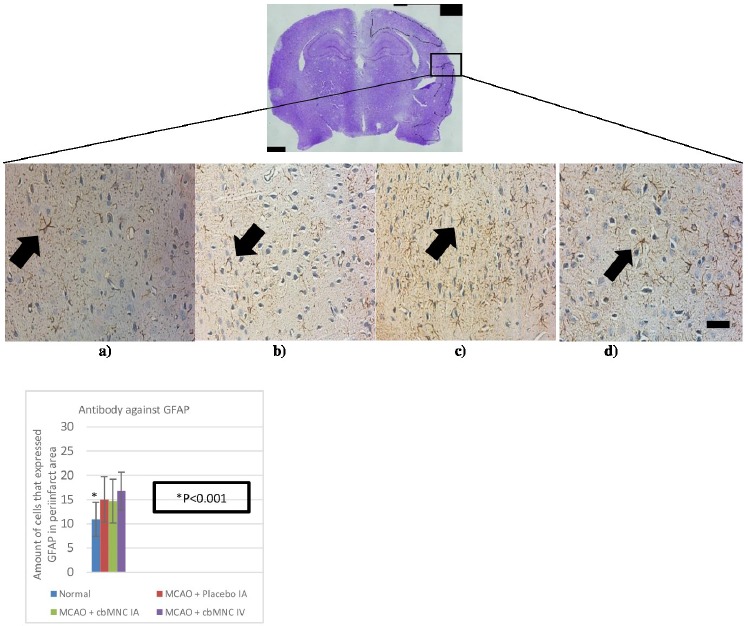
Thrombolysis (rt-PA) is the only United States Food and Drug Administration (FDA) approved drug currently available. Unfortunately, its effect has been limited by the narrow therapeutic time window. Human cord blood mononuclear cells (cbMNC) is a promising treatment for ischemic stroke by forming collateral and neo-vascularization where it is one of the important factors that contribute to cell repair. Therefore, evaluation of neo-vascularization in sub-acute stroke may be beneficial for recovery. One group for healthy rat and three groups (n=6 per group) of male wistar rats have undergone permanent middle cerebral artery occlusion (MCAO). Transplantation 1x10 cells/kg of human cbMNC intra-arterially (IA) and intra-venously (IV) were administered after 7 days. Behavioural tests were performed before MCAO, 1 week after MCAO and at 3,9 and 14 days after cbMNC transplantation. Beta III tubulin protein (TUJ1), glial fibrillary acidic protein (GFAP) and vascular endothelial growth factor (VEGF) antibody marker were evaluated. Spontaneous activity of transplanted rats by cbMNC have significantly improved compared to placebo group (p<0.05). Angiogenesis in IA group showed significant difference (P<0.001) when compared to IV and placebo respectively. The existence of neovascularization in the transplanted rats of cbMNC provide hope in accelerating repairment of the neuronal cells and functional outcome.
溶栓治疗(重组组织型纤溶酶原激活剂)是目前唯一获得美国食品药品监督管理局(FDA)批准的药物。不幸的是,其疗效受到狭窄治疗时间窗的限制。人脐带血单个核细胞(cbMNC)通过形成侧支循环和新生血管,成为缺血性中风的一种有前景的治疗方法,是促进细胞修复的重要因素之一。因此,评估亚急性中风中的新生血管形成可能有助于恢复。一组为健康大鼠,三组雄性Wistar大鼠(每组n = 6)接受永久性大脑中动脉闭塞(MCAO)。7天后经动脉(IA)和静脉(IV)给予1×10个细胞/千克的人cbMNC移植。在MCAO前、MCAO后1周以及cbMNC移植后3、9和14天进行行为测试。评估βIII微管蛋白(TUJ1)、胶质纤维酸性蛋白(GFAP)和血管内皮生长因子(VEGF)抗体标记物。与安慰剂组相比,经cbMNC移植的大鼠的自发活动有显著改善(p<0.05)。与IV组和安慰剂组相比,IA组的血管生成有显著差异(P<0.001)。cbMNC移植大鼠中新生血管的存在为加速神经细胞修复和功能转归带来了希望。