Wang Lishun, Nie Hongyan, Wang Qichen, Zhang Guoliang, Li Gang, Bai Liwei, Hua Tianshu, Wei Shuzhang
Department of Radiology, Maternity and Child Care Center of Qinhuangdao, Qinhuangdao Maternal and Child Health Hospital, Qinhuangdao, Hebei, 066000, People's Republic of China.
Department of Ultrasound, Maternity and Child Care Center of Qinhuangdao, Qinhuangdao Maternal and Child Health Hospital, Qinhuangdao, Hebei, 066000, People's Republic of China.
BMC Med Imaging. 2019 Jan 25;19(1):12. doi: 10.1186/s12880-019-0314-8.
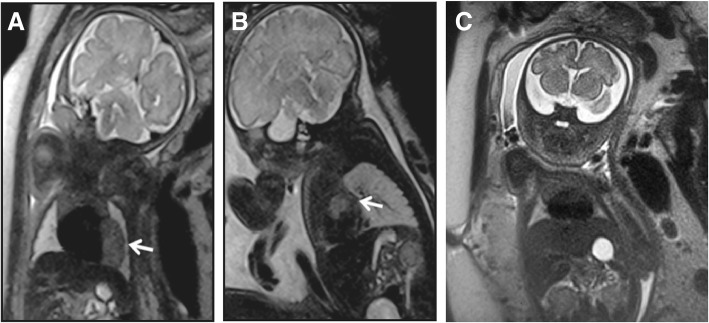
Fetal deformity is a disease caused by abnormal chromosome structure, which may be influenced by genetic factors as well as the maternal and external environment. Magnetic resonance imaging (MRI) may be used to effectively diagnose fetus deformities. However it has been reported that gene analysis is a more accurate diagnostic method. The aim of the present study was to investigate the effectiveness of MRI in combination with gene analysis for the diagnosis of fetal congenital heart disease, a form of fetus deformity.
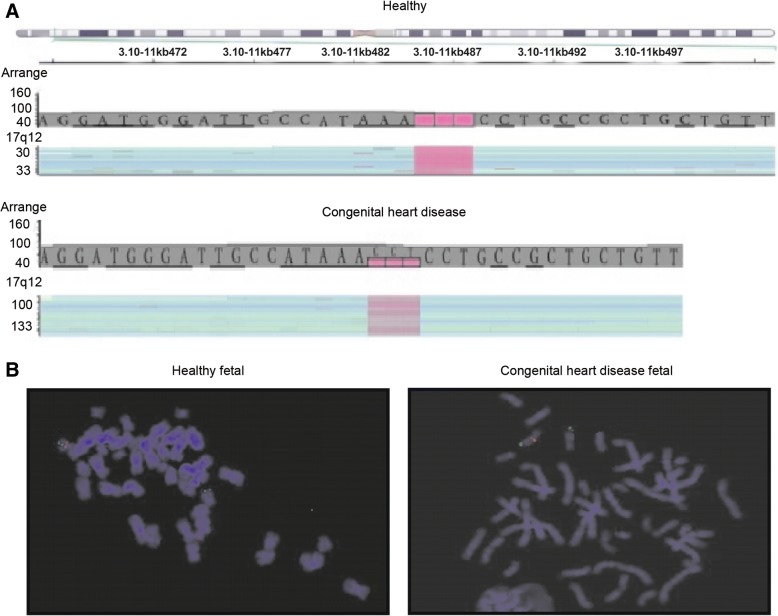
MRI, array comparative genome hybridization analysis and fluorescence in situ hybridization were used to analyze the effectiveness of the two methods in a total of 78 pregnant women with suspected fetal congenital heart disease.
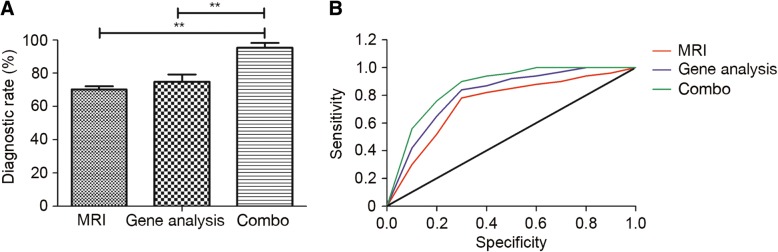
Our findings demonstrated that the combination of MRI and gene analysis resulted in significantly improved diagnostic accuracy, sensitivity and specificity for fetal congenital heart disease compared with either method alone. MRI combined with gene analysis confirmed 42 fetuses with pulmonary stenosis, 24 with aortic stenosis and 12 healthy fetuses, which was significantly improved compared with MRI or gene analysis alone. It was also observed that gene analysis was a more efficient method of diagnosis compared with MRI; however, the combination of the two methods was the most effective.
In conclusion, the results of the present study suggest that MRI combined with gene analysis may be a more effective diagnostic method for fetal congenital heart disease compared with the current protocol.
胎儿畸形是一种由染色体结构异常引起的疾病,可能受遗传因素以及母体和外部环境的影响。磁共振成像(MRI)可用于有效诊断胎儿畸形。然而,据报道基因分析是一种更准确的诊断方法。本研究的目的是探讨MRI联合基因分析对胎儿先天性心脏病(一种胎儿畸形形式)的诊断效果。
采用MRI、阵列比较基因组杂交分析和荧光原位杂交技术,对78例疑似胎儿先天性心脏病的孕妇分析这两种方法的诊断效果。
我们的研究结果表明,与单独使用任何一种方法相比,MRI和基因分析相结合可显著提高胎儿先天性心脏病的诊断准确性、敏感性和特异性。MRI联合基因分析确诊了42例肺动脉狭窄胎儿、24例主动脉狭窄胎儿和12例健康胎儿,与单独使用MRI或基因分析相比有显著改善。还观察到,与MRI相比,基因分析是一种更有效的诊断方法;然而,两种方法相结合是最有效的。
总之,本研究结果表明,与目前的方案相比,MRI联合基因分析可能是诊断胎儿先天性心脏病更有效的方法。