Niu Yu-Ming, Wang Ya-Dong, Jiang Guang-Bin, Bai Gang, Chai Hong-Bo, Li Xue-Feng, Hu Yuan-Yuan, Shen Ming
Department of Stomatology and Center for Evidence-Based Medicine and Clinical Research, Taihe Hospital, Hubei University of Medicine, Shiyan, China.
Department of Oral and Maxillary Surgery, Gui Zhou Provincial People's Hospital, Guiyang, China.
Front Physiol. 2019 Jan 10;9:1902. doi: 10.3389/fphys.2018.01902. eCollection 2018.
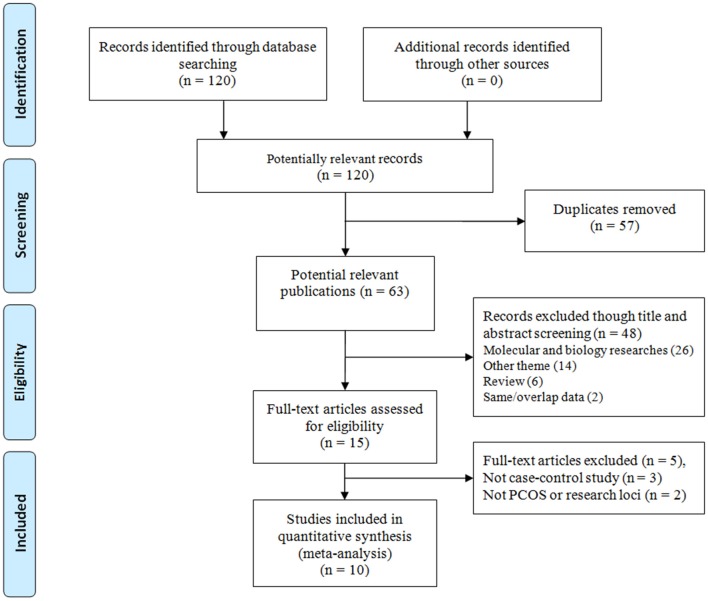
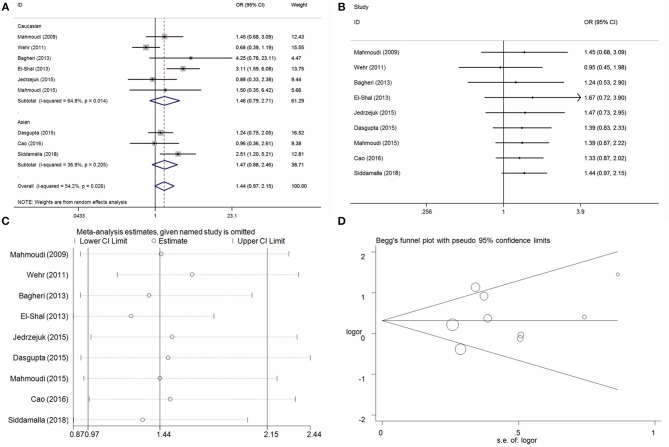
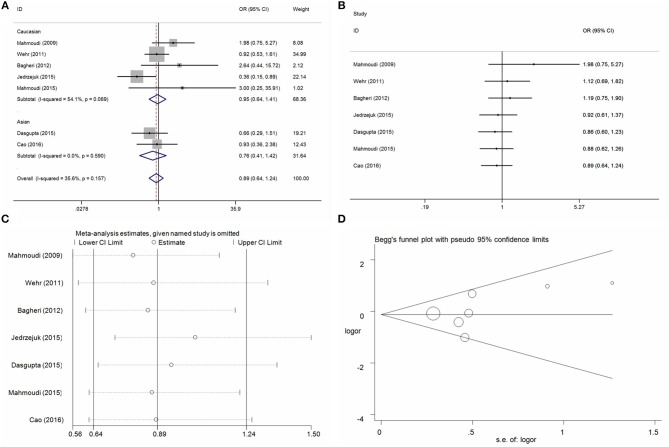
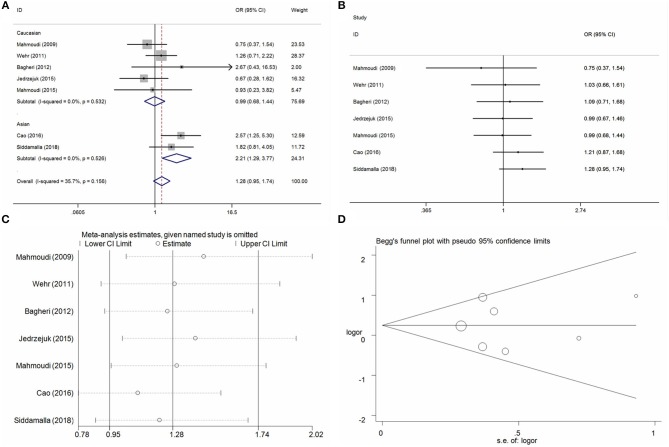
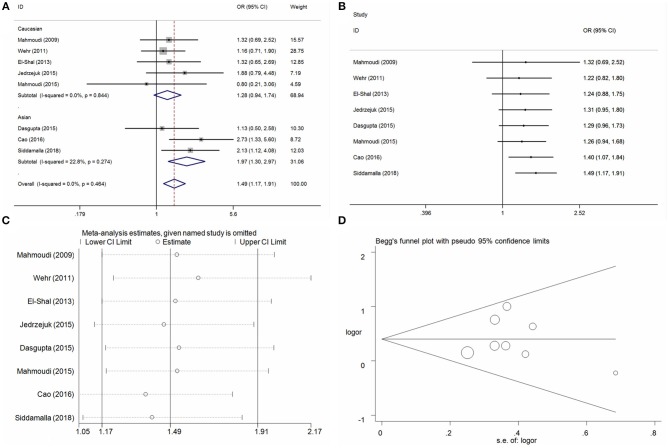
Published studies have demonstrated a closer association between vitamin D receptor (VDR) gene polymorphisms and polycystic ovary syndrome (PCOS) risk, but the results were inconsistent. We therefore performed this meta-analysis to explore the precise associations between VDR gene polymorphisms and PCOS risk. Five online electronic databases (PubMed, Embase, SCI index, CNKI and Wanfang) were searched. Odds ratios (ORs) with 95% confidence interval (CIs) were calculated to assess the association between VDR Fok I C/T (rs10735810), BsmI A/G (rs1544410), ApaI A/C (rs7975232), and TaqI T/C (rs731236) polymorphisms and PCOS risk. In addition, heterogeneity, accumulative/sensitivity analysis and publication bias were conducted to check the statistical power. Overall, 10 publications (31 independent case-control studies) involving 1,531 patients and 1,174 controls were identified. We found that the C mutation of ApaI A/C was a risk factor for PCOS (C vs. A: OR = 1.20, 95%CI = 1.06-1.35, < 0.01, = 29.7%; CC vs. AA: OR = 1.49, 95%CI = 1.17-1.91, < 0.01, = 0%; CC vs. AA+AC: OR = 1.36, 95%CI = 1.09-1.69, = 0.01, = 12.8%). Moreover, the BsmI A/G polymorphism also showed a dangerous risk for PCOS in Asian population (G vs. A: OR = 1.62, 95%CI = 1.24-2.11, < 0.01, = 0%; AG vs. AA: OR = 2.08, 95%CI = 1.26-3.20, < 0.01, = 0%; GG vs. AA: OR = 2.21, 95%CI = 1.29-3.77, < 0.01, = 0%; AG+GG vs. AA: OR = 2.12, 95%CI = 1.42-3.16, < 0.01, = 0%). In addition, no significant association of Fok I C/T, and TaqI T/C polymorphisms was observed. In summary, our meta-analysis suggested that VDR gene polymorphisms contribute to PCOS development, especially in Asian populations.
已发表的研究表明维生素D受体(VDR)基因多态性与多囊卵巢综合征(PCOS)风险之间存在更密切的关联,但结果并不一致。因此,我们进行了这项荟萃分析,以探讨VDR基因多态性与PCOS风险之间的确切关联。我们检索了五个在线电子数据库(PubMed、Embase、SCI索引、中国知网和万方)。计算了具有95%置信区间(CI)的比值比(OR),以评估VDR Fok I C/T(rs10735810)、BsmI A/G(rs1544410)、ApaI A/C(rs7975232)和TaqI T/C(rs731236)多态性与PCOS风险之间的关联。此外,还进行了异质性、累积/敏感性分析和发表偏倚分析,以检验统计效力。总体而言,共纳入10篇文献(31项独立的病例对照研究),涉及1531例患者和1174例对照。我们发现,ApaI A/C的C突变是PCOS的一个危险因素(C vs. A:OR = 1.20,95%CI = 1.06 - 1.35,P < 0.01,I² = 29.7%;CC vs. AA:OR = 1.49,95%CI = 1.17 - 1.91,P < 0.01,I² = 0%;CC vs. AA + AC:OR = 1.36,95%CI = 1.09 - 1.69,P = 0.01,I² = 12.8%)。此外,BsmI A/G多态性在亚洲人群中也显示出对PCOS的危险风险(G vs. A:OR = 1.62,95%CI = 1.24 - 2.11,P < 0.01,I² = 0%;AG vs. AA:OR = 2.08,95%CI = 1.26 - 3.20,P < 0.01,I² = 0%;GG vs. AA:OR = 2.21,95%CI = 1.29 - 3.77,P < 0.01,I² = 0%;AG + GG vs. AA:OR = 2.12,95%CI = 1.42 - 3.16,P < 0.01,I² = 0%)。此外,未观察到Fok I C/T和TaqI T/C多态性有显著关联。总之,我们的荟萃分析表明,VDR基因多态性与PCOS的发生有关,尤其是在亚洲人群中。