From the ‡Department of Immunology, Genetics, and Pathology, Biomedical Center, Science for Life Laboratory (SciLifeLab) Uppsala, Box 815, Uppsala University, SE-75108 Uppsala, Sweden.
§OLINK Proteomics, Uppsala Science Park, SE-751 83, Uppsala, Sweden.
Mol Cell Proteomics. 2019 Apr;18(4):735-743. doi: 10.1074/mcp.RA118.001208. Epub 2019 Jan 28.
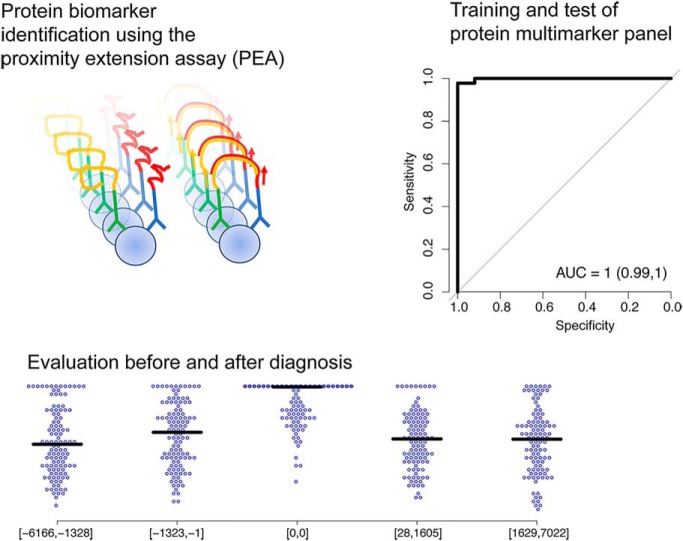
Human papillomavirus (HPV) is recommended as the primary test in cervical cancer screening, with co-testing by cytology for HPV-positive women to identify cervical lesions. Cytology has low sensitivity and there is a need to identify biomarkers that could identify dysplasia that are likely to progress to cancer. We searched for plasma proteins that could identify women with cervical cancer using the multiplex proximity extension assay (PEA). The abundance of 100 proteins were measured in plasma collected at the time of diagnosis of patients with invasive cervical cancer and in population controls using the Olink Multiplex panels CVD II, INF I, and ONC II. Eighty proteins showed increased levels in cases compared with controls. We identified a signature of 11 proteins (PTX3, ITGB1BP2, AXIN1, STAMPB, SRC, SIRT2, 4E-BP1, PAPPA, HB-EGF, NEMO and IL27) that distinguished cases and controls with a sensitivity of 0.96 at a specificity of 1.0. This signature was evaluated in a prospective replication cohort with samples collected before, at or after diagnosis and achieved a sensitivity of 0.78 and a specificity 0.56 separating samples collected at the time of diagnosis of invasive cancer from samples collected prior to diagnosis. No difference in abundance was seen between samples collected prior to diagnosis or after treatment as compared with population controls, indicating that this protein signature is mainly informative close to time of diagnosis. Further studies are needed to determine the optimal window in time prior to diagnosis for these biomarker candidates.
人乳头瘤病毒(HPV)被推荐作为宫颈癌筛查的主要检测方法,对 HPV 阳性的女性进行细胞学联合检测,以识别宫颈病变。细胞学检测的灵敏度较低,因此需要确定能够识别可能进展为癌症的发育异常的生物标志物。我们使用多重邻近延伸分析(PEA)寻找能够识别宫颈癌患者的血浆蛋白。使用 Olink Multiplex 面板 CVD II、INF I 和 ONC II 测量了在诊断为浸润性宫颈癌的患者和人群对照时收集的血浆中 100 种蛋白质的丰度。与对照组相比,80 种蛋白质在病例中表达增加。我们鉴定了一个由 11 种蛋白质组成的特征(PTX3、ITGB1BP2、AXIN1、STAMPB、SRC、SIRT2、4E-BP1、PAPPA、HB-EGF、NEMO 和 IL27),该特征可以区分病例和对照,灵敏度为 0.96,特异性为 1.0。该特征在一个前瞻性的复制队列中进行了评估,该队列采集了诊断前、诊断时和诊断后的样本,在区分诊断为浸润性癌症时的样本和诊断前的样本时,其灵敏度为 0.78,特异性为 0.56。与人群对照相比,在诊断前或治疗后采集的样本与诊断前采集的样本相比,其丰度没有差异,这表明该蛋白质特征主要在接近诊断时间时提供信息。需要进一步的研究来确定这些生物标志物候选物在诊断前的最佳时间窗口。