Ravignani Andrea, Kello Christopher T, de Reus Koen, Kotz Sonja A, Dalla Bella Simone, Méndez-Aróstegui Margarita, Rapado-Tamarit Beatriz, Rubio-Garcia Ana, de Boer Bart
Research Department, Sealcentre Pieterburen, Pieterburen, The Netherlands.
Artificial Intelligence Lab, Vrije Universiteit Brussel, Brussels, Belgium.
Curr Zool. 2019 Feb;65(1):107-120. doi: 10.1093/cz/zoy055. Epub 2018 Jul 7.
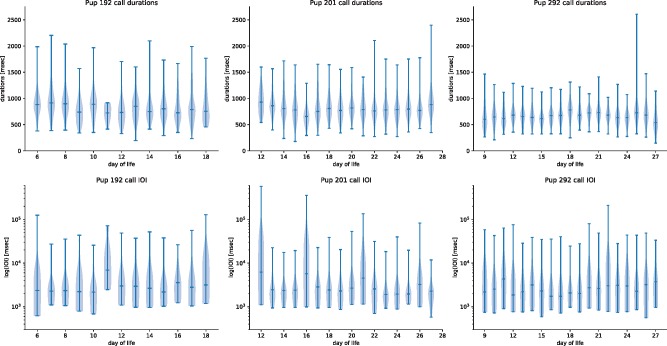
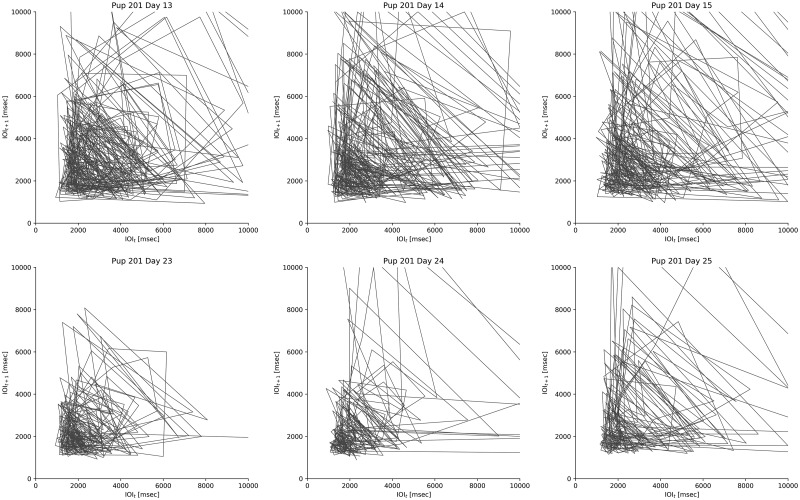
Puppyhood is a very active social and vocal period in a harbor seal's life . An important feature of vocalizations is their temporal and rhythmic structure, and understanding vocal timing and rhythms in harbor seals is critical to a cross-species hypothesis in evolutionary neuroscience that links vocal learning, rhythm perception, and synchronization. This study utilized analytical techniques that may best capture rhythmic structure in pup vocalizations with the goal of examining whether (1) harbor seal pups show rhythmic structure in their calls and (2) rhythms evolve over time. Calls of 3 wild-born seal pups were recorded daily over the course of 1-3 weeks; 3 temporal features were analyzed using 3 complementary techniques. We identified temporal and rhythmic structure in pup calls across different time windows. The calls of harbor seal pups exhibit some degree of temporal and rhythmic organization, which evolves over puppyhood and resembles that of other species' interactive communication. We suggest next steps for investigating call structure in harbor seal pups and propose comparative hypotheses to test in other pinniped species.
幼崽期是港海豹生命中一个非常活跃的社交和发声阶段。发声的一个重要特征是它们的时间和节奏结构,而了解港海豹的发声时间和节奏对于进化神经科学中的一个跨物种假设至关重要,该假设将发声学习、节奏感知和同步联系起来。本研究采用了可能最能捕捉幼崽发声节奏结构的分析技术,目的是检验(1)港海豹幼崽的叫声是否具有节奏结构,以及(2)节奏是否随时间演变。在1至3周的时间里,每天记录3只野生出生的海豹幼崽的叫声;使用3种互补技术分析了3个时间特征。我们在不同的时间窗口中识别出了幼崽叫声中的时间和节奏结构。港海豹幼崽的叫声表现出一定程度的时间和节奏组织,这种组织在幼崽期会发生变化,并且与其他物种的互动交流相似。我们提出了下一步研究港海豹幼崽叫声结构的建议,并提出了在其他鳍足类物种中进行测试的比较假设。